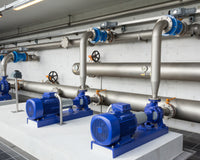

Cavitation is an undesirable and harmful phenomenon, but unfortunately it is often ignored. It must be prevented because it can lead, among other things, to erosion of pump components and, in extreme cases, to irreversible damage.
What does the phenomenon of cavitation involve?
Cavitation is a process involving the formation, accumulation, and sudden collapse of gas bubbles in the liquid around the pump impeller. The phenomenon is accompanied by sudden changes in pressure.
Cavitation occurs when the liquid pressure drops in the central part of the impeller, which in turn causes liquid to flow in through the suction nozzle. When the pressure falls below the saturation level under conditions corresponding to room temperature, the liquid begins to vaporize. This is when small bubbles form; as they collapse, they create a shock wave with considerable energy. The collapse of a large number of bubbles causes micro-impacts that contribute to the corrosion of structural materials and serious damage.
What are the main symptoms of cavitation in a pump?
A submersible pump affected by cavitation may exhibit certain characteristic symptoms. First and foremost, there is a noticeable decline in its operating parameters and performance. It also consumes more electricity. The pump operates noisily and vibrations occur, caused by pressure pulsations. After disassembly, visible damage to structural components caused by corrosion may be observed, particularly on the impeller. During operation, this damage may cause leaks.
How can cavitation be prevented?
The better a pump's anti-cavitation properties, the greater its resistance to cavitation. The phenomenon can therefore be counteracted through the pump's design, including appropriately designed impellers, properly profiled blades, the use of a limited number of blades, or prerotation (preliminary swirling in the direction of motor rotation). Equipment manufacturers take these measures, while the consumer's role is to choose a high-quality pump featuring all of these characteristics. This property is specified by the NPSHA parameter.
The NPSHA parameter can be increased in several ways. One is to use a pipeline that is short and has a large diameter. The system must also be designed with as few components as possible that contribute to pressure losses. Measures should also be taken to prevent liquid velocities above 2 m/s and fluctuations in the liquid level on the pump's suction side. The liquid should be pumped at the lowest possible temperature. It may also be helpful to use a pipeline with a smooth internal surface, such as PVC.