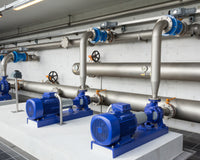

Submersible pumps are designed to operate in water and enable liquids to be pumped from very great depths. Installing submersible pumps is necessary, among other things, to obtain water from a deep well, but this is not their only application. Submersible pumps are successfully used in households and various branches of industry. They may have a screw or monoblock design and are available on the market in various sizes, determined by diameter parameters. Let’s check how a submersible pump works and where it is used.
What are submersible pumps used for?
A submersible pump is used primarily to extract water from vertical groundwater intakes, such as deep wells, as well as from freestanding tanks. Remember that pumps used to convey drinking water must have the appropriate hygienic certifications. Submersible pumps are also used in many branches of industry, including the oil industry for extracting crude oil and the mining industry for draining underground structures. They are also used in the brewing industry, water and sewage networks, and agriculture. They can also be used to extract mineral and thermal water and even to pump seawater.
Submersible pumps are used where the water table is more than eight meters below ground level. These devices may be monoblock pumps, in which the motor is integrated with the impeller, or screw pumps, which operate based on a worm mechanism. A submersible pump should be energy-efficient, reliable, and economical to operate. Submersible pumps are not designed to transport contaminated water or liquids containing fibrous or abrasive particles.
How do submersible pumps work?
A submersible pump is also called a centrifugal pump, which accurately reflects the specifics of its construction and explains how it works. A submersible pump can operate vertically or horizontally and starts only when water is being drawn. The heart of a submersible pump is a radial or diagonal impeller, which creates a pressure difference between the suction and discharge sides and increases the angular momentum of the liquid. A submersible pump is therefore a pressure pump. The impeller is driven by an electric motor cooled by the flowing liquid. The pump is mounted directly on the submersible motor in a vertical position. It is available in single-phase or three-phase versions. An integrated coupling transfers the drive from the motor to the hydraulic component, namely the system of bladed impellers. On the discharge side, the submersible pump is connected to the discharge pipeline using a flange or thread. Modern submersible pumps operate automatically and are equipped with water-level sensors and special fuses that protect the device against overheating or damage caused by an electrical short circuit. They are characterized by a high degree of failure-free operation.