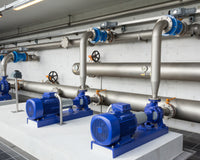

Pumps are devices widely used in industry and households. Their integral component is a motor that drives the working tool, generating the necessary pressure difference between the suction and discharge sides. This makes it possible to pump liquids or transport them to a higher level. Many types of pumps are available on the market, among the most commonly used being submersible pumps for wastewater, sludge, and drainage. Wastewater pumping devices are usually equipped with a cutting mechanism and are known as macerator pumps.
What are macerator pumps used for?
As their name suggests, the primary function of macerator pumps is to break up wastewater and sludge in order to increase the efficiency of their transport and pumping. Macerator pumps are widely used in the water and sewage sector to pump wastewater containing fibrous contaminants. They are worth using with discharge pipes of small diameters and when wastewater must be transported over considerable distances. A prerequisite for installing a macerator pump is a considerable distance from the main sewer riser. Macerator pumps are suitable when the transport distance exceeds 300 metres, the pumping height exceeds 12 metres vertically, and the discharge pipeline is less than 40 millimetres in diameter. Macerator pumps are also used when large differences in terrain elevation rule out other solutions.
Macerator pumps are very often used in places that need to be adapted into sanitary facilities but are located outside the designated sewer riser. The same applies to kitchen islands equipped with a sink. Macerator pumps are also widely used in food-service establishments, where their primary function is to protect the sewer system from blockages caused by food waste. They are also successfully used in beauty salons, hair salons, and public toilets. They are used in the food, paper, and agricultural industries, as well as in hospitals, hotels, and campsites.
What should you know about macerator pumps?
The key structural component of a macerator pump is the macerating mechanism, consisting of a blade and a cutting disc. Both parts should be made of tool steel with increased resistance to abrasion. The macerating mechanism is installed in front of the impeller. Waste is macerated in the pump’s hermetically sealed tank. The blades cut solid contaminants in the wastewater, after which the pump transports them to the sewer system, septic tank, or domestic wastewater treatment plant. Macerator pumps enable effective adaptation to local terrain conditions, which is particularly important in locations with complex topography. The pump inlet type is adapted to the type of sanitary fixture being served—different for a washbasin and different for a bidet or washing machine.
The pump housing must be resistant to mechanical damage and corrosion. Macerator pumps can be used to pump not only wastewater but also sludge and liquid manure. When choosing a suitable macerator pump, attention should be paid to additional equipment, including a thermal fuse. Macerator pumps are also equipped with convenient on/off buttons and an electronic control system. They are installed on a flat surface, approximately 5 centimetres from the wall, or integrated with a toilet pan. Macerators are an increasingly common solution in sewage pumps.