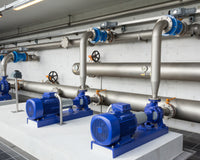
A pond is not only a garden decoration, but also a small, living ecosystem that needs constant water movement, oxygenation, and filtration. In practice, the pump determines how this entire system works. At Dambat, we do not manufacture dedicated pond equipment; instead, we supply IBO and IPRO pumps that can be successfully used for pumping, circulating, and aerating water in such tanks. Every day, we help installers and water-gardening enthusiasts choose solutions that work reliably for years, so we know well that pond pumps are essentially general-purpose pumps selected for a specific task. In this guide, we explain how to approach the subject methodically—from the parameters and types of construction to water-pump maintenance and servicing—because proper selection involves more than just the pump itself. It involves the entire chain: water circulation, mechanical filtration, and aeration. These three processes determine whether the water remains clear. Mechanical filtration captures suspended particles, while water circulation delivers the water to the filter—one simply will not work without the other.
If you are looking for a specific category, it is worth starting with our range of aeration and recirculation devices, namely IBO aerators, as well as our article on how pond fountains and fountain pumps from Dambat work. It is also worth distinguishing between two roles that customers often confuse: a pond manufacturer—understood as a producer of basins, liners, and ready-made tanks—is a completely different supplier from a pump manufacturer. Dambat is responsible only for the latter, supplying pond pumps in the form of devices that pump and set water in motion. In our projects, we work with contractors for whom every pond manufacturer is a natural partner—we simply complement their designs with the pumping section.
Why a pond needs a pump—circulation, oxygen, and cleanliness
Standing water quickly loses oxygen, blooms, and becomes a habitat for algae, which is why the proper functioning of a pond is based on three pillars: water movement, oxygenation, and the removal of contaminants. A properly selected pump ensures continuous water flow throughout the pond, equalizing temperature and oxygen concentration in the tank. Water circulation is also essential for effective filter operation, because without it even the best filter media have nothing to clean. It is constant water circulation, not isolated treatments, that maintains biological balance. In our experience, most problems with cloudy or “lively” water are not caused by chemistry, but by insufficient circulation. This leads to the first selection rule: it is better to plan some excess capacity than to operate at the limit, because a higher pump capacity provides more stable conditions, especially in summer, when oxygen solubility decreases as the temperature rises. The right pump is therefore one that maintains water circulation even on a hot day, when the ecosystem is under the greatest strain.
Which pump should you choose for a pond—key parameters
Pond pumps should always be selected individually, because there is no single universal unit that will work in every pond. The question “which pump should I buy?” is the one we hear most often, and the answer always begins with numbers. To make the right choice, we need to know three things: the tank volume, the delivery head, and the purpose of operation—circulation, a fountain, a cascade, or filter supply. Every pump parameter should be read from the technical data sheet rather than a marketing description, because these are the figures that determine which pump is suitable for a given installation.
Pump capacity and circulation time
The basic pump parameter is pump capacity, meaning the amount of water pumped per unit of time, expressed in l/h or m³/h. This parameter most often determines whether the entire selection will succeed. A practical installation rule states that the entire pond volume should pass through the pump at least once every 1–2 hours. For a tank with a capacity of 5,000 litres, this means a capacity of approximately 2,500–5,000 l/h. If fish live in the pond, circulation should be faster. In that case, higher pump capacity directly benefits the health of the entire ecosystem because it removes metabolic waste and oxygenates the water more quickly.
Delivery head and resistance along the route
The second critical pump parameter is delivery head, marked with the symbol H and expressed in metres of water column. Every difference in level between the pump and the cascade outlet, every elbow, and every long hose reduces the actual water flow. Therefore, nominal capacity should always be read from the pump curve for the specific height, not from the maximum point. This is a typical mistake when buying inexpensive equipment, where the stated litres refer to operation without back pressure. The right pump will maintain its assumed capacity even when facing installation resistance. This is why we always describe professional pumps using their full performance curves rather than isolated figures from a headline.
Power consumption and continuous operation
A pond pump operates seasonally and almost continuously, so power consumption has a real effect on your bills and is an important pump parameter during long operating cycles. Modern, highly efficient water pumps can achieve the same water flow with lower energy consumption. This is where a conscious pump choice pays off fastest, because differences in energy use accumulate throughout the season and can produce measurable savings after several months of operation.
Types of water pumps useful in a pond
Our IBO and IPRO portfolios include a wide selection of pumps suitable for various water-garden tasks. Below, we discuss the most important types of water pumps and their practical applications. It is worth learning about these types before making a decision, because they differ not only in price but, above all, in purpose. Our professional pumps cover each of the groups described below.
Fountain and cascade pumps
Fountain pumps are submersible designs intended for continuous operation underwater. They are often equipped with a set of nozzles that create a water feature. Our FON 400 fountain pump is a good example of a device that combines water circulation with a decorative effect. These types of pond pumps serve a dual purpose: they aerate the water by breaking up the stream while also maintaining movement in the tank. This is why they are often the simplest answer to the question of which pump to choose for a small ornamental pond where both visual appeal and oxygenation matter.
Submersible pumps for slightly contaminated water
When leaves, silt, and fine suspended particles accumulate in a pond, a contamination-resistant design is needed. That is why, in the categories pumps for slightly contaminated water and submersible pumps, you will find devices with impellers that allow solid particles to pass through. They are suitable for seasonal tank emptying, water transfer, and preliminary mechanical filtration—in other words, wherever an ordinary fountain pump would quickly become clogged with sediment.
Aerators and water aeration
Where oxygenation is the main priority, such as in fish-farming ponds and larger tanks, we use blowers and aerators, because water aeration is more effective here than circulation alone—it introduces oxygen directly into the water column. One example is our 400V aerator, designed for demanding applications. In large tanks, intensive water aeration can be even more important than the choice of a circulation pump, because oxygen deficiency disrupts biological balance most quickly.
Pumps for larger tanks and water transfer
Large ponds and swimming ponds sometimes require the transfer of water heavily loaded with sediment, for example when emptying the tank before cleaning. In such cases, we direct customers to the category of sewage and septic-tank pumps, which can handle heavily contaminated water during servicing and bottom cleaning. These designs are not suitable for the daily circulation of an ornamental pond, but they are invaluable during maintenance work when a large volume of water and accumulated silt must be removed quickly.
Peripheral, circulation, and deep-well pumps—when to choose other types
A pond rarely operates in isolation. It often needs to be supplied with water, connected to a treatment system, or integrated with a garden installation. It is therefore worth knowing the wider range of solutions that can work with a pump operating directly in the tank. For filling and watering from a water source near the pond, you can use a surface pump. Our range includes both IBO surface pumps and garden pumps. If the water source is a well, choose deep-well pumps. In systems with a heat exchanger or water heating in a swimming pond, circulation pumps and domestic hot-water circulation pumps will work well. If you need a small, high-pressure unit, learn about its design and applications in the article peripheral pump—what is it? For garden irrigation using collected rainwater, we recommend pumps for watering and rainwater, which complete the water cycle throughout the garden.
Equipment: controllers, valves, filters, inverters, and pressure gauges
A good pump is half the success; the other half is the equipment that protects the device and allows the water flow to be adjusted to the actual needs of the installation. Our IBO brand range includes controllers for automated switching and dry-run protection, valves (solenoid valves) for controlling the direction and division of the flow, and water filters that support mechanical filtration and protect the impeller from contaminants. Another group consists of inverters, which regulate pump speed, smoothly changing pump capacity and reducing power consumption. It is worth remembering that Dambat inverters regulate the pump’s operating conditions, not energy from photovoltaic panels. The system is completed by pressure gauges and pressure sensors, which provide control over system parameters. A full overview of both product ranges can be found on the IBO and IPRO pages.
Water-pump maintenance and pond servicing
The service life of the entire system depends on regular maintenance. Water-pump care in a pond involves several routine tasks that every user can perform independently, ideally scheduling pond servicing according to the seasons. During the season, check the inlet weekly, remove leaves and algae from the strainer, and inspect the flow. Once a month, rinse the filter media and assess the condition of the mechanical filtration system, hose, and seals. In spring and autumn, carry out start-up and winterization. In the Polish climate, fountain and submersible pumps should be removed before frost, cleaned, and stored either in water or in a room with a positive temperature. Regular servicing not only extends equipment life but also maintains stable oxygenation and water clarity throughout the season. Water-pump maintenance is easiest when you choose a design that is simple to disassemble from the outset. This is exactly the broad selection of pumps we offer under the IBO and IPRO brands.
Pond size, lighting, and selecting a complete set
Finally, let us bring all the elements together, because pond size determines not only the pump itself but also the remaining equipment. Small home ponds with a capacity of up to approximately 2,000 litres can usually be handled by a compact fountain pump. Medium and large tanks require a more powerful unit, a separate filter, and, when fish are present, additional support from an aerator. The optimal operating mode will also differ for each pond: continuous in summer and limited during transitional periods. Although pond lighting is mainly decorative, it is worth planning it together with the pump, because shared cable conduits and protective devices simplify installation and later servicing. Well-designed pond lighting also enhances the effect of a fountain and cascade in the evening.
If you are unsure which pump is right for your project, take advantage of our experience. As a pump manufacturer and supplier, we help select professional pumps for transferring and circulating water in ponds, from small ponds to swimming ponds. Our professional IBO and IPRO pumps combine durability with reasonable energy consumption, while our wide selection of pumps makes it possible to match a solution to any budget. The right pump is an investment that pays off with clean, oxygenated water throughout the season, and well-maintained ponds can delight the eye for many years.
FAQ—frequently asked questions about pond pumps
Assume that the entire volume circulates once every 1–2 hours. For 5,000 litres, this means a pump capacity of approximately 2,500–5,000 l/h, read at the actual delivery head rather than at the maximum point. If fish live in the pond, choose the higher range because greater pump capacity noticeably improves oxygenation.
No. Fountain pumps are submersible and are designed to circulate water already present in the tank. To fill the pond from a water source or well, you need a surface or deep-well pump, as these are two completely different pump applications.
Clean the inlet strainer weekly, rinse the filter media and check the mechanical filtration monthly, and carry out start-up and winterization in spring and autumn. Regular water-pump maintenance extends service life and keeps the pond functioning reliably throughout the season.
An inverter smoothly regulates the pump speed, allowing you to adjust the water flow and reduce power consumption. Remember, however, that Dambat inverters regulate the pump’s operating conditions and have nothing to do with solar inverters.
IBO is our core brand of pumps and equipment, while IPRO is the premium version—the same design approach, but with higher specifications, better materials, and a longer warranty. You will find both ranges in our wide selection of pumps.
For slightly contaminated water, choose a submersible pump with an impeller that allows solid particles to pass through. For heavily contaminated water and bottom cleaning during servicing, sewage and septic-tank pumps are a better choice because they can transfer even dense sediment.