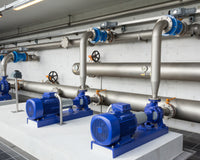
Pumping dirty water, domestic and municipal wastewater, or slurry requires a completely different approach from pumping clean water. In installation practice, the most common mistake is choosing a submersible pump “by eye,” without analyzing the medium, flow rate, and head. In this article, we explain how the various impeller designs differ, when to choose a pump with an agitator or grinder, and how to select a high-performance 400V submersible pump for a specific application—from pumping wastewater on a farm, through wastewater treatment plants, to draining basements and excavations.
When a high-performance submersible wastewater pump is needed
A low-power wastewater pump (up to 750 W, 230 V power supply) is sufficient for typical household tasks—draining basements, inspection chambers, or small tanks. The situation is completely different when dealing with large amounts of contaminated water, thick slurry, sludge from wastewater treatment plants, or the need to pump over long distances and heights. In such cases, a submersible wastewater pump powered by 400 V, with an output of approximately 500 W or more, often reaching several kilowatts, is required.
Typical applications of a high-performance dirty water pump include:
- pumping domestic and municipal wastewater and industrial wastewater,
- operation of domestic and underfloor wastewater pumping stations,
- slurry pumps on agricultural and livestock farms,
- dewatering basements, construction excavations, and drainage ditches,
- power supply and support for wastewater treatment plant operation.
Types of impellers—how to choose the right design for a submersible pump
Choosing the right pump largely means choosing the right impeller—it determines how well the pump handles solids, fibers, or sediment in the pumped liquid. Below are the key solutions used in our IBO and IPRO brands, along with a simplified diagram showing how each design works.
Impeller with agitator
The mixer breaks up sediment at the bottom of the tank
Steel impeller (channel / vortex)
Vortex flow, abrasion resistance
PPO plastic impeller
Lightweight design, corrosion resistance
Macerator pump
Knives shred fibrous contaminants
Impeller with agitator
An agitator is a mechanical mixer mounted at the bottom of the pump that breaks up and lifts sediment settled on the bottom of the tank, directing it toward the inlet. This solution is ideal for septic tank and slurry pumps, where thick sediment accumulates at the bottom of the tank and the pump alone would not be able to draw it into the housing.
Steel impeller (channel / vortex)
Impellers made of stainless steel or cast iron are suitable for pumping contaminated water containing sand, small stones, and abrasive impurities. The vortex design creates a swirling flow that limits contact between solids and the impeller itself, extending the pump’s service life. This is a good solution where wastewater contains a large amount of sand.
PPO plastic (polyamide) impeller
PPO polymer impellers are lighter, corrosion-resistant, and withstand contact with media with variable pH or mild chemical aggressiveness. They are used mainly in pumps for slightly and moderately contaminated water, where the ratio of capacity to device weight and resistance to mineral deposits are important.
Macerator pump
A macerator pump shreds fibrous contaminants – wipes, rags, organic residues – before pumping them further through the system. This makes it possible to use smaller-diameter pipes and pump the medium over greater distances without the risk of clogging. You can find solutions of this type in the Wastewater and septic tank pumps with macerators collection.
Comparison of impeller designs – table
| Impeller type | Type of contaminants | Free passage | Main advantage | Typical application |
|---|---|---|---|---|
| With agitator | Dense sediment, slurry | Large | Releases sediment accumulated on the bottom | Septic tanks, slurry tanks |
| Steel (vortex) | Sand, abrasive solids | Medium / large | Abrasion resistance | Sandy wastewater, sludge |
| Made of PPO plastic | Slightly/medium-contaminated water | Medium | Lightweight construction, no corrosion | Drainage, groundwater |
| With macerator | Fibrous contaminants | Small (after shredding) | Pumping through small-diameter pipes | Pumping stations, domestic wastewater |
Technical data – what to consider when selecting a pump
Selecting a submersible pump for professional applications is based on several key technical parameters:
- Pump capacity (m³/h or l/min) – the amount of liquid the unit can pump in a given time; the maximum capacity specified in the catalog refers to operation at zero lifting height; in practice, it is worth calculating the actual capacity at the target pumping height,
- Water lifting height – the maximum lifting height is a theoretical parameter; the actual pumping height depends on the length and diameter of the pipe and system resistance,
- Motor power – in high-performance submersible wastewater pumps, typically from 500 W to several kW, with 400 V (three-phase) power supply, allowing continuous operation under heavy loads,
- Free passage – the diameter of solid particles the pump can pass without clogging; particularly important when pumping slurry and wastewater containing fibers,
- Submersion depth and IP protection rating – determine operating safety when fully submerged.
Detailed technical data for individual models, including performance curves, can be found on the product pages for each pump in our store.
Examples of high-performance IBO and IPRO 400V submersible pumps
Dambat’s range includes models specifically designed to work with dirty water, sewage, and slurry under heavy-load conditions:
- WQ and MWQ pump family – high maximum capacity with a 400 V power supply, intended for operation with heavily contaminated water,
- QBS pump family – a submersible pump for industrial applications and sewage pumping stations requiring high motor power,
- KBFU pump family – designed for media with a high content of sediment and sludge.
These are examples from the top performance segment in our range – if you are looking for a model with different motor power parameters, it is worth consulting the selection through our contact form.
Accessories necessary for the proper operation of the system
A high-capacity 400 V submersible pump rarely operates on its own – the proper and failure-free operation of the system depends on correctly selected accessories:
- Controllers – automatically switching the pump on and off depending on the liquid level, often with a dual-pump operation function in pumping stations,
- Inverters – regulate pump operating parameters (not to be confused with a photovoltaic inverter – a pump inverter controls only the pump motor’s operating conditions, adapting its capacity to the system’s current demand),
- Valves – check and shut-off valves protecting the system against backflow,
- Filters – protecting subsequent system components against mechanical contaminants,
- Pressure gauges – monitoring the water pressure in the discharge system, helpful when diagnosing pump operation.
It is worth remembering that an automatic pump equipped with a float or level sensor significantly facilitates operation in unmanned pumping stations – it reduces the need for manual supervision and protects the motor against dry running.
How a sewage pump differs from other solutions in our range
Not every water-related task requires a high-capacity 400 V sewage pump. If you are looking for equipment for other purposes, our range also includes:
- Rainwater and watering pumps – for clean and slightly contaminated water, e.g. a garden sprinkler pump,
- Drainage and excavation pumps – lower power, for seasonal removal of water from construction excavations,
- Combustion engine pumps – where there is no access to an electrical power supply,
- accessories for submersible pumps – hoses, fittings, and coupling feet.
Pump selection should always be based on an analysis of the medium (clean water, contaminated water, wastewater, slurry), the required capacity, and the lift height – not on price or motor power considered separately from the application. Only such an analysis makes it possible to identify the “best pump” for a specific installation.
Frequently Asked Questions (FAQ)
Which pump is best for slurry – one with or without an agitator?
For slurry and sediment accumulating at the bottom of a tank, a pump with an agitator is recommended. The mechanical agitator breaks up and lifts the sediment, allowing it to be drawn freely into the impeller – without an agitator, thick slurry may remain beyond the pump’s reach and cause it to overload.
What is the difference between a pump’s maximum capacity and actual capacity?
The maximum capacity specified in the product data sheet refers to pump operation at zero lift height (the so-called zero point of the performance curve). In a real installation, at a given discharge height and pipe length, the actual capacity will be lower – this should be taken into account when selecting a pump.
When is it worth choosing a pump with a grinder, and when one with a vortex impeller?
A pump with a grinder is suitable for media containing fibrous contaminants (wipes, rags, fabrics) that could clog the discharge pipe. A vortex impeller handles abrasive contaminants, such as sand, better, without the risk of damaging the grinder blades.
Is an inverter for a submersible pump the same as a photovoltaic inverter?
No. An inverter used with pumps regulates the pump motor’s operating conditions (e.g. smooth starting and matching output to the installation’s demand), not energy from a photovoltaic system. Despite the similar name and comparable frequency-control technology, its application is entirely different.
What power supply voltage is required for high-capacity sewage pumps?
High-capacity models with motor power from approximately 500 W and above most often require a three-phase 400 V power supply. This enables stable operation under heavy loads and continuous operation, which is typical for sewage pumping stations and industrial installations.
How do you select a pump for a domestic or underfloor sewage pumping station?
When selecting a pump for a sewage pumping station, you should consider the daily volume of wastewater, the required lift height to the main collector, and the type of medium (domestic wastewater, rainwater). You can find the full range of equipment for this application in the Sewage Pumping Stations collection.
Do you have questions about selecting a specific pump model for your installation? Contact us via the Dambat contact form – we will help you select a pump based on your installation’s actual parameters.