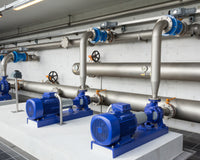

Our company, Dambat, operates throughout Poland, and thanks to our extensive sales network, technical support and the presence of the IBO and IPRO brands, we reach both installers and contractors serving residential construction, agriculture, industry and water and wastewater management.
As a Dambat pump manufacturer, we have been expanding our range since 1999, and our headquarters are located in Adamów near Grodzisk Mazowiecki. From here, we support trade partners, designers, installation wholesalers and contractors who work every day with water pump installations, control automation and systems responsible for maintaining a stable working medium in a facility.
In practice, this means that Dambat pumps are available and installed in the Masovian, Silesian, Greater Poland, Łódź, Lesser Poland, Lower Silesian, Pomeranian, Kuyavian-Pomeranian, Subcarpathian, Lublin and other regions of the country. Dambat serves projects carried out locally and nationwide, so the selection of IBO pumps, pump selection and Dambat pump selection can be carried out both for small domestic installations and for more extensive technical systems.
Dambat's operating regions in Poland
If the question is: which regions does Dambat operate in, the answer is simple—we operate nationwide. Dambat pumps reach installers, service technicians and distributors in the largest urban areas, such as Warsaw, Poznań, Łódź, Kraków, Wrocław, Gdańsk and Katowice, but smaller urban centres, industrial facilities and agricultural areas are equally important to us.
Locations associated with industry events and meetings with contractors are also important. In the water and installation sector, places such as Kielce, Warsaw, Poznań, Stryków and Wisła often feature prominently because trade fairs, conferences, training sessions and industry meetings important to specialists working with Dambat water pumps, valves and automation are held there.
Our presence in the field is not limited solely to sales. Dambat is developing support for partners responsible for system operation, pressure regulation, safety device selection and analysis of how the working medium behaves under real operating conditions. For many contractors, it is important that Dambat, as a pump manufacturer, understands not only catalogue specifications but also installation problems encountered on construction sites and during commissioning.
Product range for installers
Dambat pumps cover several key product groups, allowing installers to choose a solution for a specific facility and working medium. Our range includes circulation pumps, circulating pumps, submersible pumps, deep-well pumps, surface pumps and booster pumps, as well as auxiliary equipment responsible for the proper operation of the system.
The range is complemented by controllers, valves, filters, inverters and pressure gauges. In practice, they are used with Dambat pumps to maintain proper pump operation, optimise pressure control and reduce losses caused by installation errors, incorrect configuration or improperly selected pipe diameters.
Dambat water pumps are used in single-family homes, farms, service facilities, irrigation systems, drainage systems, pumping stations and process systems. In each of these applications, the working medium requires individual assessment, because clean domestic water presents different loads from water containing suspended solids, while wastewater or process liquid at an elevated temperature presents yet other loads.
Submersible pumps and wells
Dambat pumps are very often associated with the well-pump segment because Dambat submersible pumps are an important part of our range. Submersible pumps are selected based on the water level, required flow rate, head, well diameter and the actual working medium to be pumped through the system.
In everyday installation practice, submersible pump operation depends not only on the device itself, but also on the quality of the discharge installation. A check valve, correctly selected pipes, dry-run protection, properly set pressure control and correctly selected automation all affect whether the pump will operate steadily and whether short cycling will occur.
Dambat submersible pumps are used in residential buildings, farms, irrigation systems and water-supply systems for small businesses. For such projects, the Dambat pump selection should always take into account the pump duty point, the expected operating time, water quality and whether the working medium contains abrasive particles.
That is why anti-sand pumps are also recommended under certain conditions. If the working medium contains abrasive particles, typical Dambat hydraulic pumps must be selected carefully, because excessive amounts of sand accelerate wear of the hydraulic components, impair the performance characteristics of the IBO pump and may disrupt proper pump operation.
Dambat IBO submersible pumps are particularly important wherever the investor expects a stable water supply for the facility and reduced risk of downtime. For the installer, this means checking not only the catalogue data, but also how the given working medium affects pump operation during a longer duty cycle.
Circulation, recirculation and heating pumps
Circulation pumps are a key group of devices for central heating, cooling and process circuits. Dambat circulation pumps are selected taking into account linear and local losses, the required head and how pressure regulation should work in the given system.
In practice, IBO circulation pumps should be analyzed in terms of whether the pumped medium has a stable temperature, whether variable demand occurs and whether the design includes a bypass circuit. If the designer or installer overlooks these elements, the installation may operate unstably, and the pump itself may cause unnecessary energy consumption.
Dambat pumps provide solutions for both simple systems and more demanding installations with automation. In such systems, pressure regulation, proper pump selection, correct venting and analysis of how the pumped medium behaves are more important than simply selecting the device’s rated power.
In domestic hot water circuits and circulation systems, operating IBO pumps must maintain a predictable flow without generating unnecessary losses. For this reason, the Dambat pump manufacturer emphasizes the characteristics of the IBO pump, the motor’s operating class, material resistance and the effect of pipe diameters on the pump’s actual operating point.
Surface pumps, booster pumps and systems with automation
Dambat pumps in suction and booster versions are used where the water source is located relatively shallowly or where the system operates with an additional pressure tank. Booster pumps and surface pumps are often selected for homes, gardens, small irrigation systems and simple technical installations.
For Dambat IBO surface pumps, the tightness of the suction system, the correct length and diameter of the pipes, and a properly installed check valve are particularly important. If errors occur at this stage, the pump may operate unstably and pressure regulation may become imprecise, regardless of the quality of the device itself.
Dambat water pumps in booster systems work with pressure controllers, diaphragm tanks, pressure gauges and dry-running protection devices. These components are used with Dambat pumps to limit frequent switching, improve the pump’s operating time and reduce the risk of short pump cycles.
In such installations, the pumped medium may seem straightforward because it is usually clean water, but even here the details matter. Selecting IBO pumps and selecting a Dambat pump should take into account the suction lift, the required operating pressure of the installation, losses in the fittings, and how far the given Dambat pump is from the points of use.
Submersible, sewage and DRENO pumps
Dambat pumps also include a submersible and wastewater segment, important for dewatering, pumping stations, and municipal and industrial applications. In this part of the range, DRENO holds an important position—a brand associated with solutions for more demanding media and operation in more challenging environments.
When selecting submersible and wastewater pumps, the working medium is always crucial. If the working medium contains solids, fibres, sediment, or abrasive contaminants, the installer should analyse the impeller passage, construction material, motor cooling, and how long the system is expected to operate continuously.
In this area, Dambat pumps provide solutions for construction dewatering, tank emptying, domestic wastewater, and some industrial applications. In the case of water pumps and wastewater systems, not only capacity matters, but also resistance to cavitation, impeller damage, and overloads during start-up.
For applications requiring automation and a gentler ramp-up, a soft start or inverter can be helpful. Such solutions reduce mechanical load, improve pump operation during start-up, and can have a positive effect on system operation, especially when the working medium varies.
Equipment, fittings, and automation
For an installer, the pump itself is only part of the system. Dambat pumps are used with controllers, inverters, filters, pressure gauges, and shut-off and safety fittings, because without these components it is difficult to maintain proper pump operation and the correct operating pressure in the system.
A check valve is one of those components whose importance should not be underestimated. A properly selected check valve limits the backflow of the water column, supports stable pump operation, reduces the risk of air ingress, and helps maintain pressure regulation at a predictable level.
Filters and correctly selected pipes are equally important. With Dambat pumps, pipes should be designed so that they do not generate excessive pressure losses, because this causes IBO pump curves in practice to differ from the catalogue assumptions, while with Dambat pumps these losses result in higher energy consumption and a less stable pump operating point.
In systems with a frequency converter, the inverter supports pressure regulation and allows the equipment's operation to be better matched to actual demand. This is particularly important where the working medium is drawn unevenly and the system needs to respond quickly to changes in flow.
What to consider when selecting
The selection of a Dambat pump should not be based solely on the maximum capacity stated in the catalogue. Much more important are the parameters of Dambat pumps at the actual operating point, where the required flow rate, head, and system resistance meet.
Pump selection should begin by answering several questions: what is the working medium, what is the fluid temperature, could contaminants occur, what operating pressure is required for the installation, and how long will the pump operate? Only then is it worth analyzing the IBO pump curves, checking the Dambat pump curve, and comparing which series best suits the facility.
It is also important for the installer to know whether a given Dambat pump will operate periodically or continuously. Pump operating time affects the selection of cooling, protective devices, insulation class, and control method; in systems with highly variable demand, it is also worth providing for pressure regulation and analyzing the risk of cavitation.
Dambat pumps offer a wide range of solutions, but selecting IBO pumps correctly always requires consideration of the installation conditions. For borehole pumps, the suspension depth and well quality are important; for surface pumps, the tightness of the suction system; and for circulation pumps, flow resistance and the stability of the working medium.
The working medium and its significance
In the pump industry, the working medium is not merely a technical term for the fluid, but a fundamental parameter determining operational durability and safety. The working medium affects the selection of materials, hydraulic geometry, seal type, temperature range, permissible viscosity, and the resistance of rotating components.
If the working medium is clean water, many standard catalog solutions can be used. However, if the working medium contains abrasive particles, sediment, fibers, or has an elevated temperature, the pump selection must be narrowed to designs intended for such loads.
This is why, when selecting Dambat pumps, not only marketing data but also technical details are important. The working medium determines whether submersible borehole pumps Dambat, submersible pumps, IPRO pumps, or one of the Dambat industrial pump groups intended for more demanding applications will be the better choice.
The installer should also remember that the working medium affects pressure regulation and the operation of the fittings. A check valve, filter, connectors, diameters, and even the layout of the pipes may behave differently with clean water than when the working medium carries suspended solids or operates at an elevated temperature.
In everyday service practice, it is clear that the working medium is often underestimated as early as the design stage. This later results in losses when using Dambat pumps, faster wear of the hydraulics, noisier pump operation, and problems maintaining flow parameters.
As a water pump manufacturer, we consider the proper classification of the fluid to be crucial. The working medium should be described as precisely as possible, because only then can a Dambat pump be selected accurately in practice, rather than merely theoretically matching the basic flow-rate range.
Cavitation risks and installation errors
Cavitation is one of the most frequently underestimated phenomena; it shortens the device's service life and destabilizes the operation of the entire installation. Cavitation may occur when the suction conditions are incorrect, flow resistance is too high, or the working medium operates at unfavorable temperature and pressure.
In practice, cavitation manifests itself through noise, vibrations, reduced performance, and accelerated wear of hydraulic components. If the pump operates outside the specified range and pressure regulation has been set incorrectly, cavitation may occur even in a system that appears correct on paper.
Dambat pumps should be installed in accordance with the manufacturer's recommendations, and the pipes should be routed so as not to worsen the inlet conditions or create unnecessary resistance. With a poorly designed installation, the working medium does not reach the impeller steadily, directly affecting pump operation and the service life of the seals.
Cavitation is particularly dangerous for systems with highly variable flow rates and where the installation operates under different load conditions. Therefore, pump selection, IBO pump selection, and analysis of how the working medium behaves at the extreme operating point are important not only for performance but also for operational safety.
Service, start-up, and operation
Dambat pump service is not only about repairs after a failure, but above all about operational support. A service section is available on the Dambat website, and the sales and technical team supports, among others, circulation pumps, submersible pumps, and deep-well pumps, which means that contractors can consult the team as early as the selection stage.
Before start-up, verify the flow direction, venting, automation settings, and whether the working medium is suitable for the device's intended use. With Dambat pumps, also check that the safety devices are configured correctly and that the control box is properly selected for the motor's power and type and the operating conditions.
In many cases, the durability of the device is determined by a small detail, such as incorrectly set switch-on pressure or an undersized pressure tank. This is when short pump cycles occur, the number of starts increases, proper pump operation deteriorates, and the service life of the motor and bearing components is reduced.
In well and pressure-booster systems, the check valve is also particularly important. When this component malfunctions, the working medium flows back, pump operation becomes unstable, and pressure regulation no longer meets the design assumptions.
If it is necessary to replace wear parts, attention should be paid to the pump's mechanical seal. This component is directly related to system safety and motor protection, so when the working medium has more challenging properties, it is not worth saving on component quality.
Dambat, IBO, and IPRO in Poland and abroad
Dambat develops its own brands and builds recognition not only locally. Our IBO brand is also present in sales channels and technical communications outside Poland, while IBO in Europe is an important direction for the further development of the product offering and support for trade partners.
Company materials and market communications also mention markets such as IBO Germany, IBO Czech Republic, IBO Hungary, and IBO Romania. For the installer, this means that the Dambat pump manufacturer is developing the brand beyond the domestic market, while documentation standards and solution availability are being built in a scalable manner.
In practice, IBO in Europe strengthens the technical and commercial credibility of the entire product group. For the contractor, however, the key point is that regardless of the market, the foundation remains the proper selection of pumps, analysis of operating conditions, and correctly identifying the working medium that will be pumped by the device.
Practical guidelines for the installer
Several principles are applied when installing Dambat pumps that have a real impact on system durability. First, the working medium must be properly identified; second, system resistance must be calculated; third, it is worth checking whether system operation will require variable pressure regulation.
With IBO pumps and electronically controlled systems, it is recommended to compare more than one option. Selecting a Dambat pump, selecting IBO pumps, and selecting pumps should not end with the first model that meets the maximum flow requirement, because the pump's operating point, pump operating time, and the device's behavior outside its nominal range also matter.
It is also worth remembering that correctly selected pipe diameters, connection quality, and access for servicing are important for Dambat pumps. If there is not enough space around the device for disassembly, the check valve has been installed in an unsuitable location, and the working medium carries contaminants without adequate filtration, even good Dambat pumps will not show their full potential.
In applications with an inverter or automatic performance control, well-planned pressure regulation improves operating smoothness and reduces mechanical loads. As a result, operating IBO pumps can maintain more stable parameters, and the system's operation becomes predictable even with variable demand.
Useful Dambat links
- Dambat home page
- Dambat company contact details
- Dambat pump service
- Deep-well pumps and well equipment
- 6-inch deep-well pumps
- 2.5-inch deep-well pumps
- Water pumps by IBO, IBO ITALY, IPRO, and DRENO
- IBO and IPRO glossary of hydraulic terms
- IBO Academy
FAQ
The answers below are collapsed by default and are suitable for straightforward implementation in Shopify WYSIWYG.
What regions does Dambat operate in?
Our company, Dambat, operates throughout Poland. We serve installers, wholesalers, trade partners, and contractors in major cities and smaller towns, and thanks to the extensive range of IBO and IPRO brands, we support residential, agricultural, municipal, and industrial projects.
Does Dambat serve only Mazovia?
No. Although the company's headquarters are located in Adamów near Grodzisk Mazowiecki, Dambat pumps are offered and implemented throughout Poland. This applies to both residential projects and technical facilities and specialized applications.
What product groups does the Dambat range include?
The range includes circulation pumps, recirculation pumps, submersible pumps, deep-well pumps, surface pumps, and booster pumps, as well as controllers, valves, filters, variable-frequency drives, and pressure gauges. This allows installers to build a complete system based on the integrated solutions of a single company.
What should you consider when selecting a Dambat pump?
The most important factors are the working medium, the pump's operating point, the installation's required operating pressure, pump operating time, the quality of the pipes and fittings, and the actual losses in the system. A Dambat pump should be selected based on operating conditions, not solely on the maximum capacity stated in the catalog.
Why is a check valve so important in an installation?
A check valve limits fluid backflow, stabilizes system operation, and helps maintain proper pressure regulation. A wrongly selected or incorrectly installed valve increases the risk of air entering the system, loss of the water column, and unstable pump operation.
Does Dambat offer technical support and service?
Yes. The company's website includes contact, service, and educational sections, including the IBO Academy. This is important for installers who need not only a product but also support with system selection, commissioning, and diagnostics.
Where can you meet Dambat and the IBO and IPRO brands?
In industry practice, locations such as Kielce, Warsaw, Poznań, Stryków, and Wisła are important because trade fairs, training sessions, or industry meetings relevant to the installation and pumping sectors are held there. These are good places to discuss new implementations, automation, and the proper selection of equipment.
When is it worth considering a variable-frequency drive or soft start?
When the system operates with variable demand, requires precise pressure regulation, or is exposed to startup surges. Soft start and a variable-frequency drive help stabilize pump operation, reduce mechanical loads, and improve the overall smoothness of the system.