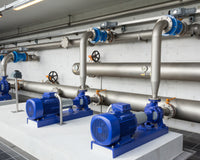
An Abyssinian well is one of the simplest and most affordable solutions for drawing water from a well. Also known simply as an Abyssinian well, it is an excellent choice for those looking for quick access to groundwater without complicated installations. It is worth noting, however, that besides a manual hand pump, there are modern alternatives that allow water to be drawn automatically from the well all the way to the tap. Our company, Dambat, offers a full spectrum of solutions — from a simple Abyssinian well with a hand-operated pitcher pump, through systems with surface pumps, to advanced installations with submersible pumps and automatic controllers.
In practice, this means that if you already have an Abyssinian well and want to upgrade it, or are only planning to drill a well on your property, we can help you choose the best solution. Whether you live in the Mazovia, Greater Poland, Silesian or another region of Poland, Dambat provides technical advice and products from the IBO and IPRO brands to every corner of the country. Contact us — our team will be happy to advise you.
How does an Abyssinian well work and what is its capacity?
An Abyssinian well works effectively thanks to its simple design. A well pipe with a diameter of 1–2 inches is driven or screwed into the ground, usually to a depth of 7–15 metres, until it reaches the aquifer. The well pipe has an Abyssinian well filter at the bottom, which retains sand and larger contaminants. When the hand-operated pitcher pump (or a modern hand pump) is operated, a vacuum is created, lifting groundwater through the pipe into the vessel.
The capacity of an Abyssinian well is usually 8 to 25 l/min (0.5–1.5 m³/h), which makes it ideal for households. An Abyssinian well is particularly suitable for holiday homes, gardens and small settlements. The well filter must be cleaned regularly, especially in sandy soils, where the water level and sediment content may change seasonally. An Abyssinian well, also called a tubular well or narrow-pipe well, refers to a similar concept — all are shallow wells with filters and manual pumping. However, a narrow-pipe well requires properly constructed deep wells, whereas an Abyssinian well can be built quickly.
The depth of an Abyssinian well usually does not exceed 15 metres — at greater depths it becomes inefficient, and a narrow-pipe well requiring greater depth calls for other well-drilling methods. The aquifer must be shallow enough for the driving or screwing method to be economically viable. The maximum permissible depth for an Abyssinian well is 15 m — beyond this limit, deep wells are used.
Advantages and disadvantages of an Abyssinian well — a practical comparison
The advantages of an Abyssinian well are obvious: low cost (under several thousand złoty), quick construction, minimal environmental impact and no need to rent expensive drilling equipment. The components of an Abyssinian well are simply a well pipe, casing pipe, well filter and hand pump — everything can be purchased from any local building-supply wholesaler.
However, the disadvantages of an Abyssinian well are a real issue, especially in Polish conditions. Insufficient depth means that during droughts the water level may be too low, making the Abyssinian well less effective. Water contamination may be higher than in deep wells, particularly if clay soil or sandy ground contains significant amounts of plant-derived material. The filter should be serviced regularly — the well filter must be replaced every few years. Filter maintenance is not a one-time expense; it requires recurring service work. In the event of frequent use or high contamination levels, we recommend replacing the filter more often.
Perched water and shallow groundwater may be susceptible to seasonal changes, while surface perched water threatens the quality of water drawn from the well. That is why we recommend additional filtration — not only a well filter, but a complete system with a pressure gauge and check valve to ensure clean water and protection against backflow. You can find a full range of pump accessories — filters, valves and controllers — in our offer.
Cost of an Abyssinian well — realistic estimates
The cost of an Abyssinian well and the cost of constructing one depend on many factors. If you want to save as much as possible, the construction costs range from several hundred to one thousand złoty (for materials only, if you install the system yourself). However, if you hire a professional to construct the Abyssinian well, you should expect costs of several thousand złoty, depending on the region, access to the site and the difficulty of drilling.
However, if you would like to eliminate manual pumping completely and have water delivered to the tap as it is at home, you need to add a surface pump or a hydrophore tank — in which case the minimum budget is already several thousand złoty, depending on the power and sophistication of the system. The price of the well also depends on the borehole — if professional drilling is required, the price increases significantly.
Well-construction services are available in most regions of Poland. However, by choosing a hand pump, you can save significant amounts on electrical work and advanced automation. This is precisely why an Abyssinian well works well in poorer communities and places without access to electricity. At Dambat, we can help you choose a pump or solution suited to your conditions.
From an Abyssinian well to a deep well — when to change the system
If an Abyssinian well proves insufficient — for example, during droughts — it is worth considering an upgrade. Deep wells require professional drilling, but they provide access to water at depths of 20–100 metres, where the permissible well depth and aquifer are more stable.
Our company, Dambat, offers a full range of pumps: surface pumps for standing water, submersible pumps for narrow-pipe and tubular wells, and submersible pumps for removing sediment from wells full of deposits. We can equip every pump with an automatic controller, diaphragm pressure tank, check valve, pressure gauge and filters — together, these components create a system in which water flows to the house without manual effort.
The driving and screwing methods are intended only for Abyssinian wells and shallow wells. For deep wells, the technology changes to professional drilling. The construction costs of deep wells are higher, but their capacity and reliability are incomparable with those of an Abyssinian or narrow-pipe well.
Service and consultations — Dambat throughout Poland
Whether you need advice on constructing a deep well in Warsaw, Poznań, Łódź or a small village in the Lublin region, we have the experience and products. Our IBO and IPRO brands are available in every county, and our service network covers the whole of Poland. If you would like to learn more about our products, visit IBO, IPRO and DRENO water pumps — manufacturer.
If you already have an Abyssinian well and need advice on replacing the hand-operated pitcher pump with something more modern, please contact us. Our specialists will help you choose the right system: whether it is a simple upgrade to the existing installation or a complete modernization. Minimal environmental impact is our principle, without sacrificing convenience and reliable water supply. You can also explore the educational materials from the IBO Academy, where you will find detailed advice.
FAQ — answers to frequently asked questions
What exactly is an Abyssinian well and how is it constructed?
An Abyssinian well, also called an Abyssinian well, is a shallow tubular well driven or screwed into the ground to a depth of 7–15 m. Its components are a well pipe, casing pipe, well filter and hand pump. Constructing an Abyssinian well is simple and inexpensive — the pipe is most often installed using the driving or screwing method, without the need for complicated drilling.
What is the capacity of an Abyssinian well, and is it sufficient for a house?
The capacity of an Abyssinian well is usually 8 to 25 l/min (0.5–1.5 m³/h). This is sufficient for small households, gardens and holiday homes, but may be insufficient for year-round use by a family. In that case, it is worth considering a tubular well with an electric pump or a deep well.
What are the main advantages of an Abyssinian well?
The advantages of an Abyssinian well include: low cost (under several thousand złoty), quick construction, minimal environmental impact, no need to rent drilling equipment, simple operation of the hand-operated pitcher pump and the possibility of installation without electricity.
What are the disadvantages of an Abyssinian well?
The disadvantages of an Abyssinian well include: limited depth (max. 15 m), low capacity, the risk of insufficient water in dry conditions, the need for regular filter maintenance, the possibility of higher water contamination, dependence on manual pumping and susceptibility to surface perched water.
How often does the filter of an Abyssinian well need to be cleaned and serviced?
The filter should be serviced every 2–3 years, or annually in sandy soils. If clay soil contains sediment, the Abyssinian well filter needs to be cleaned more frequently. Filter maintenance and additional filtration help monitor the condition of the system.
Can I install an electric pump instead of a hand pump in my Abyssinian well?
Yes, absolutely. A hand-operated pitcher pump is the simplest option, but Dambat offers surface pumps that can work with an existing well pipe. You can even add a diaphragm pressure tank and an automatic controller — the water will then be pumped into the tank automatically, without manual effort.
At what depth is the aquifer located?
The aquifer is usually located at a depth of 5–15 metres, depending on the region and soil conditions. An Abyssinian well is suitable for depths of up to 15 m. Below this level, professional well drilling and deep wells are required. The permissible depth for a narrow-pipe well is 20–30 m, while deep wells can reach 100+ m.
What is the difference between an Abyssinian well and a deep well?
An Abyssinian well is a shallow tubular well up to 15 m deep, installed using the driving or screwing method. Constructing a deep well requires professional drilling and can reach depths of 100+ metres. Deep wells have higher capacity, better water quality and greater reliability during droughts, but they are more expensive.
Does an Abyssinian well work effectively during droughts?
An Abyssinian well is less effective during droughts. When the water level falls below the depth of the well pipe, the hand pump cannot lift the water. In such conditions, deep wells or a reserve tank that stores water during better weather are better options.
Can I build an Abyssinian well myself?
Yes, DIY construction of an Abyssinian well is possible. Its components are available from wholesalers. However, we recommend consulting a professional to ensure that the well pipe and casing pipe are installed correctly, the well filter works properly and the water is safe to drink. Having the well constructed by professionals provides a warranty and quality supervision.
How can Dambat help me choose a water-drawing system?
Our company, Dambat, offers consultations for every customer. Whether you are looking for a hand-operated pitcher pump for an existing Abyssinian well or want to change the entire system, we will help you choose the best solution. The IBO and IPRO brands cover every budget, and our service network operates throughout Poland.