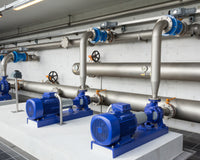

Calculating the hourly energy consumption of a water pump is essential for reliably assessing a system’s operating costs. Whether you are designing a new home installation, selecting a circulation pump for central heating, or verifying the efficiency of an existing hydrodynamic system, precise calculations will help you avoid overpaying for electricity and choose a device with optimal parameters. In this article, we will guide you through the entire process: from basic formulas and factors affecting annual energy consumption to the specifics of individual pump types from Dambat’s range—IBO and IPRO brands.
Energy fundamentals – what is the power drawn by a pump?
Every electric pump draws electrical energy from the grid, expressed in watts (W) or kilowatts (kW). The calculation result is the kWh of energy consumption by the pump over a given period. This input power is not the same as hydraulic (useful) power—the difference between them is described by the pump efficiency (η), defined as the ratio of hydraulic power to electrical power drawn from the grid. For typical water pumps, efficiency ranges from 30–80%, depending on the device class, its operating point, and its degree of wear.
Energy consumption expressed in kWh of electrical energy is calculated using a simple formula (the result is kWh of energy consumption drawn from the grid):
where: E – energy drawn from the grid, P – power drawn by the pump (from the nameplate), t – operating time in hours
Example: a circulation pump with a power rating of P = 0.09 kW (90 W), operating for 12 hours a day, will consume daily: E = 0.09 kW × 12 h = 1.08 kWh of electrical energy. Over a month (30 days), this amounts to approximately 32.4 kWh, and annually—nearly 395 kWh. This is already a significant item on the electricity bill.
Rated power versus actual electricity consumption
The manufacturer states the rated power (or input power) on the nameplate, corresponding to operation at full load. In practice, installers should remember that the actual power consumption depends on the pump’s operating point on the Q-H curve. When the pump operates at a lower flow rate or higher pressure than the rated values, its power may be higher or lower than declared.
The inverter (variable-frequency drive) plays an important role here. Inverters from the Dambat range enable smooth adjustment of the rotor speed, adapting power consumption to the instantaneous flow demand. In practice, this can reduce energy consumption by as much as 30–50% compared with systems operating at a constant speed. This is particularly important in installations where flow varies—for example, in the water supply systems of small buildings or domestic hot water circulation systems.
Hourly and daily formula—sample table of IBO/IPRO pump powers
Below, we present approximate data for selected pump types from the Dambat portfolio. The operating time is illustrative and should be adjusted to the actual operating schedule.
| Pump type | Rated power [kW] | kWh / h | kWh / day (8 h) | Annual energy consumption (3,650 h) |
|---|---|---|---|---|
| IBO energy-efficient circulation pump (class A) | 0,05–0,15 | 0,05–0,15 | 0,40–1,20 | 183–548 kWh |
| IBO domestic hot water circulation pump | 0,03–0,08 | 0,03–0,08 | 0,24–0,64 | 110–292 kWh |
| IBO surface pump (domestic) | 0,37–0,75 | 0,37–0,75 | 2,96–6,00 | 1350–2738 kWh |
| IPRO 4" submersible pump | 0,37–2,20 | 0,37–2,20 | 2,96–17,60 | 1350–8030 kWh |
| IBO submersible pump (for dirty water) | 0,37–1,10 | 0,37–1,10 | 2,96–8,80 | 1350–4015 kWh |
| IPRO 6" submersible pump | 2,20–11,0 | 2,20–11,0 | 17,60–88,0 | 8030–40,150 kWh |
The data in the table above is approximate. Detailed parameters for each device can be found in the product data sheets available at dambat.pl – catalogs for download.
Seasonal energy consumption—why does the operating schedule matter?
Annual and seasonal electricity consumption by a pump rarely results solely from multiplying its power by 8,760 hours. In reality, central heating circulation pumps operate mainly during the heating season (approx. 1,800–2,400 h/year in Poland), domestic hot water circulation pumps may operate around the clock with interruptions controlled by the controller, while submersible pumps operate intermittently—only when water outlets are opened or the pressure tank is being filled.
Therefore, seasonal energy consumption is calculated separately for each operating period. Professionally, this is done using the degree-hour method or based on a detailed energy analysis of the building. Seasonal formula:
where f_load – actual load factor (typically 0.5–0.9 for central heating circulation pumps)
For circulation pumps in energy class A (EEI ≤ 0.23), seasonal power consumption is typically 50–70% lower than that of conventional pumps with asynchronous motors. For installers and designers, this is a key argument when selecting equipment—both to meet ErP standards and to deliver tangible benefits for the investor.
EEI, energy classes, and the Ep indicator – what do the numbers tell us?
The European ErP (Energy-related Products) directive required manufacturers to label the energy efficiency of circulation pumps using the EEI (Energy Efficiency Index). The lower the EEI, the more energy-efficient the pump. Since 2015, only pumps with an EEI ≤ 0.23 may be offered on the market. In practice, modern circulation pumps with EC motors (electronically commutated motors) achieve an EEI below 0.15.
The Ep indicator (the indicator of demand for non-renewable primary energy), expressed in kWh/(m²·year), is equally important in the context of a building’s energy performance. It describes how much energy from non-renewable sources is needed to cover the building’s annual needs for heating, ventilation, cooling, and DHW preparation. The lower this value, the better—the building meets the requirements of the WT 2021 technical conditions, which set a limit of ≤ 70 kWh/(m²·year) for new single-family homes.
An energy-efficient circulation pump directly affects the calculated Ep indicator. Using an energy-saving IBO class A pump can reduce this value by several points—which in practice may determine whether the building achieves energy class A or B. This also applies to the building’s heat demand, expressed in kWh/(m²·year), which serves as the basis for determining the Ep indicator.
Building energy demand – how does the pump fit into the balance?
The building demand for electricity is the sum of the demand of all devices: lighting, household appliances, HVAC systems, and pumps. In a typical single-family building, the demand for thermal energy is covered by a boiler, heat pump, or electric heating, while circulation and circulation pumps are auxiliary devices whose consumption is often omitted in simplified analyses.
Meanwhile, in buildings with extensive systems (e.g. underfloor heating + DHW + radiator heating), the total building demand for electricity to power the pumps may exceed 600–900 kWh/year. This is comparable to the annual consumption of a washing machine or dishwasher. Precise calculations are therefore necessary both when designing the system and when verifying operating costs.
It is also worth considering the building’s energy efficiency as a whole. Thermal insulation of the building directly affects the length of the heating season and, consequently, the operating time of circulation pumps. Good insulation shortens pump operating time, reducing seasonal energy consumption and the actual electricity bill. On the other hand, better-insulated buildings enable the use of a low-temperature system (e.g. underfloor heating at 35/28°C), which significantly reduces the thermal energy demand generated by the heat source.
Heat pump COP and annual electricity consumption
In heat pump systems, electricity consumption by the water pump (circulation or deep-well) must be analyzed in the context of COP (Coefficient Of Performance) – the heat pump’s energy efficiency coefficient. COP (Coefficient Of Performance) specifies how many units of thermal energy the device delivers for each unit of electricity consumed. Typical COP values are 3.0–5.0 for ground-source heat pumps and 2.5–4.5 for air-source heat pumps.
However, the COP provided by the manufacturer applies only to the heat pump unit itself. Annual energy consumption for the entire system also includes: the circulation pump in the primary circuit (glycol/brine), the pump in the secondary circuit (central heating), the domestic hot water circulation pump, controllers, and valves. Total auxiliary electricity consumption may amount to 400–900 kWh, which can reduce the system’s actual SCOP (Seasonal COP) by 0.2–0.5 points compared with the catalog value.
That is why selecting energy-efficient auxiliary pumps – such as the IBO range of energy-efficient circulation pumps – has a real impact on the overall energy balance of a heating system. In systems with low-temperature system applications (underfloor heating, fan coils), pumps can be set to lower pressure and flow parameters, further reducing power consumption and the system’s operating costs.
Average annual consumption and energy efficiency – how can they be measured and improved?
Average annual consumption of energy by a pumping system is calculated as the sum of seasonal energy consumption, increased by standby-mode consumption (for controllers and electric valves). Measurements can be taken using energy meters installed directly in the distribution board or by using built-in meters available in modern controllers and inverters.
Building energy efficiency in the context of pumping systems is improved primarily by:
- Selecting a pump for the actual operating point – avoiding oversizing, which leads to operation with valve throttling and energy loss.
- Using an inverter – smooth speed control eliminates unnecessary power consumption when flow demand varies. Dambat inverters are compatible with IBO and IPRO submersible and surface pumps.
- Regular maintenance – limescale deposits and corrosion increase flow resistance, resulting in higher energy consumption at the same hydraulic output.
- Thermal insulation of pipelines – limiting heat loss from joints and straight sections reduces the building’s heat demand and shortens circulation pump operating times.
- Controllers with daily schedules – limiting pump operation to the actual hours of demand reduces seasonal electricity consumption without compromising comfort.
The Dambat website offers an energy savings calculator that allows you to quickly compare the electricity consumption of an old and a new circulation pump. It is a useful tool for presenting the cost-effectiveness of replacing the equipment to the end customer.
Energy audit and pump selection – what should an installer know?
An energy audit of a building is a formal analysis of energy consumption, completed with recommendations for thermal modernization. One element of the audit is an assessment of pumping systems – both from a technical and an energy perspective. The installer or designer working with the auditor should provide data on:
- the types and power ratings of the installed pumps.
- the operating schedule of the equipment (h/year).
- the actual operating point in the system (Q and H).
- the energy efficiency class of circulation pumps (EEI).
- the control measures used (inverter, controller, valves).
Based on this data, the audit analysis makes it possible to precisely calculate the annual energy consumption of the pumping system and identify specific savings resulting from replacing the equipment with newer models. It is worth taking advantage of the capabilities offered by Dambat controllers and automation systems – they record operating times and alarms, making it easier to collect data for analysis.
Filters, valves, and pressure gauges – the impact of equipment on the energy balance
The pump itself is only one element of the installation. Filters, valves and pressure gauges affect flow resistance and therefore indirectly affect the energy consumed by the pump. A clogged filter causes an additional pressure drop that the pump must overcome – resulting in higher energy consumption at the same water flow rate. Regularly replacing filter cartridges is therefore not only a matter of water quality but also of the system’s energy efficiency. A building’s energy efficiency starts with attention to every installation component – not only insulation and windows, but also plumbing equipment.
Pressure gauges installed on the pump’s suction and discharge sides enable continuous monitoring of the operating point and early detection of filter fouling or impeller wear. Dambat pressure gauges are available in various pressure ranges and accuracy classes – choose one suitable for the installation’s operating pressure. In turn, check valves and backflow prevention valves protect the pump against the medium flowing backward, preventing hydraulic shocks and extending the service life of mechanical seals.
Selecting a pump for an installation – practical tips for installers
Correct pump selection requires knowledge of several key installation parameters:
- Required flow rate (Q) [m³/h or l/s] – resulting from heat demand, the number of water outlets or well yield.
- Required head (H) [m of liquid column] – the sum of linear and local losses in the pipeline plus the geometric difference in levels.
- Medium temperature – central heating circulation pumps must be suitable for the temperature of the heating medium (up to 110°C for most IBO models).
- Protection class and resistance to the medium – for clean water, contaminated water or wastewater.
- Required energy class – particularly important for low-energy and passive buildings, where the Ep indicator must not exceed statutory limits.
Dambat’s offer includes complete IBO, IBO ITALY and IPRO pumps – from 30 W circulation pumps, through multistage submersible pumps up to 11 kW, to industrial units exceeding 15 kW. You can select the pump yourself using the calculators available at dambat.pl, or contact the manufacturer’s technical department.
IPRO submersible pumps – electricity consumption in well water intake systems
IPRO deep-well pumps in the 4", 6", and 8" series are designed for continuous operation when pumping water from drilled wells. Their annual energy consumption depends on the well yield, the depth of the water table, the length of the pipe column, and the operating flow rate. For a small household (Q = 1–2 m³/h, H = 40–60 m), a typical 4" IPRO pump rated at 0.55–0.75 kW will operate intermittently – approximately 500–1000 h/year in total, resulting in annual energy consumption of around 275–750 kWh.
In sets with a variable-frequency drive (e.g. Dambat sets with a variable-frequency drive), the pump operates smoothly, maintaining constant pressure without hydraulic shocks. This means not only lower power consumption, but also longer service life for the pipe column, fittings, and valves. Well-industry installers are familiar with the problem of the so-called “water hammer” – a variable-frequency drive effectively eliminates it, especially at greater installation depths.
Circulating and circulation pumps – energy classes and EEI
Energy-efficient IBO circulating pumps from the ECM (Electronic Commutation Motor) series meet and exceed the requirements of the ErP 622/2012 regulation. They have an EEI below 0.20, while the best models achieve an EEI of < 0.15. For installers, this means that the average annual energy consumption of a circulating pump can be limited to 50–150 kWh/year – many times less than in older models with asynchronous motors.
Domestic hot water circulation pumps are a separate category. Their purpose is to maintain continuous circulation of domestic hot water in circulation pipes, eliminating the need to wait for hot water at the taps. Although these devices have low power ratings (15–50 W), they usually operate around the clock or according to a schedule, and their annual electricity consumption may amount to 130–440 kWh/year. Using a controller with a timer and temperature sensor makes it possible to reduce operating time and achieve a real 30–40% reduction in energy consumption.
You can find a detailed selection of IBO circulation and circulating pumps on the dambat.pl – circulating pumps and accessories website.
Summary – how do you calculate a pump's hourly electricity consumption in practice?
The hourly electricity consumption of a water pump is the product of its rated power (or actual power consumption) and operating time. However, a complete analysis also includes: the operating point on the Q-H curve, hydraulic and mechanical efficiency, the effect of the fluid temperature, the condition of filters and valves, and, in systems with a variable-frequency drive, the load profile over time. On this basis, you can determine annual energy consumption, include it in the building's energy performance calculation, and assess whether replacing the device is cost-effective.
Accurate analysis helps improve the building’s overall energy efficiency. Dambat supplies not only high-quality IBO and IPRO pumps, but also calculation tools, technical catalogs, and technical department support. Use the resources available at dambat.pl to select a pump that is optimal both hydraulically and energetically—and enjoy an installation that operates efficiently for years.
FAQ – Frequently asked questions from installers and specialists
How do you calculate the kWh of energy consumed by a submersible pump per hour?
The formula is simple: E [kWh] = P [kW] × t [h]. Example: an IPRO 4" submersible pump with a power rating of P = 0.75 kW operating for 1 hour will consume 0.75 kWh of electrical energy. Assuming intermittent operation (approximately 2 h/day), daily energy consumption will be 1.5 kWh. Always use the power listed on the nameplate or in the technical data sheet—not hydraulic power or shaft power, as these values are lower than the actual power drawn from the grid.
What is the Ep indicator, and how does a pump affect its value?
The Ep indicator (the primary energy indicator) measures demand for non-renewable primary energy and is expressed in kWh/(m²·year). WT 2021 regulations set a limit of Ep ≤ 70 kWh/(m²·year) for new single-family homes. Energy-intensive pumps—especially low-efficiency circulation pumps—increase the Ep indicator. Replacing one with an energy-efficient IBO pump with an EEI < 0.20 can reduce this indicator by 2–5 kWh/(m²·year), which can be decisive in helping a building achieve energy class A or B.
What is the seasonal electricity consumption of a domestic hot water circulation pump?
A 25 W domestic hot water circulation pump operating 16 h/day for 365 days will consume 0.025 kW × 16 h × 365 = 146 kWh/year, or 146 kWh of electrical energy. Using a controller with a schedule (for example, only in the morning and evening, for a total of 6 h/day) will reduce consumption to approximately 55 kWh/year—savings of up to 60%. IBO circulation pumps with a built-in timer and temperature sensor do this automatically, without additional equipment.
Does a variable frequency drive really reduce a pump’s energy consumption?
Yes—and significantly. The power consumed by a pump is proportional to the third power of its rotational speed (the affinity law). This means that reducing the rotational speed by 20% cuts power consumption by approximately 49%. In practice, in systems with variable flow demand, a variable frequency drive can achieve 30–55% lower energy consumption compared with a pump operating at a constant speed with flow throttled by a valve. Dambat variable frequency drives are available as dedicated modules for IBO and IPRO submersible pumps.
How does a building’s thermal insulation affect the operation of circulation pumps?
Thermal insulation of the building directly shortens the heating season—in a well-insulated passive building, it lasts approximately 1,200–1,600 hours per year, while in old, uninsulated buildings it can last as long as 3,500 hours per year. With the same 100 W circulator pump, the difference in annual energy consumption is: 100 W × (3,500–1,400) h = 210 kWh/year. In addition, better insulation makes it possible to use a low-temperature installation and select a pump with lower pressure parameters, further reducing power consumption.
What does a heat pump’s COP mean, and how should it be included in calculations?
COP (Coefficient Of Performance) is the ratio of the heat energy produced to the electrical energy consumed. A COP of 4.0 means that for every 1 kWh of electricity consumed, the heat pump supplies 4 kWh of heat. When calculating the system’s annual energy consumption with a heat pump, we take SCOP (seasonal COP) into account, which is an average value for the entire heating season. Auxiliary energy must also be included in the balance: circulator pumps, controllers, and valves—which realistically reduces system efficiency by 5–15%.
How does an energy audit help with pump selection?
An energy audit provides data on the building’s actual heat demand and the electricity consumption of auxiliary systems. Based on this information, the installer can precisely select a circulator pump to meet the required hydraulic parameters (Q and H), calculate the expected annual energy consumption, and identify the savings resulting from replacing the equipment. An oversized or undersized pump always means higher energy consumption and faster mechanical wear.
Which pump parameters should be entered in the building’s energy performance certificate?
The building’s energy performance certificate (ŚE) includes the electrical power of circulator and circulation pumps, as well as their estimated operating time during the season. For Class A circulator pumps with an EEI < 0.20, the nominal power specified in the product data sheet and the seasonal operating time indicated in the installation design are used. The Ep indicator calculated on this basis must comply with the WT 2021 requirements. Dambat controllers record operating time and alarms, making it easier to retrospectively verify the calculation assumptions.
Does lower energy consumption result in a shorter payback period for a new pump?
Yes. A simple example: an old 80 W circulator pump versus a new energy-efficient 25 W IBO pump. The difference in power consumption is 55 W. With a heating season of 3,000 hours per year, the lower energy consumption is 55 W × 3,000 h = 165 kWh/year. At an energy price of PLN 0.80/kWh, the savings amount to PLN 132/year. A new energy-efficient IBO pump costs approximately PLN 400–700, so the investment will pay for itself within 3–5 years. The average annual energy consumption of a Class A pump is up to four times lower than that of older models.