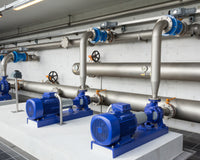

Every property owner wants using their property to be comfortable while also allowing them to save money. Solutions are therefore sought that are effective and, at the same time, inexpensive to operate. This applies to many elements affecting a building’s energy efficiency, including its installations. In this article, you will learn how a circulation pump can improve the energy efficiency of an installation.
A circulation pump is a device used to circulate liquid in installations. It is used in central heating systems and other heating systems, as well as in air conditioning systems. This makes it possible to maintain the efficiency and performance of the entire system. Using a circulation pump allows the entire installation to be laid out more effectively, as it makes it possible to use pipes with a smaller diameter and route them more freely. Shortening the pipes that make up the installation and reducing their diameter results in lower inertia. All of this directly translates into faster circulation of the heating or cooling medium, leading to significantly more efficient operation of the entire installation.
In addition, modern circulation pumps are electronically controlled devices. A suitably selected controller analyses the parameters of the installation and adjusts the device’s operation accordingly. As a result, both the pump’s output and torque are fully adapted to the installation’s demand, allowing for maximum energy savings. Lower energy consumption is also possible thanks to a potentiometer, which enables stepless adjustment of the pump’s output and head.
A circulation pump can significantly improve the energy efficiency of an installation, provided that it is properly selected for the type of equipment. For this reason, it is best to seek advice from a reputable seller, who can help choose a pump that meets specific requirements.