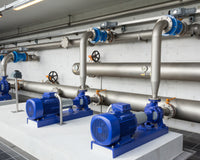
Efficient farm operations depend on many factors. Whether we are dealing with crop fields or livestock farming, all of this requires large amounts of water. For this purpose, it is best to use your own water sources, which allows for significant savings. However, to make this convenient, it is necessary to use suitable pumps. We explain how to choose a water pump for a farm.
Farms have substantial water needs. It is therefore difficult to imagine drawing water from the mains, as this would require enormous financial outlays. Consequently, the vast majority of farmers use their own water sources—wells or bodies of water. Fast and convenient water extraction is therefore extremely important to them, and this is provided by surface and submersible pumps.
Surface Pumps
Surface pumps are devices used to pump water from your own water sources, suitable for immersion depths of no more than 7 meters. They can therefore be used to draw water from shallow wells or ponds. One of their major advantages is that they do not need to be filled with water before operation. They are therefore extremely convenient to use, as they can be installed anywhere—both below the water surface and outside the water. They can be used to supply water to agricultural land, industrial plants, and service facilities. Surface pumps are therefore suitable for farms that draw water from shallower sources. The only thing to remember is to choose devices with higher output, as this will enable more efficient operation.
Submersible Pumps
Submersible pumps are used to extract clean water from depths exceeding 8 meters. Their greatest advantage is their ability to generate high pressure, which translates into highly efficient operation. They are ideal for farms with high water demand. They can draw water from both deep wells and bodies of water. However, to meet the required water demand, they must be selected individually according to specific needs. For this purpose, it is worth considering several factors, the most important from a farm's perspective being the pumping head and water demand.
The pumping head determines the pressure the pump must generate without taking losses into account. It is therefore the difference between the highest-located liquid outlet and the water level. To select the appropriate pump power, this value must be determined precisely. Water demand is equally important. To establish it, consider the number and type of water outlets, as well as the required pressure. Only then will it be possible to select a pump with the required capacity. In addition, the source capacity must be determined so that a pump with parameters exceeding the source's maximum capacity is not installed.
Surface and submersible pumps are the best choice for farms, as they enable water to be supplied efficiently and quickly. However, to ensure fully effective operation, first determine your water demand and the terrain conditions, then select a pump with the appropriate power and capacity.