A winter evening, a gale outside, and suddenly the lights go out throughout the house. Along with them, the boiler and circulation pump fall silent. With a gas boiler, this may not be a major problem, as only the radiators cool down. With a coal- or wood-fired boiler, the situation is completely different: there are still hot embers in the firebox, while the water stops circulating.
The good news is that the boiler and pump require little electricity to operate, so they can be protected without a major investment. All you need is a backup power supply (UPS) with a battery that automatically takes over the power supply when the voltage fails and keeps the heating running for several or even a dozen or so hours. Choosing a UPS with the right parameters is crucial. We explain how to select the entire setup below.
Table of contents
- What are the benefits of backup power for a furnace and pump?
- Backup power supply (UPS), inverter, or generator?
- How much power does a C.O. pump and boiler consume?
- How many hours will the battery last?
- Fixed phase: why does a gas boiler shut down on backup power?
- Solid-fuel boiler without power: risk of overheating
- Frequently asked questions
What are the benefits of backup power for a furnace and pump?
Backup power is primarily about keeping the home warm when the grid fails, and in the case of a solid-fuel boiler, it also provides genuine safety. The main benefits include:
- the heating continues to operate despite a failure, because the boiler and pump do not switch off when the power goes out,
- a solid-fuel boiler is safer, because the pump continues to remove heat from it,
- the system is protected against freezing for longer during a power outage,
- the boiler does not shut down with an error during operation and does not need to be restarted.
Backup power supply (UPS), inverter, or generator?
Before choosing a solution, it is worth understanding one concept on which the entire selection depends: pure sine wave. The voltage in a socket changes smoothly, drawing a smooth wave on a graph - a sine wave. Cheaper inverters and some power supplies produce only a simplified version of it, the so-called stepped waveform (modified sine wave), in which the voltage changes in steps.
It makes no difference for a light bulb, but the motor of a circulation pump powered by a stepped waveform hums, heats up more, and wears out faster, while the boiler’s electronics may operate unstably. These symptoms can easily be confused with the faults described in the article on symptoms of circulation pump malfunction. Therefore, regardless of the solution chosen, the pump and boiler must be powered exclusively by a device with a pure sine wave.
Backup power supply (UPS) with a battery
The backup power supply constantly stands by between the mains and the boiler. When the voltage disappears, it switches to the battery within a fraction of a second, and when power returns, it automatically recharges it. This is the most convenient solution for homes with gas, oil, or pellet boilers.
- Advantages: automatic switching without household members' involvement, battery charging, and continuous protection for the boiler and pump.
- Disadvantages: higher cost than an inverter, and operating time limited by the battery capacity.
- What to look out for: pure sine wave, a fixed phase for a gas boiler, and the ability to charge a high-capacity battery.
Inverter with a battery
An inverter converts the battery's 12 V voltage to 230 V, but it does not switch automatically or charge the battery. It works as an emergency solution, mainly for powering the pump itself.
- Advantages: low price and simple construction.
- Disadvantages: manual switching, often at night and in the dark, and separate battery charging.
- What to look out for: a pure sine wave model only.
Generator
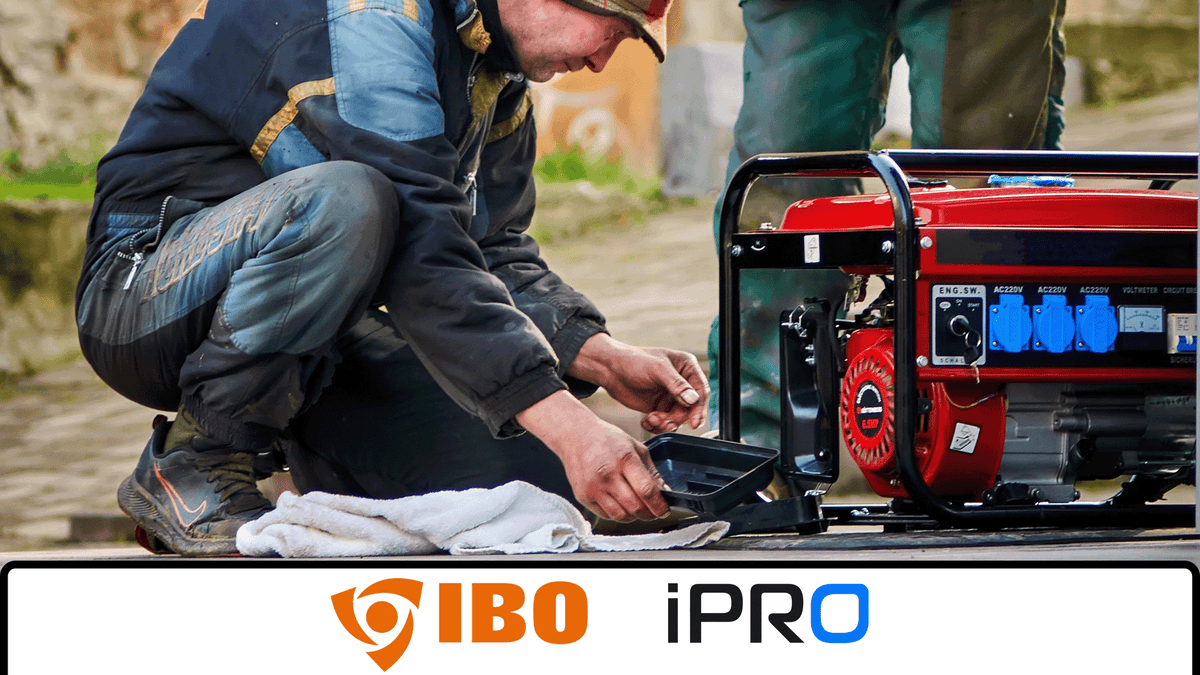
A generator produces electricity from fuel, so it is the only option that provides power for many hours or even days. It makes sense during lengthy outages or where power interruptions occur frequently.
- Advantages: virtually unlimited operating time and the ability to power the entire house.
- Disadvantages: manual start-up, noise, and the need to install a switch in the distribution board.
- What to look out for: voltage stability and the neutral conductor's reference point, which is important for a gas boiler.
Never connect a generator to the home's electrical installation through a wall socket. This could result in electric shock to household members and grid workers, so it must be connected exclusively through a switch in the distribution board, installed by an electrician. A generator must always operate outdoors because its exhaust fumes contain carbon monoxide.
How much power does a C.O. pump and boiler consume?
Power consumption is where the entire selection process begins, as it determines the battery size and operating time. An electronic circulation pump consumes very little, for example, the OHI C.O. 25-60/180 pump by IBO consumes between 5 and 45 W, depending on the setting.
| Device | Operating consumption | Notes |
|---|---|---|
| Electronic pump | From several to several dozen W | Depends on the setting, low starting current |
| Three-speed pump | Several dozen W | Constant consumption, higher starting current |
| Gas boiler | From several dozen to approximately 150 W, depending on the model | The consumption usually includes the boiler's built-in pump, so it is not added separately |
| Pellet boiler | Several dozen W, several hundred W during ignition | Choose the power supply capacity based on the ignition load |
You can find the values for your devices on their rating plates or measure them with a plug-in wattmeter. Every watt saved means longer battery operation, which is why energy-efficient circulation pumps with low power consumption are ideal for use with backup power. Proper pump settings also help; we discuss them in the article about circulation pump operating modes.
How many hours will the battery last?
You can easily estimate the battery operating time yourself:
operating time [h] = voltage [V] × capacity [Ah] × discharge × efficiency / consumption [W]
- Voltage and capacity can be read from the battery, e.g. 12 V and 100 Ah.
- Discharge of a lead-acid battery should not exceed half, so enter 0.5.
- Efficiency accounts for losses in the power supply; it is safe to assume 0.85.
- Consumption is the total consumption of the boiler, pump, and the power supply itself, which usually uses several to a dozen or so W.
| Load | 12 V 50 Ah battery | 12 V 100 Ah battery |
|---|---|---|
| Electronic pump approx. 20 W | approx. 8.5 h | approx. 17 h |
| Pump approx. 45 W | approx. 4.5 h | approx. 9 h |
| Gas boiler approx. 50 W | approx. 4 h | approx. 8.5 h |
| Gas boiler approx. 150 W | approx. 1.5 h | approx. 3 h |
Choose a battery designed for cyclic operation, such as an AGM or gel battery. A car battery quickly loses capacity after deep discharge. Also check whether the power supply can handle a large battery, because charging can take a very long time if it is too weak.
Fixed phase: why does a gas boiler shut down on backup power?
A gas boiler has an additional power supply requirement. Its ionization electrode monitors the flame, and its measurement is reliable only when the neutral conductor (N) is at earth potential and has not been swapped with the phase conductor (L). If the power supply output is isolated from earth, the boiler's control system does not detect the flame: the burner ignites, goes out after a few seconds, and the boiler reports a flame failure.
The solution is a backup power supply designed for boilers, with a fixed phase, meaning the neutral conductor is connected to the protective conductor (PE), and a properly grounded socket.
If the boiler shuts down when running on backup power, call an electrician instead of modifying plugs or sockets yourself. An electrician can also install a generator transfer switch and a permanent connection for the backup power supply.
Solid-fuel boiler without power: risk of overheating
A coal- or wood-fired boiler does not switch off when the power goes out: the firebox continues to release heat while the pump stops. If the installation has neither a gravity circulation system nor thermal protection, the water in the boiler may boil. An emergency power supply for the pump and controller significantly reduces this risk, but it does not replace the boiler safety devices required in its manual.
Remember that with this type of boiler, the pump often operates in a return protection group with a thermostatic valve, so the emergency power supply must also cover it and the controller.
If the boiler still overheats:
- close the air supply to the firebox,
- do not add more fuel,
- open the radiator valves so that the installation can dissipate heat,
- do not add cold water to the installation,
- do not pour water over the boiler or touch hot components.
If the water in the boiler is boiling, leave the boiler room and call for help. Before restarting, bleed the central heating pump. The circulation pump has water-lubricated bearings, so an air pocket in its housing acts similarly to a lack of water and accelerates bearing wear, as described in our guide to protecting a pump against dry running.
Frequently asked questions
How do you connect an emergency power supply to a central heating boiler?
Connect the boiler and pump to the power supply's pure sine wave output, and in the case of a gas boiler, with a fixed live conductor. A permanent connection in the boiler circuit must be installed by an electrician.
What power rating should an emergency power supply for a boiler have?
At least the combined power consumption of the boiler and pumps, with a margin for startup. Runtime is determined by the battery capacity, not the power supply's wattage.
How many hours will a central heating pump run on a 100 Ah battery?
Approx. 17 hours for an electronic pump consuming approx. 20 W, with discharge to 50% and the power supply's consumption taken into account. The actual runtime depends on the pump setting and the power supply's efficiency.
Is a car power inverter suitable for a central heating pump?
Yes, but only with a pure sine wave and as a temporary solution. It does not switch over automatically or charge the battery.
Can a generator be connected to a socket to power the boiler?
No. Do not connect the generator to a wall socket, because the electricity will then flow into the entire installation and the grid. Power the household installation only through a switch in the distribution board installed by an electrician.
Dambat - a trusted manufacturer of pumps and hydrotechnical equipment with quality certifications.