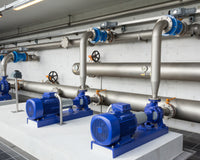

Circulation pumps are one of the most important components of a modern heating system. Generally speaking, their main task is to circulate liquid through the heating system, thereby improving the efficiency of the system. However, many people wonder whether using a circulation pump is necessary. If so, in what situations? And what should you pay attention to? We discuss this topic in our article.
Circulation pump—when should it be used?
A circulation pump is a solution to many problems that previously had no answer. For example, in older systems, the process of heating rooms was based on the natural buoyancy resulting from the difference in density between hot and cold water. However, this operation involved numerous limitations related, among other things, to the specific design of the entire system. The methods used previously also involved:
- the need to position the boiler lower than the radiators,
- the need to select pipes with relatively large diameters,
- the need to arrange the pipes appropriately to limit flow resistance.
The solution to the problems mentioned above, and at the same time a method adapted to customers' growing expectations, was the use of circulation pumps. Why? Their use eliminates the most common difficulties, such as poor heating and uneven heat distribution. A pump ensures excellent efficiency, even when our system has been designed incorrectly or carelessly. Using a high-quality circulation pump also helps solve the problem of pipes becoming clogged with limescale and, consequently, the reduction in their flow capacity, which is characteristic of older systems.
One device or two?
Depending on our needs, we can use one or two separate devices to increase the efficiency of our heating system. The final decision should depend primarily on the size and complexity of the entire system. In single-family homes, one properly selected circulation pump may be sufficient. However, if we own a building with both radiators and other heat sources, such as underfloor heating, additional support in the form of two pumps is recommended.
It is also worth adding that in strategic facilities where an interruption in the heat supply cannot occur, the use of so-called dual systems is recommended. This means creating a system consisting of a primary pump and a backup pump.
What are the benefits of using circulation pumps?
Using circulation pumps offers numerous advantages. Some of them include:
- high efficiency, which means greater savings and lower heating costs,
- no need to plan radiators vertically or maintain a minimum distance from the boiler,
- the possibility of expanding the heating system more flexibly,
- the possibility of using modern thermostatic valves,
- exceptionally easy temperature control in all rooms,
- faster and more even heating of radiators and, consequently, rooms,
- high efficiency, quiet operation, and reliability confirmed by user reviews,
a sense of comfort.