The heating season in Poland usually begins around the turn of September and October, when it gets cold for several days in a row and the heating system resumes operation after its summer break. This is when all the neglect from the previous year becomes apparent: air in the radiators, low pressure, and a seized pump. Instead of waiting for a problem to appear during the first frost, it is worth spending an hour calmly inspecting the system. In this guide, we go through it step by step, from things you can do yourself to those for which it is better to seek professional help.
When does the heating season begin in Poland?
There is no single fixed date for the heating season in Poland. Its beginning depends on weather conditions, and in practice it is generally accepted that heating should be turned on when the average temperature over a 24-hour period remains below approximately 10 degrees for several consecutive days. In buildings connected to a district heating network, a threshold close to 12 degrees is usually applied. Formally, the concept of the heating season is defined by the regulation on the operation of district heating systems, but for the owner of a single-family home, a simple rule matters: the first prolonged cold spell is a signal that the system should resume operation.
Why is it worth inspecting the system before it gets really cold? Because most faults reveal themselves precisely when the system is first switched on, when everyone turns on the heating at once. This is also when heating technicians are busiest and appointments take the longest to arrange. An hour spent calmly checking everything in September can save you stress in November.
Check the system pressure
Pressure is the first thing worth checking, because a drop in pressure is behind most autumn heating problems. In a typical single-family home, the pressure gauge on a cold system should show approximately 1 to 1.5 bar. This value increases with the height of the heated building—roughly by 0.1 bar for every meter of height up to the highest radiator.
You will usually find the pressure gauge on or next to the boiler. If the needle is clearly below the normal range, the system needs to be topped up with water. If the pressure rises sharply every time the system heats up and drops after it cools down, the cause is usually the expansion vessel, which we discuss in the next section.
What you can do yourself: read the pressure gauge and top up the water to the correct level. When to call a professional: if the pressure keeps dropping despite topping up the water—this usually indicates a leak that needs to be located. We describe the symptoms, causes, and safe water top-up procedure separately in our guide on what to do when there is not enough water in the system.
Check the expansion vessel
The expansion vessel is a tank that absorbs the increase in water volume as it heats up and maintains stable pressure throughout the circuit. When it loses pressure in its air cushion, the system stops stabilizing properly, and the symptoms are characteristic: the pressure gauge needle jumps whenever the system heats up, and the safety valve begins to drip. This is the element most often overlooked during an autumn inspection, even though it is very frequently the source of pressure problems.
The expansion vessel should ideally be checked once a year, before the season begins. Measuring its pressure and, if necessary, pumping it up requires isolating the tank from the system and draining the water from it; otherwise, the reading will be unreliable. We describe the full procedure, the correct pressure values for buildings of different heights, and how to recognize a damaged diaphragm step by step in a separate guide on how to inflate an expansion vessel in C.H. and D.H.W. systems. If you are choosing a tank or wondering about its capacity, the article how to choose an expansion vessel will help you make the decision.
Start the circulation pump after the summer shutdown
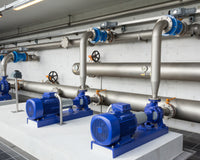
The circulation pump is the component most likely to stop working after several months of inactivity. It remains stationary throughout the summer, and sediment and tiny magnetite particles from the system can block its impeller. The result can be misleading: the boiler heats up, everything looks fine on the pressure gauge, yet the radiators remain cold because the water is not circulating. Sometimes the pump is completely silent; at other times it hums but cannot start the impeller.
How can you tell whether the problem is with the pump? Place your hand on it while the heating is running. A properly operating pump vibrates slightly and is warm, while the pipe immediately after it gradually heats up. If the pump makes no sound and is cold, or hums clearly while the circuit still does not start, this may indicate a seized impeller. It is worth knowing that a lack of circulation is not always caused by the pump itself: sometimes the culprit is a blocked check valve that mimics a pump failure.
What you can do yourself: check whether the pump has power and whether it is set to the correct speed. When to call a professional: if the pump has power but still does not work, it is better to leave unlocking the impeller or carrying out a more detailed diagnosis to an installer. Interfering with the device itself without knowing its construction may damage it. Good preventive maintenance for the future is to run the pump briefly from time to time outside the heating season as well. Many modern pumps and controllers have a built-in periodic start-up function that does this automatically and protects the impeller from seizing. We explain how a circulation pump operates in a system and what to consider when choosing one in the article on how a C.H. circulation pump works.
Bleed the radiators and the pump
You can identify air in the system by a radiator that is cold at the top but warm at the bottom. This is the opposite of sludge buildup, where the lower part of the radiator is cold. Air collects at the highest points of the system and blocks the flow, preventing the radiator from delivering its full output, while gurgling can be heard in the pipes.
Before you begin, turn off or slow down the circulation pump so that the water settles and air bubbles do not circulate through the system. If you have several radiators, it is usually convenient to start on the ground floor and work upward, although the order also depends on the type of system. After bleeding the radiators, the system pressure will drop, so check the pressure gauge at the end and top up the water. You can find detailed instructions, including how to bleed different types of radiators, in the guide on how to bleed a radiator step by step.
Check whether the system is clogged with sludge
If a radiator is cold at the bottom despite being bled, the pump operates noisily, and individual radiators heat unevenly, the most likely cause is sludge buildup. Magnetite, a black deposit formed by the corrosion of steel, accumulates inside the system. It circulates with the water, settles in the radiators, and is drawn into the pump, gradually reducing the efficiency of the entire system.
This is a step in the inspection that you will usually not be able to carry out yourself. Effective removal of the deposit requires flushing, often with chemicals, using a flushing pump, and this is a task for an installer. It is worth commissioning this work if the symptoms persist despite bleeding the radiators and topping up the water. We describe what this process involves, the methods used, and when it is necessary in a separate article on flushing a C.H. system.
Open the thermostatic valves after summer
This is a simple but often overlooked step that can save you from an unnecessary service call. The thermostatic head—the numbered knob on the radiator—is usually turned off throughout the summer. If the valve pin beneath the head does not move for several months, it may seize because of sediment and fail to return to the open position, even when you turn the head to the maximum setting. The symptom can be misleading: the radiator remains cold even though everything appears to be set correctly.
That is why, before the season begins, it is worth turning all the heads fully open and checking whether the pin moves freely. You can see a metal pin at the bottom of the head. Once the head is removed, it should press in easily and return on its own. If it remains stuck, it has seized. When to call a professional: if the pin does not return on its own, because attempting to force it free may damage the valve.
The boiler and chimney: what is actually mandatory?
It is best to schedule boiler servicing before the season begins. For many appliances, especially gas boilers, an annual service is required to maintain the manufacturer’s warranty, and it must be carried out by a technician with the appropriate qualifications.
It is also worth knowing what is a genuine legal obligation and what is simply good practice. The Construction Law requires annual inspections of gas installations and chimney flues, meaning smoke, exhaust, and ventilation flues. This obligation rests with the building owner, including the owner of a single-family home, and the inspection itself must be carried out by an authorized specialist; in the case of chimneys, this is a chimney sweep. The central heating system itself is different. Radiators, the pump, the expansion vessel, and system pressure are not subject to a separate statutory obligation for periodic inspection. Carrying out such an inspection before the season is a matter of common sense and system durability, but for your own safety it is worth treating it just as seriously.
Neglect in this area may only become noticeable later. The lack of a current chimney or gas inspection report may matter, for example, when settling an insurance claim, so it is best to obtain detailed information from an authorized chimney sweep or the company servicing your boiler.
How to avoid losing heat during the season
An efficient system is one thing, but some heat escapes for reasons that can be easily limited with little effort. Several simple habits can genuinely reduce the load on your heating system:
- Do not cover the radiators. Furniture pushed up against a radiator, built-in covers, and long curtains extending behind the radiator can noticeably limit the transfer of heat into the room. Estimates suggest that covering a radiator can result in heat losses of as much as 15–20 percent. Simply leave enough open space around it.
- Consider installing a radiator reflector. A mat with a reflective layer, placed behind the radiator on a cold external wall, directs heat into the room instead of allowing it to warm the wall. This is mainly useful when the wall is poorly insulated.
- Seal windows and doors, but do not block ventilation. Replacing worn seals limits the uncontrolled inflow of cold air. Remember, however, not to cover ventilation grilles or air inlets, because effective ventilation is essential, especially with gas boilers.
- Ventilate briefly and intensively. Instead of leaving a window tilted open for hours, open it wide for a few minutes. The air will be replaced quickly, while the walls and radiators will not have time to cool down as much as they would with prolonged ventilation. It is worth turning down the radiator while airing the room.
- Lower the temperature where possible. It is estimated that lowering the room temperature by one degree results, roughly, in several percent less energy consumption. In rooms that are used less frequently or at night, this makes a real difference to the bill.
Frequently asked questions
When does the heating season begin in Poland?
The heating season has no fixed date. It is generally accepted that heating should be turned on when the average daily temperature remains below approximately 10 degrees for several consecutive days. In practice, this usually occurs around the turn of September and October, while buildings connected to a district heating network use a threshold close to 12 degrees.
What pressure should there be in a home C.H. system?
In a typical single-family home, the pressure gauge on a cold system should indicate approximately 1 to 1.5 bar. The higher the building, the slightly higher the pressure should be—roughly by 0.1 bar for every meter of height up to the highest radiator. The pre-charge pressure in the expansion vessel is set separately and is lower.
Why is the radiator not heating even though the boiler is working?
The most common causes are air in the radiator, a seized circulation pump, sludge buildup, or a seized thermostatic valve pin. The radiator itself indicates the likely direction of the diagnosis: cold at the top means air, while cold at the bottom means sediment. If all radiators are cold even though the boiler is operating, check whether the circulation pump is running and whether the system pressure is correct.
What should I do if the circulation pump does not start after the summer?
After months of inactivity, the pump impeller can seize. First, check whether the pump has power and is set to the correct speed. If it does not operate despite having power, is silent and cold, or hums loudly, it is better to leave unlocking the impeller and diagnosing the problem to an installer, because interfering with the device without knowing its construction may damage it.
Is inspection of a C.H. system mandatory?
The central heating system itself is not subject to a separate statutory requirement for periodic inspection. However, the gas installation and chimney flues are subject to mandatory annual inspections, and this obligation rests with the building owner, including the owner of a single-family home. Inspecting the C.H. system before the season is good practice that prevents failures and extends the system’s service life.
What position should thermostatic heads be set to during the summer?
During the summer break, when the heating is not operating at all, it is worth turning the heads to the maximum setting. If the valve remains in one position for months, its pin may seize because of sediment and fail to return to fully open when the season starts. This is not about heating, since the boiler is switched off anyway, but about preventing the pin from becoming stuck in the closed position. It also helps to move the valve periodically by fully opening and closing it from time to time.
Dambat—a trusted manufacturer of pumps and hydrotechnical equipment with quality certificates.