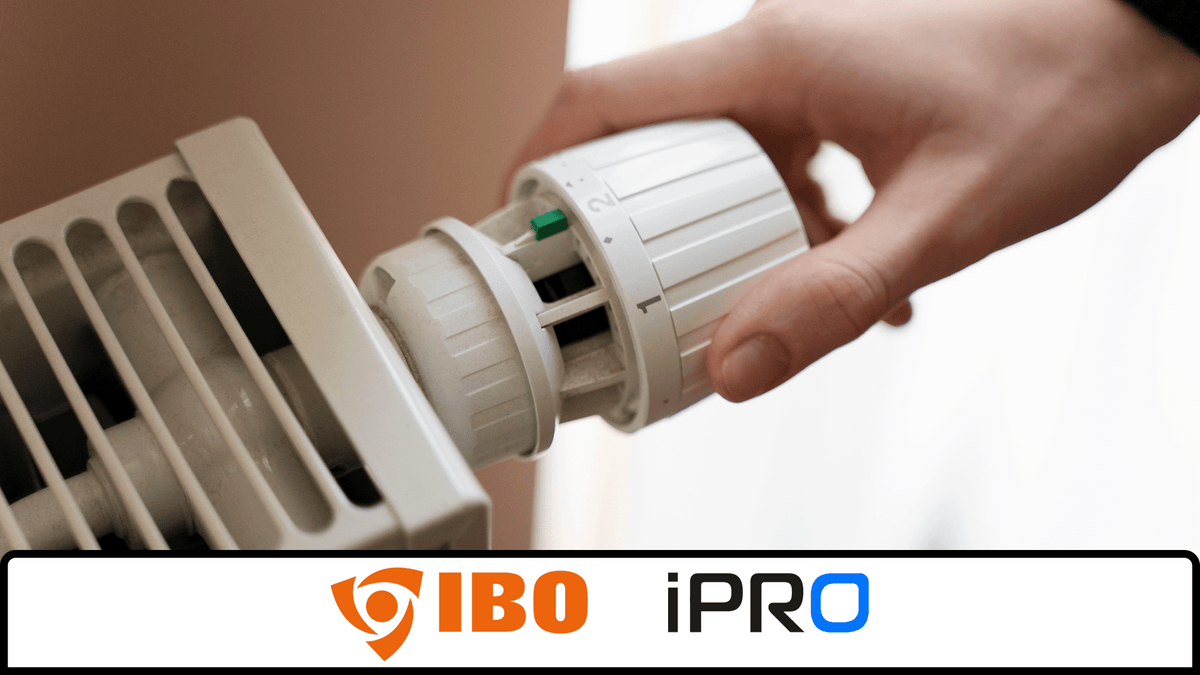
To bleed a radiator, simply open the bleed valve with a radiator key or screwdriver, wait until water starts flowing out instead of hissing air, and then close the valve. This seemingly simple procedure usually takes a few minutes and does not require shutting down the entire boiler or draining the central heating system — however, carrying it out without prior preparation and proper safety precautions can lead to serious consequences. In this article, we explain how to identify an air-locked radiator, which tools you need, what to watch out for during the procedure, and how to safely bleed cast-iron, aluminum, panel, bathroom, and trench radiators. A guide written from the perspective of the manufacturer of pumps and heating equipment for the IBO and IPRO brands.
Symptoms of air in a radiator
The most common sign that a radiator needs bleeding is uneven heating — the radiator is cold at the top and warm at the bottom because air, being lighter than water, collects along the upper edge of the body and blocks the flow of heating medium there. It can also happen that the radiator behaves in exactly the opposite way — cold at the bottom — which usually indicates air in the lower branch of a ladder or trench radiator, where air settles in a different part of the system than in a conventional panel radiator.
- Cold areas or patches on the radiator surface despite the system operating.
- Gurgling and air bubbles audible at the bleed valve or inside the body.
- A noisier circulation pump that starts more frequently — trapped air increases flow resistance.
- Uneven heating of radiators throughout the room despite the thermostatic valves being set correctly.
An air-locked radiator is not the same as too little water in the entire central heating system — if all radiators are cold at once and the pressure gauge shows a clear drop in pressure, it is worth checking separately how to distinguish a lack of water from air in the system and safely top up the water in the central heating system.
Causes of air in a radiator
Air in a radiator most often comes from filling or topping up the system with mains water—some of the air dissolved in the water is released as the temperature rises and travels to the highest points of the system, usually the upper chamber of the radiator. Air can also enter the system after maintenance work, such as removing a radiator or replacing a valve, and when the automatic air vent on the radiator or riser is damaged or clogged. It is worth remembering that in systems frequently topped up with water, the problem may recur—we describe this phenomenon in more detail in the full guide to bleeding a pump and the entire central heating system, which covers bleeding at the circulation pump and manifold, rather than a single radiator.
Why it is worth bleeding radiators regularly
An airlocked radiator heats less effectively, resulting in specific, measurable effects—not just thermal discomfort.
- Lower heating efficiency—air insulates part of the radiator's surface, so it releases less heat while the boiler consumes the same amount of energy.
- Higher heating bills—to compensate for poorer heating, the system operates for longer or at a higher supply temperature.
- Additional strain on the circulation pump—the accumulated air increases flow resistance, so the pump operates more intensively and noisily.
- Uneven thermal comfort in the room—part of the radiator is cold while another part is warm, making it difficult to maintain a constant room temperature.
How to prepare for bleeding a radiator
Before you start bleeding the radiator, it is worth preparing a few simple tools—in most household systems, they are sufficient to carry out the entire procedure safely and quickly.
- Radiator bleed key or wrench—suitable for the square stem of a typical manual valve.
- Flat-head screwdriver—to use with older valves that have a slot instead of a square stem.
- Small container—to catch the water flowing out together with the air.
- Cloth—to wipe the valve and the area around the radiator after completing the procedure.
You can find a complete range of valves and installation accessories for central heating systems in our Dambat heating equipment selection.
How to bleed a radiator—step-by-step instructions
The procedure below provides general guidelines for bleeding radiators—it applies to typical radiator air-bleed valves and works in both one-pipe and two-pipe systems.
- If possible, switch off or mute the circulation pump for the duration of the procedure—this will reduce water splashing.
- Place a cloth or a small container under the air-bleed valve.
- Unscrew the air-bleed valve using a wrench, key, or screwdriver—carefully and slowly, by just under one full turn.
- Wait until the hissing air stops and a continuous stream of water without bubbles begins to flow.
- Close the valve, wipe the area around the radiator, and check the pressure on the gauge—if it has dropped significantly, top up the water according to the system manufacturer's instructions.
This procedure allows you to bleed the radiator more quickly without risking air entering neighboring units in the system. Afterward, it is worth checking the system pressure with a pressure gauge right away, as bleeding always involves a small loss of water.
What to watch out for when bleeding a radiator
Bleeding is simple, but a few careless movements can result in scalding, flooding, or damage to the system. Before you begin, pay attention to the following hazards.
- Opening the valve too quickly and fully on a hot, operating system—this may cause hot water to spray out and result in scalding; it is best to unscrew the valve slowly, by less than one turn.
- Failing to place a cloth or container underneath—it is easy to flood the floor, carpet, or furniture next to the radiator.
- Using the wrong tool for a corroded valve, such as a screwdriver that is too small—increasing the risk of rounding off the slot and having to replace the entire valve.
- Keeping the valve open for too long or bleeding multiple radiators in succession without checking the pressure gauge—excessive water loss can cause the circulation pump to run dry and become damaged.
- Carelessly unscrewing the cover of an automatic air vent valve under pressure—it may shoot off; automatic air vents require different handling than manual valves.
- Bleeding too often “just in case” and refilling with fresh mains water—oxygenated water can, over time, contribute to internal corrosion of radiators and pipes.
Types of air vent valves
Radiators are fitted with different types of air vent valves, depending on the age of the system and the design solutions used.
- Manual screwdriver-operated valve — the oldest type, requiring a flathead screwdriver.
- Manual key-operated valve — with a square stem, opened using a dedicated key.
- Manual valve with a knob — opened by hand, without tools.
- Automatic air vent valve — releases accumulated air on its own and works well in hard-to-reach places, such as on system risers or beneath the floor.
Sometimes an older radiator does not have any air vent valve—in such a situation, do not improvise your own methods of releasing air. The proper solution is to have a valve installed by a professional, selected according to the type and age of the radiator.
Bleeding different types of radiators
The bleeding procedure itself is similar for every type of radiator, but it is worth knowing a few design differences that make it easier to locate the valve and speed up the entire process.
Cast-iron radiator
In older cast-iron sectional radiators, commonly called cast-iron radiators, the bleed valve is usually located at the end of the last section. Because such a radiator has a greater water capacity, bleeding may require waiting slightly longer for a continuous stream of water without air.
Aluminium radiator
Aluminium radiators have a lighter construction and respond more quickly to changes in water temperature. The bleed valve is most often located near the supply connection, in the upper corner of the radiator.
Panel radiator
This is the most popular type of radiator in residential buildings. The bleed valve is usually installed in the upper corner, opposite the heating supply connection.
Bathroom radiator (towel radiator)
In towel radiators installed vertically, the bleed valve is usually located at the top of one of the vertical tubes. In dual-function (water-electric) versions, the bleeding procedure applies only to the water circuit.
Trench radiator
Trench radiators installed in the floor or a window recess often have limited access to the valve—before bleeding, you usually need to remove the radiator grille or cover.
When bleeding is not enough
If a radiator becomes airlocked regularly despite being properly bled, this indicates a deeper problem in the system rather than with the radiator itself. The most common causes include a minor leak allowing air into the system, an incorrectly selected diaphragm expansion vessel that is not operating properly during the system’s heating and cooling cycles, and—in larger systems—the lack of an air separator installed directly in the heating circuit. If you suspect that a recurring airlock is caused by the expansion vessel, check how to correctly select a diaphragm expansion vessel for a central heating system. If the pressure dropped noticeably after bleeding the radiator, we explain step by step how to safely top up the water in a central heating system. It is also worth remembering that recurring airlocks place additional strain on the circulation pump, increasing flow resistance and the risk of noisier operation. We discuss preparing the entire heating system for the heating season in greater detail in a separate guide.
Dambat—a trusted manufacturer of pumps and hydrotechnical equipment with quality certifications.
Frequently asked questions (FAQ)—how to bleed a radiator?
What is radiator bleeding, and when should it be done?
Bleeding a radiator means removing the air accumulated in its upper part by opening the air vent valve until water starts flowing out. This should be done when the radiator heats unevenly or remains cold despite the central heating system operating.
What is the difference between a radiator with trapped air and a lack of water in the system?
A radiator with trapped air is usually cold in only one part—either the top or the bottom—whereas radiators that are completely cold throughout the system, combined with low pressure on the pressure gauge, indicate a lack of water in the system rather than trapped air alone.
Does every radiator have an air vent valve?
Most modern panel and bathroom radiators have a factory-fitted air vent valve. Older cast-iron radiators sometimes do not have one—in that case, we recommend having a valve installed by a heating professional instead of using improvised bleeding methods.
How often do radiators need bleeding?
In a properly functioning system, radiators usually need bleeding once per heating season, most often when it starts. If the problem recurs more often, this is a sign that it is worth checking the system’s tightness or the operation of the expansion vessel.
Should an automatic air vent valve be tightened or loosened?
The top cap of an automatic air vent should be unscrewed by just under one turn—air is automatically released from the system through this gap. Tightening the cap completely blocks the mechanism, and the radiator stops bleeding itself automatically.
Where can I buy heating equipment for central heating systems from the IBO and IPRO brands?
As a manufacturer, we do not sell directly. Heating equipment for central heating systems from the IBO and IPRO brands is available from our sales partners and plumbing wholesalers.
Does bleeding lower the pressure in the central heating system?
Yes—bleeding always involves a small loss of water and a drop in pressure. Afterward, it is worth checking the pressure gauge and, if necessary, safely topping up the water in the central heating system.