
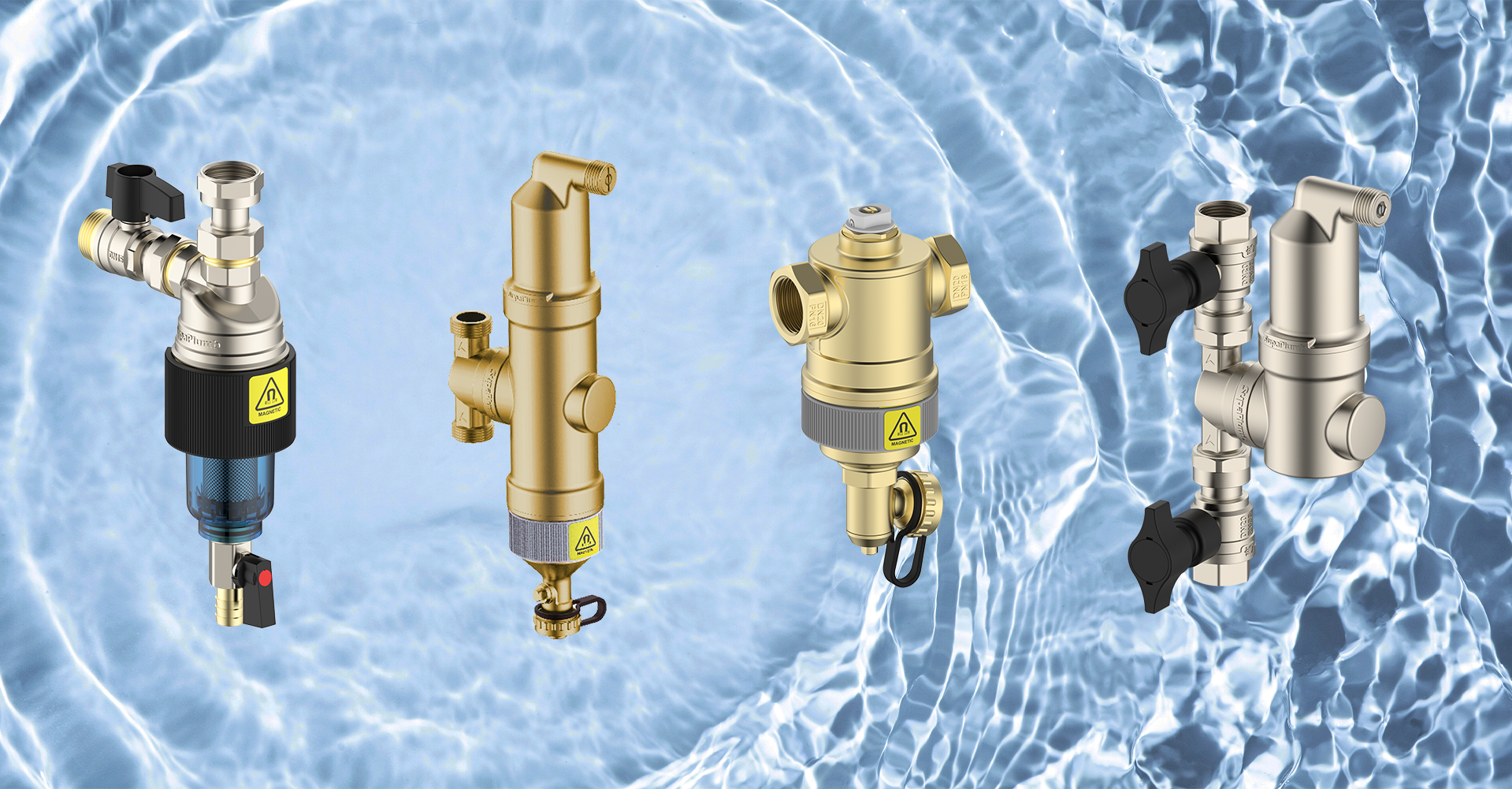
Magnetic filters for central heating are components that significantly extend the service life of heating systems by protecting them against harmful contaminants, such as iron oxides, which are the main component of rust. Iron oxides are formed as a result of corrosion of metal components in the system and then circulate through it, accumulating in various parts. Installing magnetic filters prevents these particles from settling, protecting the system against reduced efficiency and extending its service life.
How magnetic filters work
Magnetic filters work by capturing iron oxide particles and other contaminants that may be present in the heating medium. They are particularly effective in systems where the heating medium is a water and glycol solution (with a glycol content of up to 50%). These filters can also be used in cooling and solar systems, where they additionally capture contaminants such as sand. These systems use dual filtration, which enables the effective removal of both magnetic and non-magnetic particles.
The key component of a magnetic filter is a 9000 Gauss magnet, which separates magnetite and other ferromagnetic contaminants. Non-magnetic contaminants are captured by an additional filter element in the form of a mesh or sleeve. This design ensures effective filtration without disrupting the flow of the heating medium.
Installing magnetic filters
The magnetic filter should be installed in accordance with the manufacturer's guidelines and the specific characteristics of the heating system. Magnetic filters are usually installed on the return line before the boiler, at least 1 meter from the boiler, to effectively protect the system against contaminants. Installation should be carried out after shutting down the system, draining the water, and properly preparing the installation location.
During installation, shut-off valves and the gaskets supplied with the filter should be fitted. It is important that the direction of flow of the heating medium corresponds to the arrows on the filter housing. Once installation is complete, make sure that all connections are tight, then start the system and bleed the magnetic filter.
Why use magnetic filters?
Using magnetic filters in central heating systems offers a range of benefits. Above all, these filters protect boilers, pumps, and heat exchangers against contaminants that may cause them to fail. As a result, the system operates more efficiently, which translates into lower operating costs and a longer service life for individual components.
Thanks to dual filtration, magnetic filters effectively remove both magnetic and non-magnetic contaminants, such as sand. Regular filter maintenance, including cleaning and emptying, ensures uninterrupted system operation without the risk of sudden drops in efficiency.
Types of magnetic filters
Several types of magnetic filters are available on the market, differing in their technical specifications and applications. The most commonly used models, such as I-001 and I-002, can be installed in both vertical and horizontal positions, while model I-003 is designed exclusively for vertical installation. The choice of the appropriate filter depends on the specific characteristics of the system and the available installation space.
Maintaining magnetic filters
For a magnetic filter to perform its function effectively over a long period, regular maintenance is essential. The filter chamber should be emptied regularly of accumulated contaminants using the drain valve. Regular maintenance not only ensures optimal system operation but also extends the service life of the filter itself.