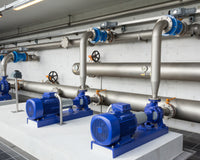
Water in an excavation does not wait. If groundwater inflow outpaces the progress of earthworks, the schedule ceases to matter and the cost of downtime increases with every hour. As a pump manufacturer since 1999, we know this scenario firsthand—which is why our company, Dambat, has developed a separate line of equipment intended exclusively for operation in abrasive media. Dewatering pumps are not ordinary submersible pumps with an added label. They are designs in which the hydraulics, mechanical seal, and cooling system have been engineered for one scenario: pumping dirty water containing sand, silt, and mineral suspension continuously for many hours.
In this article, we show how the individual series in our range differ, which parameters actually determine the selection, and where the boundary lies between pumps for clean water and equipment for sludge. If you are simply looking for a reliable dirty water pump for a construction site, you will find here all the criteria worth checking before ordering. You can find the full range in the dewatering and excavation pumps category.
What is the difference between a sludge pump and an ordinary submersible pump?
The difference lies not in capacity, but in what the pump can pass through without losing service life. Classic submersible dewatering pumps, used for basement drainage, operate in water containing a small amount of suspended solids. When the medium contains quartz sand, clay, or drilling spoil, standard hydraulics made of ordinary cast iron wear out within a few dozen hours of operation—the impeller loses its geometry, axial clearance increases, and performance declines.
A sludge pump addresses this with three design solutions. First, the impeller is coated with a heavy-duty, wear-resistant chromium alloy layer or made of ductile iron with increased abrasion resistance. Second, the mechanical seal uses a SiC/graphite or SiC/SiC configuration that is resistant to operating in a pressurized suspension. Third, the motor is surrounded by a cooling jacket, which we discuss below. The result is that dewatering submersible pumps can operate where an ordinary submersible sewage pump would last only one season.
It is worth distinguishing the categories as early as the inquiry stage. If you are interested in a medium containing solid particles of domestic origin, the right choice is septic tank pumps and pumping stations, not dewatering equipment. We discuss this distinction in greater detail in the article what is the difference between a submersible pump and a grinder pump.
Dewatering, submersible, and slurry pumps—let's clarify the terminology
In quotation requests, the same device is sometimes described in five different ways, which regularly leads to misunderstandings during selection. Below, we organize the terms used by installers, designers, and earthwork contractors.
- Dewatering pumps—the broadest term, covering any device used to lower the water level in a work area, regardless of its design.
- Submersible drainage pumps—a subcategory that operates in the medium, meaning immersed in the pumped liquid. The term submersible refers to the installation method, not the hydraulic system's durability.
- Submersible dewatering pumps—in practice, a synonym for the above; in our documentation, we use the term submersible because it corresponds to standard terminology and the IP68 protection rating.
- Submersible slurry pumps—a narrower group designed for abrasive media: sand, silt, and mineral suspension. These are used in excavations, mines, and quarries.
- Submersible sewage pump—a separate design adapted to fibrous and solid particles of domestic origin, with a completely different impeller geometry.
The practical conclusion is that a submersible dewatering pump and a dewatering submersible pump are exactly the same device described with the words in a different order, whereas a submersible sewage pump is a different product category. Distinguishing between these terms at the inquiry stage saves both parties time and, at the same time, protects against selecting equipment that will not survive its first week on the construction site. Both pumping water out of an excavation and draining water from the area around foundations are carried out with devices from the same family—the difference lies in the operating time and the degree of contamination of the medium.
Cooling jacket—the parameter that determines excavation dewatering
This is the most frequently overlooked feature when purchasing, yet the most important one in construction practice. In an excavation, the water level drops while the pump is running—and that is, after all, the purpose of the entire operation. A device without a cooling jacket requires full immersion because the motor dissipates heat directly into the medium. When the water level falls below the motor housing, the thermal protection switches off the pump, and dewatering comes to a halt.
In our designs, the motor is surrounded by a jacket through which the pumped liquid flows forcibly and removes heat. As a result, the submersible drainage pump can operate partially submerged and lower the water level to very low levels: the KBFU 25-0,45 model pumps water down to 3 mm, while the KBFU 50-0,45 pumps it down to 60 mm. For the contractor, this means there is no need to finish the job with a diaphragm pump or manually remove the remaining water from the bottom.
Note the exceptions: not every model in the range has a cooling jacket. For example, KBFU INOX 50-0,75 M operates without a cooling jacket and pumps water down to a level of 90 mm – in return, it offers an AISI 316 stainless steel housing and shaft, meaning resistance to media with increased acidity. This is a deliberate compromise, not missing equipment.
Drainage pump series in the Dambat range
In the drainage category, we offer two IBO product families with several design variants within them – from compact single-phase models to heavy-duty submersible sludge pumps at 400 V. Below are the differences that really matter when selecting a model.
KBFU – the cast-iron base of the series, from 0.45 to 7.5 kW
The most widely used family and at the same time the most popular drainage pumps from IBO. The hydraulic unit is made of cast iron, the impeller is coated with a highly wear-resistant chromium alloy layer, the motor housing is made of stainless steel, the shaft and rotor are made of AISI 304, and the bearings are NSK. These are versatile pumps within the drainage category itself: the power range covers models from 0.45 kW at 230 V to 7.5 kW at 400 V, with discharge outlets from 1" to 4", allowing one family to handle both a residential excavation and large pumps for draining industrial sites. The top-of-the-range KBFU 100-7,5 achieves a head of up to 40 m – the maximum pumping height in the entire series, useful for long horizontal pipelines and deep excavations without staging.
This family also includes versions with an agitator. The chromium-alloy mixer installed beneath the impeller puts the sediment into a swirling motion and breaks up suspension clusters at the inlet. The KBFU 80-4-4.0P T goes a step further: its four-pole motor operates at 1,450 rpm instead of 2,850, handles particles up to 30 mm, and manages medium densities of up to 1,200 kg/m³ and pH 5–9. Lower speed means less stress on the drive system and longer bearing life during continuous operation—a typical choice for drilling companies working with bentonite and geotechnical contractors.
KBFU AUTO – automation without an external control cabinet
AUTO versions use a level sensor built into the control system instead of a float switch. The design is enclosed, so it cannot be blocked by a float wedged against formwork or a protective pipe—a common problem in cramped chambers. These models are equipped with an agitator and a SiC-SiC / SiC-SiC double mechanical seal. The largest model in the series, KBFU AUTO 100-3,7, delivers 1,550 l/min through a DN 4" connection and handles particles up to 10 mm. This solution is intended for permanent installations—tunnel drainage systems, underground car parks, and process pumping stations—where the pump is expected to operate for seasons without operator supervision.
IBX – compact stainless-steel construction
The IBX series takes a different approach to materials. The body and motor housing are made of AISI 304 stainless steel, while the shaft is made of AISI 420SS—a harder, more wear-resistant steel, which matters when it is in constant contact with sand. The impeller is semi-open, made of ductile iron coated with a heavy-duty wear-resistant layer. Operating parameters: IP68 protection rating, 2,850 rpm, medium temperature up to 40°C, density up to 1,200 kg/m³, immersion depth up to 7 m, permissible contaminants up to 8 mm, 10 m power cable.
The IBX 80-1.5 version is a single-phase pump operating at 230 V with a built-in float switch—it is suitable for smaller construction sites and for draining flooded garages or halls. It is a submersible pump designed to operate in water contaminated with abrasive materials, not for permanent pressure installations. The IBX AUTO 80-3.7 version is powered by 400 V and has a control and protection controller instead of a float switch. This is an important difference compared with the KBFU series and is the one installers most often ask about.
Series comparison table
| Series | Hydraulics | Particle passage | Control | Typical application |
|---|---|---|---|---|
| KBFU | Cast iron + heavy-duty wear-resistant coating (chromium alloy) | up to 7–10 mm, agitator versions up to 30 mm | With or without float switch | Excavations, construction sites, mines |
| KBFU INOX | AISI 316 stainless steel | up to 7 mm | Vertical float switch | Media with increased acidity |
| KBFU AUTO | Cast iron + agitator, SiC-SiC / SiC-SiC mechanical seal | up to 10 mm | Level sensor | Permanent installations, unattended operation |
| IBX | AISI 304, AISI 420SS shaft, semi-open impeller | up to 8 mm | Float switch or controller (AUTO) | Single-family construction, flooded buildings |
How to choose a drainage pump step by step
Selection comes down to five decisions made in a specific order. Reversing this order is the most common cause of complaints handled by our service department. Every submersible pump designed for drainage has a defined operating range, and exceeding it always results in a shorter service life.
- Medium characteristics. Determine the maximum solid-particle size and estimated density. If the medium contains bentonite or drilling spoil, go straight to models with an agitator. If it is clean rainwater or drainage water, lighter designs are sufficient. For an intermediate medium, namely water contaminated with a low concentration of sand, the expected operating time is decisive.
- Required flow rate. Estimate the inflow of groundwater into the excavation, not the volume of the excavation itself. The pump must keep up with the inflow, not empty the space just once.
- Head height including losses. Add pipeline and hose resistance to the difference in elevation. Our pressure and flow loss calculator and other installation converters are helpful. When selecting the diameter, the DN-to-inches converter is also useful.
- Power supply on site. Up to 1.5–2.2 kW, 230 V is usually sufficient; above that, choose 400 V versions. With a long cable on a construction site, voltage drop becomes critical – check what cable cross-section to choose for the given power.
- Operating mode. Occasional supervised operation calls for the version with a float. Continuous operation in a fixed installation calls for the AUTO version or a separate control and protection system.
Control, protection and discharge equipment
The pump itself is half of a dewatering installation. The other half determines whether it will last the season. We supply our dewatering pumps as devices ready for operation, but the discharge equipment and control system are selected for the specific site.
Level control. In versions with a float, the switch also serves as the basic protection against dry running. However, in a confined pit, the float needs freedom of movement – if there is not enough room, the AUTO version or an external float switch with a longer cable is a better choice. We describe the consequences of an error in the article about pump dry running.
Motor protection. All our dewatering pumps have thermal protection built into the motor winding, but with three-phase power it is worth adding protection against phase loss and phase imbalance. Manufacturer-supplied dewatering pumps have this component as standard, while mains protection remains the responsibility of the installation. The IPRO range includes PROTO-X series protection devices and IPC controllers for one or two pumps – details can be found in the guide to pump motor control and protection.
Discharge pipeline. The vertical outlet direction on our pumps allows you to connect a flexible hose using a hose clamp or quick coupling. For installations with several pumps, use manifolds and DN25–DN100 ball check valves available in the submersible pump accessories category. A check valve is always mandatory when the discharge hose runs upward—without it, the water column returns to the excavation every time the pump is switched off. Pressure gauges are used to monitor pressure in complex systems, while variable frequency drives regulating pump operating conditions are used with pumps powered by a fixed installation.
Drainage versus other pump categories—where the line is drawn
Not every water pumping task requires a sludge pump, although dirty water pumps are often instinctively purchased for everything. If the medium is lightly contaminated and the task is draining water from a basin or tank, a cheaper and lighter solution is a clean and lightly contaminated water pump from the IQX, IDL, or ISQ series. You can find them in the clean and lightly contaminated water pumps category. However, such a lightweight submersible pump will not withstand operation in sand—this is its natural limitation, not a defect. For removing water containing mineral suspended matter, we therefore return to sludge-pump designs.
Emergency situations—when volume is all that matters
In the event of flooding, a flooded hall, or a breached embankment, the priority shifts from hydraulic durability to the number of liters discharged per unit of time. We designed the SWQ PRO 1500 for such tasks—a single-phase 1.5 kW flood pump operating at 230 V, with a built-in float, a capacity of up to 1,400 l/min, and a DN 80 (3") discharge outlet. The polymer PPO multi-channel closed impeller allows soft particles up to 30 mm to pass freely, so the unit can handle floodwater containing fine organic matter without pre-filtering the medium. Its cast iron and steel construction, IP68 protection rating, continuous-duty operation, and 10 m cable with a plug allow the pump to be started on site without preparing a connection.
The application limit is clear here, however, and it is worth knowing before buying: SWQ PRO 1500 is designed for technically clean water and lightly contaminated water, not abrasive suspension. The polymer impeller will pass a twig or leaf, but constant contact with quartz sand will wear it out much faster than cast iron with a heavy-duty wear-resistant coating. In an excavation receiving groundwater carrying mineral particles, the KBFU and IBX series remain the right choice.
When the tank is shallow and the pump can be positioned beside it, surface pumps are an alternative. Surface pumps and self-priming pumps draw water from an intake located several metres lower, but they cannot handle mineral suspension and are sensitive to cavitation when the suction line is too long – we discuss this topic further in the article about cavitation in pumps. We have compiled the range in the surface pumps category.
It is also worth distinguishing dewatering equipment from well-pump designs. A submersible multistage pump in a deep-well configuration is used to extract water from a borehole at high pressure, but it does not tolerate sand in the quantities that submersible sludge pumps do. Where a submersible multistage pump is involved, we are talking about a water intake, not site dewatering. These are two different hydraulic philosophies, even though both operate while submerged.
A site without an electricity supply is a separate case. In that situation, petrol-driven pumps are a sensible choice, as described in the article about IBO petrol-driven pumps, available in the petrol-driven pumps category.
Five mistakes that cost the most
The situations below occur repeatedly on construction sites, regardless of how good the dewatering pumps used there are. Each one shortens the equipment's service life or directly blocks dewatering.
- Placing the pump on the bottom of the excavation. Even the best submersible dewatering pump will then suck up the coarsest sediment. Hang it on a rope a dozen or so centimetres above the bottom or place it on a slab – the impeller's service life increases many times over.
- Selecting solely by the catalog capacity. The stated capacity is given at zero head. In a real installation with 15 m of hose and an 8 m lift, you will obtain only a fraction of that value.
- A discharge hose that is too narrow. Reducing the diameter from 3" to 2" over several dozen meters can consume most of the available pressure reserve.
- Operating without a check valve. The reversing column of water causes the impeller to rotate backward at every start and accelerates mechanical seal wear.
- Ignoring the medium temperature. The permissible liquid temperature in these designs is usually 40°C. Process water may be warmer than assumed in the design.
Service, documentation, and selection support
As versatile-use pumps, our dewatering pumps are used in a wide range of installations—from a one-off excavation for a connection to permanent systems in industrial plants. That is why we make the technical documentation publicly available. You will find datasheets and manuals in the IBO manuals section, and complete specification tables in the downloadable catalogs. IBO products are covered by a 24-month manufacturer’s warranty; Dambat is the only authorized service provider. Wear parts—impellers, mechanical seals, and capacitors—can be ordered in the IBO spare parts section, while service requests are handled by our service department.
Regardless of whether the task is one-off pumping out water after a downpour or permanent water drainage around the foundations of a structure, a properly selected submersible drainage pump pays for itself with the first avoided downtime. If you are selecting equipment for a specific excavation and have doubts about the specifications, write to us. Provide the estimated inflow, excavation depth, discharge route length, and the nature of the medium—especially the proportion of contaminated water containing mineral particles—and we will use this information to recommend a model instead of referring you to a table. We have also compiled useful terms in the glossary of basic hydraulic terms.
FAQ—pumps for dewatering and excavations
Can a sludge pump operate in clean water?
Yes, the design does not impose any limitations here. The issue is economic: a submersible drainage pump with reinforced hydraulics costs more than typical clean water pumps, so if the sump contains clean rainwater, a light-duty submersible pump is entirely sufficient. The opposite is problematic—a device for clean water used in a medium containing sand will wear out very quickly. That is why we treat dirty water pumps and sludge pumps as separate product lines in the catalog.
What is the permissible size of contaminants in drainage pumps?
In standard models from the KBFU and IBX series, it is 7–8 mm; in versions with an agitator, 10 mm; and in the KBFU 80-4-4,0P T model with a four-pole motor, as much as 30 mm. We always provide the value for the specific model on its product page—all our drainage pumps have this parameter clearly specified.
Does the pump have to be completely submerged during operation?
Models with a cooling jacket—no. Liquid flows through the jacket and removes heat from the motor, so the device operates during partial submersion and reaches the minimum level specified in the technical data, in extreme cases as low as 3 mm. Models without a jacket, such as KBFU INOX 50-0,75 M, require a maintained level of 90 mm. In practice, the jacket is what determines whether a submersible drainage pump can complete the dewatering of an excavation.
Float-operated version or level-sensor version?
The float works well wherever it has freedom of movement— in a sump of sufficient diameter or in an open excavation. In tight spaces, around shoring and casing pipes, AUTO versions with a level sensor in a closed housing are a better solution. We explain more about the idea of level control itself in the article about the float switch pump.
What is an agitator, and when is it really necessary?
An agitator is a chrome-alloy mixer mounted beneath the impeller. It sets the sediment into a swirling motion, allowing the suspension to enter the hydraulics instead of settling on the bottom. It is useful for thick sludge, bentonite suspensions, and drilling spoil. For ordinary groundwater containing some sand, it is not necessary—standard KBFU series sludge pumps can handle the job without it.
230 V or 400 V on a construction site?
Up to approximately 1.5–2.2 kW, a single-phase pump operating at 230 V is available and can be started from any construction-site outlet. Above this power level, 400 V three-phase power is standard. For long cable runs on a construction site, calculate the voltage drop—an underestimated conductor cross-section is one of the most common causes of motor overheating.
Can these pumps be used for domestic sewage?
That is not what they are designed for. Drainage pumps are designed for mineral suspensions, not fibrous materials, which is why a submersible sewage pump has completely different flow-channel geometry. For domestic sewage, use sewage and septic tank pumps or complete sewage pumping stations, including versions with a macerator.
How can you pump water out of a flooded basement or garage quickly?
For removing water from flooded rooms, submersible drainage pumps and dewatering submersible pumps with a low residual water level are suitable—the lower it is, the less water will need to be removed manually. For larger floods, where capacity is the priority, the SWQ PRO 1500 flood pump, with a capacity of up to 1,400 l/min and a 30 mm free passage, is a good choice. We have compiled practical tips in our guide on basement flooding, while a broader overview of the category can be found in the article dirty water pumps – selection, types, and applications.