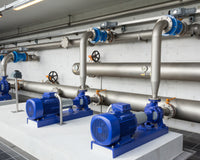

Various types of pumps used in households, agriculture, and many areas of industry make tasks involving pumping out water and supplying it to collection points much easier. However, to ensure trouble-free operation, they must be properly protected against dry running and overload, which could seriously damage them. We explain how to protect them against the risk of failure.
Why can dry running and overload be dangerous for pumps?
Dry running can occur in both deep-well and submersible pumps. There may be several causes, ranging from installing the pump too close to the water level, through a drop in that level, to selecting a device with excessive capacity for the well’s parameters. It is extremely dangerous because it is generally difficult to notice that it has occurred, and it may be too late to react. A pump running dry cannot cool its motor, which may cause the hydraulic components to seize and even seriously damage the control unit.
Overload is another equally dangerous phenomenon that can have similar consequences. It is most often caused by installing the pump too close to the bottom. This may result in sand and silt being sucked in, which in turn leads to faster wear of the pumping components and, consequently, dangerous overheating of the motor. Since both phenomena pose a threat to the pump, it is worth knowing how to prevent them.
The best ways to protect a pump
There are several ways to help protect a pump against dry running and overload. These include:
- proper pump installation - the pump should be installed at a depth such that the lowest dynamic water level (the water level established during continuous pumping with free discharge) is at least 2 m above the pump’s discharge connection. If the well’s capacity makes such installation impossible (the well has insufficient capacity in relation to the pump’s capacity), a valve that continuously limits the flow can be installed on the discharge pipeline, or a dry-running protection device can be installed to monitor the water level and, if dry running is likely to occur, cut off the power supply to the pump unit,
- installing pressure switches - this is a fairly simple solution designed to monitor pump operation and switch it off when the pressure drops,
- installing water-level sensors - these sensors are placed in the well and are designed to monitor the water level. When it falls to a specified level, they switch off the pump and switch it back on when the water returns to the proper depth,
- using modern control devices - a comprehensive solution is to use modern pump controllers. They protect and control the operation of deep-well, submersible, and surface pumps. They protect them against dry running, voltage drops, and overload,
- using a variable-frequency drive - this device provides comprehensive control of pump operation. One of its greatest advantages is that it guarantees constant pressure regardless of water consumption. Eliminating pressure surges, in turn, extends the service life of the pump and installation by preventing so-called water hammer. A pump equipped with a variable-frequency drive is effectively protected against overload, low and high voltage, phase loss and phase asymmetry, as well as dry running.
In conclusion, there are many ways to protect deep-well and submersible pumps against dry running and overload. It is certainly worth choosing at least one of them to ensure that the pumps operate reliably for many years.