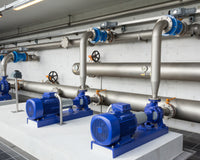

Submersible pumps are modern devices designed to extract clean water from great depths. They are most commonly used for wells deeper than 8 meters, as well as for water reservoirs. They operate extremely efficiently provided that they are properly selected for individual needs. Find out which 10 mistakes to avoid when choosing a submersible pump for your home.
The main advantages of a submersible pump
Submersible pumps are used in various irrigation systems, and their numerous advantages make them suitable for single-family homes as well as industrial plants and farms. They can successfully be used to supply water to pressure, irrigation, and water supply systems, and even to extract mineral or thermal water. Their most important feature is the ability to generate high pressure, which enables them to pump water effectively from great depths. What is more, they provide adequate pressure at all water outlets. They most often have a compact design, taking the form of an elongated cylinder containing a motor and a hydraulic system. However, to perform their functions properly, they must be selected individually.
How to choose a submersible pump for your individual needs?
A submersible pump is an efficient device with high operating efficiency. However, it is important to be aware that only a properly selected pump will perform its functions correctly.
The 10 mistakes to avoid when choosing one are:
- not measuring the water level - in practice, this means installing the pump in a well or water reservoir less than 8 meters deep. In such a situation, the pump will certainly not operate efficiently and may even fail,
- failing to analyze soil and water conditions - for the pump to operate properly, it is worth knowing the depth of the aquifer, whether there are significant fluctuations in the water level, and, above all, what the water quality is. This is particularly important if the water has a high sand content, as a pump with suitable parameters and reinforced construction will then be required,
- failing to match the pump to the well dimensions - it is extremely important that the pump diameter be smaller than the diameter of the casing pipe, which is part of a deep well. This will not only allow the device to be installed freely, but will also force water to flow around the pump and ensure better motor cooling,
- failing to match the pump to the well’s capacity - a pump that is too powerful for the well’s capacity may seize, while a pump that is too weak will not be able to pump the water properly,
- incorrectly determining the pumping height - the pumping height is the difference between the highest liquid outlet and the water level. Incorrectly determining this value is one of the most common mistakes when choosing a pump and causes it to fail to deliver water as expected,
- choosing the wrong power supply - submersible pumps are available with two power supply options: 230V or 400V. The first require a single-phase power supply and can therefore be connected to a standard socket. The latter operate on a three-phase power supply and therefore require a three-phase connection,
- incorrect pump capacity - pump capacity indicates how much water, in liters, a pump can transfer per minute or hour. Before choosing a device, it is worth carefully determining the water demand. To do so, consider the number and type of water outlets, as well as the required pressure. Only then will it be possible to select a pump with the appropriate capacity. Excessive capacity will generate unnecessary costs, while insufficient capacity will result in water pressure that is too low and, consequently, problems with the installation,
- incorrectly selecting the pump control system - a submersible pump can be controlled using various devices, such as a pressure tank with a pressure switch, a tankless automatic controller, or a frequency converter, commonly known as a “frequency inverter.” The controller should be selected according to the type of use,
- relying solely on motor power - motor power is not the only criterion determining pump capacity. Its hydraulic design is considerably more important,
- using the wrong type of pump - sometimes a pressure-booster pump is used instead of a submersible pump because the specific characteristics of the two devices are not understood and they are treated as interchangeable.
A submersible pump will operate fully efficiently only if it is selected individually. Before purchasing, it is worth carefully reviewing its technical specifications and adapting it both to your needs and to the conditions on your property.