For tap water to be fully comfortable to use, it must have the right pressure. Unfortunately, it sometimes happens that, due to various factors, its level is far too low. Read our guide to learn how to increase the water pressure in your home's plumbing system.
Causes of excessively low pressure
The pressure in a plumbing system is regulated by law and ranges from 0.5 to 6 bar. However, 4 bar is generally considered the optimal, sufficient pressure, which is why valves in home plumbing systems are most often set to this level. Sometimes, however, the pressure drops sharply, making it difficult to use the water. There may be several reasons for this.
First of all, check whether there is a leak in the system. It is also worth checking the valve settings, especially in new buildings. In older buildings, excessively low pressure may be caused by blocked pipes containing a large amount of limescale. It can also happen that the problem is caused by the water utility, so it is certainly worth reporting it. If all the causes listed above have been ruled out, you will need to deal with the problem yourself, which is possible by purchasing suitable equipment.
Hydrophore sets
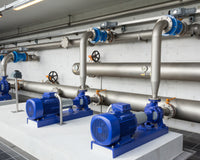
A device that effectively maintains the correct pressure in a plumbing system is a hydrophore. Since it is most often used together with a pump, the two are referred to as hydrophore sets. Generally, this is a small system that enables water to be transported from a well when there is no connection to the water supply network, while also maintaining constant pressure in the pipes. The pump's task is to increase the pressure of the water stored in the hydrophore. These devices are most commonly used in private buildings, but they can also be installed in municipal systems. A hydrophore is essential when water is drawn from a private well or when insufficient pressure at the connection point to the water supply network prevents water from reaching all outlets.
For the hydrophore and pump to perform their functions effectively, it is worth choosing them according to your specific needs, as individual models can differ significantly. The market offers both compact sets that can be placed in a kitchen cabinet and much larger units requiring installation in a separate room. To choose the right hydrophore set, you must first determine your water requirements. The greater the water consumption, the larger the tank should be and the more efficient the pump should be.
Proper water pressure provides users with greater comfort and also ensures the safety of the system. For this reason, its condition should be monitored and, if any irregularities occur, you should try to find the cause of the problem. Sometimes, purchasing a hydrophore set turns out to be the only effective solution.