Choosing the right pump for watering the garden depends primarily on two variables: the water source and the irrigation system’s requirements. An installer working with a deep well faces completely different challenges from one designing an installation based on a rainwater storage tank. In both cases, the key is to precisely match the equipment’s parameters to the actual operating conditions—before visiting the manufacturer’s website and clicking “add to cart.”
Well or rainwater—water sources and what they entail
At the design stage of a garden irrigation system, the first step is always to identify the water sources. Each source dictates a different pump type, different automation, and different filtration requirements. A private deep well is the most stable but also the most demanding source: the pump’s suspension depth, the water level, the well’s yield, and the water’s physicochemical composition (the presence of sand, iron, and manganese)—all of this must be examined before selecting the equipment. In the case of dug wells or low-yield boreholes, it is particularly important to ensure that water withdrawal does not exceed the source’s safe operating limits.
The situation is completely different when the installation uses rainwater collected in an underground or above-ground tank. In this case, the well’s yield is irrelevant, but other variables come into play: the tank’s fill level, water quality (biological contamination and suspended solids), the tank’s location relative to the draw-off zone, and the irrigation system’s pressure requirements. A rainwater pump must cope with a changing water level in the tank, often operates in start/stop mode, and should be equipped with pre-filtration. In open technical tanks, where the medium is of poorer quality, a dirty-water pump with suitable passage for solid contaminants may sometimes be necessary.
Key parameters that determine pump selection
To select a submersible or garden pump for a specific installation, the installer must work with precise figures—not estimates. The starting point is checking the well’s yield under dynamic conditions, that is, conducting a pumping test to show how quickly the water level drops at a specified draw-off rate. The difference between the static and dynamic water levels directly affects the required head and must be taken into account with an appropriate design margin.
The total head is a complex parameter: it is the sum of the pump suspension depth, the difference in elevation between the intake and the supply point, linear losses in the pipeline, and local losses in the fittings. For a typical garden with an automatic irrigation system using sprinklers delivering 3–4 bar of pressure at the manifold, the submersible pump pressure requirements are often higher than the investor assumes during the initial discussion. Therefore, hydraulic calculations must precede the model selection, not the other way around. The appropriate pump capacity is one that, at the operating point—not merely at the maximum point on the performance curve—covers the total demand of all irrigation sections operating simultaneously.
How to Select a Submersible Pump for a Drilled Well
When supplying a garden irrigation system from your own drilled well, a submersible pump from the IBO or IPRO brands manufactured by Dambat is the natural choice. Installing a submersible pump in a 4" or 3.5" diameter borehole requires careful matching of both the unit’s dimensions and its Q/H characteristic to the source parameters. A high-capacity submersible pump from the IPRO series, available among other options in an anti-sand version, is particularly suitable for wells where water quality may vary seasonally.
When selecting a pump for a well, the installer should remember several rules. First, the pump’s capacity at the operating point must not exceed the well’s stable yield; otherwise, the pump will run dry and become damaged. Second, the pressure at the outlet of the submersible pump must cover all hydraulic losses and the pressure requirements of the end devices, namely lawn sprinklers, misting nozzles, or drip lines. Third, when the irrigation system comprises several independent sections supplied sequentially or in parallel, it is worth considering extending the installation with a booster set featuring a diaphragm tank, which buffers the water pressure and reduces the number of submersible pump starts. Such a system ensures efficient garden watering without pressure surges and without the risk of excessively frequent motor start cycles.
For larger plots, where watering larger gardens requires several zones to be supplied simultaneously, a high-capacity submersible pump should be selected with a flow-rate reserve, and the entire system should be calculated for the maximum simultaneous water demand. The detailed technical data for IPRO pumps available from Dambat make it possible to precisely select a model suitable for a specific project.
Rainwater pump – selection and installation configuration
When the primary source is a rainwater tank, using a submersible well pump in the traditional sense of the term is not appropriate. Here, submersible pumps, submersible pressure pumps, and self-priming pumps operating beside the tank as units that draw water through a suction pipe play the decisive role. Each of these solutions has its own application profile and a different range of operating parameters.
A submersible pump placed directly in the tank is a simple and reliable solution—water is drawn from the bottom or middle of the liquid column, and pumped directly into the garden network through the discharge connection. The disadvantage is the need to remove the pump from the underground tank for inspections and possible repairs. A submersible pressure pump combines the advantages of a submersible pump and a pressure pump: it generates higher water pressure, allowing it to supply both manual hoses and automatic irrigation zones without an additional pressure-boosting stage. This solution is particularly recommended for hybrid systems in which garden irrigation operates alternately from a well and a rainwater tank.
A self-priming pump operating alongside an above-ground tank is a classic suction pump used with IBC tanks, barrels, or small underground tanks with a shallow water level. Its suction capacity is limited by the geometric suction height—usually up to 7–8 m—so the depth at which the tank is located must be considered when selecting the model. If the tank is deep underground, it is worth considering a self-priming multistage suction pump, which compensates for greater losses in the suction line. A rainwater-based irrigation system should be sized so that the amount of water stored is sufficient for a complete garden irrigation cycle, requiring prior calculation of daily water consumption or consumption over a weekly cycle.
Types of IBO and IPRO pumps—a guide for designers and installers
Dambat’s range includes a wide variety of pump types for garden and domestic applications. An installer selecting equipment for a specific project has several product classes at their disposal, differing not only in installation type but also in their range of hydraulic parameters.
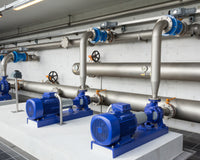
A hydrofor pump is a classic garden pump designed for dry operation, with a built-in or external pressure switch and hydrofor tank. It provides high water pressure and is an ideal solution for systems supplying both the home and garden from a single source—for example, a dug well or rainwater tank. A hydrofor set, consisting of a complete electric pump with a diaphragm tank, pressure switch, and safety fittings, is the installers’ preferred all-in-one solution—especially when purchasing a pump for a private investor who expects a system ready for connection. The IPRO series multistage deep-well pump, in turn, is Dambat’s response to the needs of systems requiring high pressure and high flow—a type of equipment intended for well boreholes and industrial groundwater intakes. Wherever water must be lifted to great heights or conveyed through long mains, a multistage pump is the optimal choice.
In the budget segment of pumps for garden and emergency work, Dambat IBO offers self-priming pumps, a hand pump to support installations without an electricity supply, as well as dirty-water pumps for draining excavations, tanks, or areas after flooding. A butterfly pump, a single-stage pump, and a circulation pump are further examples of solutions that can be incorporated into more advanced installation systems—for example, for circulating water in tanks or heating systems integrated with a garden installation.
Pump selection procedure – step by step
Choosing the right pump for a garden professionally does not start with browsing a catalog—it starts with an inventory. The installer should determine the type and depth of the water source, check the well's output or the capacity of the rainwater tank, measure or calculate the required head, and then determine the water flow required by the irrigation system based on the assumed number of sections operating simultaneously. Only after collecting this data can you consult the catalog and proceed with selecting a pump of a specific type and model.
The next stage is hydraulic calculations: the total linear and local losses in the main line, the water pressure required by the end devices (sprinklers, nozzles, and drip emitters), and the pump pressure needed to overcome them with an appropriate reserve. Errors at this stage result in overestimating or underestimating the required power—both scenarios are costly. An oversized pump generates high pressure in the installation, leading to accelerated wear of fittings and pump faults resulting from operation outside its performance curve. An undersized pump will not provide sufficient water flow and pressure at the outlets, resulting in uneven watering of plants.
When purchasing a pump, you should consider not only the price of the device but also the cost of the accessories: the pressure tank, control automation, filtration, check valves, and dry-run protection. Planning these elements at the design stage helps avoid costly installation modifications after commissioning. Dambat offers both individual devices and ready-made pressure-boosting sets that installers can order as complete packages.
Submersible pump vs. garden pump – typical applications
| Source / Garden type | Recommended pump type | Key application |
|---|---|---|
| Drilled well | IPRO submersible pump (multistage) | Permanent water supply for the house and garden irrigation system; high pressure and high capacity at great depths |
| Dug well | Self-priming pump / IBO hydrofor pump | Shallow water sources; simple installation, possibility of installation in a technical room |
| Rainwater tank (underground) | IBO submersible pressure pump | Watering plants with rainwater; variable water level, automatic start/stop |
| Rainwater tank (above ground / IBC) | Self-priming pump / IBO suction pump | Seasonal water intake; easy removal for winter |
| Large garden (over 1000 m²) | High-capacity submersible pump + hydrofor tank | Irrigation of larger gardens; continuous pressure across multiple garden irrigation sections |
Pressure, flow and capacity – operating parameters of an irrigation system
Pump pressure is the parameter that connects all installation components into a single system. The pressure of the submersible pump must be high enough that, after overcoming all losses in the pipeline and fittings, the sprinklers operate at full range and the drip lines distribute water evenly along the entire length of the section. In practice, a minimum of 2.5–3 bar at the controller inlet is assumed, which, accounting for installation losses, often means requiring 4–5 bar at the pump terminal at full flow.
The water flow and water volume at the pump's operating point must be synchronized with the irrigation controller schedule. A typical garden irrigation system is divided into sequential zones precisely to avoid exceeding the capacity of the water source and pump when several sections draw water simultaneously. Check the well's capacity not only under static conditions but also after several hours of intensive irrigation—this is a real test for the entire system. Excessive water intake exceeding the source's recharge rate leads to dry running and pump damage.
Water consumption in garden systems is often underestimated. Even small rotary sprinklers use 0.3–0.7 m³/h each, and with a dozen or more heads operating simultaneously, demand rises to a level requiring a pump with a capacity of 3–6 m³/h at the appropriate pressure. A pressure pump or multistage submersible pump from the IPRO series can meet these requirements, but only when pump selection is preceded by a reliable analysis rather than a rough estimate. High pressure in the installation combined with insufficient water flow in the irrigation sections is one of the most common design errors.
Hydrofor tank and hydrofor set in a garden system
Using a large pressure tank in an installation supplying a garden from its own well offers several direct benefits. The pressure tank buffers water pressure: when the controller opens an irrigation section, water is initially drawn from the tank without the need to start the submersible pump. Only after the pressure drops below the pressure switch’s activation threshold does the submersible pump start and refill the tank. A large tank—for example, 100–200 l—means several times fewer start-up cycles per day, which directly extends the motor’s service life and reduces pump damage caused by frequent starts.
A pressure-boosting set as a ready-made solution for the installer means both reduced installation time and a guarantee of factory-matched operation between the pump, pressure switch, and tank. Dambat IBO offers ready-to-connect sets comprising an electric pump, a diaphragm pressure tank, and connection fittings. For facilities requiring continuously high water pressure across multiple sections simultaneously, a higher-end set based on an IPRO multistage pump is a high-performance solution with consistent parameters and easy servicing.
Garden irrigation system—from a small plot to a large garden
Small gardens around detached houses, covering up to 200–300 m², are most often served by a simple IBO garden or pressure-boosting pump with a small tank. A few lawn sprinkler sections and manual hoses are applications for which a single-stage self-priming pump with medium pressure is sufficient. Control may be limited to a simple pressure switch or manual valve—the installation is simple and quick to install.
In a large garden, especially when combining lawn irrigation with flowerbeds, a vegetable garden, and orchard zones, the irrigation system becomes an extensive network of pipes and valves, requiring a stable and continuous water source. Here, a suitable IPRO series submersible pump, selected for high output at the required pressure, together with a pressure tank and a multi-zone controller, creates a complete and autonomous garden irrigation system. Irrigating larger gardens requires dividing them into sequential or zone-based sections managed automatically, as this is the only way for one tank and one pump to efficiently serve the entire installation without exceeding the source’s capacity. Watering plants sensitive to water shortages—such as those in greenhouses and cold frames—requires precise regulation of water flow and pressure on the drip line, which necessitates selecting a pump with variable control or using a pressure reducer.
Dambat IBO and IPRO technical support for installers
As a Polish manufacturer of IBO and IPRO pumps, Dambat provides installers and designers not only with an extensive product catalog but also with active technical support when selecting equipment. The company’s technical department helps select a submersible pump for a specific well, analyzes system parameters, and identifies the optimal model from the available range. This is particularly important for non-standard projects—for example, when well capacity is limited, the water level varies seasonally, or the garden irrigation system combines several independent water sources.
The manufacturer’s website provides product data sheets, installation manuals, electrical diagrams, and guides to pump types and their applications. The service system also includes after-sales support: requests for spare parts for IBO and IPRO pumps can be submitted via a dedicated form, while the service department performs diagnostics and provides advice on repairing or replacing the device. This makes choosing the right pump a process supported by the manufacturer’s data and expertise, rather than solely by the installer’s intuition.
Useful links – IBO and IPRO pumps available from Dambat
- Dambat – manufacturer of IBO and IPRO pumps, home page
- IBO garden pumps – electric self-priming pumps for garden watering
- Pumps for rainwater and watering – tanks and irrigation systems
- IBO pumps – the full range: submersible, pressure-booster, and immersion pumps
- IPRO pumps – multistage submersible pumps for drilled wells
Frequently asked questions
Which garden pump should you choose for a drilled well?
For a drilled well, the best choice is a submersible pump from the IPRO series (Dambat), selected based on the suspension depth, dynamic water level, and the required water pressure at the garden irrigation system’s supply point. With several lawn sprinkler zones, it is worth adding a pressure tank to the installation. It buffers pressure and reduces the number of submersible pump starts to several dozen cycles per day instead of several hundred.
What is the difference between a submersible pump and a garden pump?
A submersible pump operates underwater in a borehole or well—it is sealed, resistant to the pressure of the water column, and designed for lifting heights of several dozen or even more than one hundred meters. A garden pump is usually a surface-mounted device installed outside the water source that operates by suction. Its use is limited by the geometric suction height (7–8 m), making it ideal for shallow water sources such as dug wells, above-ground tanks, and rainwater storage tanks.
How to check a well’s capacity before selecting a pump?
The well’s capacity is checked by conducting a pumping test: water is pumped out at a constant flow rate for at least several minutes while the water level is monitored. If the water level stabilizes at a constant height and does not continue to fall, this means that the well is replenishing water at a rate at least equal to the specified flow rate—this is the safe water withdrawal limit for the selected well pump. The test result is a key input parameter when selecting a submersible pump.
Is a regular submersible pump sufficient for rainwater?
A standard submersible pump is sufficient for simply emptying a tank or occasional watering. However, if the installation is to operate an automatic garden irrigation system with sprinklers or drip lines, a submersible pressure pump or a dedicated rainwater pump with higher water pressure will be a better choice—for example, from the IBO series offered by Dambat. Only this type of pump will ensure stable pump pressure throughout the irrigation network, regardless of the current water level in the tank.
When is it worth using a pressure-boosting set in the garden?
A pressure-boosting set is particularly justified when the same submersible pump is to supply both the building and the garden watering system, while the irrigation controller operates in multi-zone mode with frequent start cycles. The pressure tank buffers water pressure and limits the number of motor starts, reducing energy consumption and extending the service life of the electric pump. For a large garden requiring high capacity when irrigating larger areas, a set with an IPRO multistage pump and a large tank is the solution that provides the highest operating comfort.
What is the difference between a self-priming pump and a suction pump?
In technical terms, a suction pump is any surface pump that draws water through a suction pipe—including both single-stage centrifugal pumps and multistage pumps. A self-priming pump is a subcategory of suction pump: a device that automatically vents the suction system during startup without the need to manually fill the pump housing with water. This is an important distinction when designing garden installations, where, after the system has been drained for winter, automatically starting the irrigation system in spring does not require the installer to be present.
What is a submersible pump used for outside the garden?
The use of a submersible pump extends far beyond simply watering the garden. IPRO series submersible pumps are used as the main water source in single-family homes, guesthouses, small manufacturing facilities, agriculture, and intensive horticulture. Where the irrigation system works together with the household installation—for example, jointly supplying a pressure-boosting system—the submersible pump serves a dual role: it provides water for drinking and household use, as well as pressure for the garden irrigation zones.