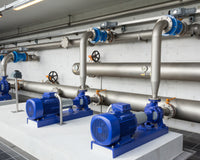

Dambat is a Polish manufacturer of modern water pumps, pressure booster pumps, and wastewater pumping equipment, cooperating, among others, with the IBO and IPRO brands, formerly also operating under the name IQ PR. Its product range includes water pumps for heating systems, domestic hot water, pressure boosting systems, wastewater pumping stations, and industrial applications, enabling installers and plumbers to select complete, compatible solutions for almost any application.
Types of water pumps offered by Dambat
Dambat’s professional water pumps include a wide range of devices: submersible pumps, pressure booster pumps, dirty-water pumps, wastewater pumps, circulation pumps, and various types of industrial pumps. The range is designed for demanding domestic and commercial installations, allowing installers to choose both high-performance septic tank pumps with grinders and energy-efficient central-heating pumps for heating systems.
Colloquial language includes imprecise terms such as “central-heating pumps” or “central-heating pumps for boilers,” but the correct industry terminology is circulation pumps or central-heating circulation pump, which are available in many variants from the IBO brand. The phrase “central-heating pumps” is also sometimes confused with other products, whereas Dambat emphasizes clear terminology to make it easier to select the right water circulation pump for a specific installation.
IBO circulation and hot-water circulation pumps
The range of products for heating and domestic hot-water systems includes IBO circulation pumps, including models such as the IBO central-heating circulation pump, electronic circulation pump, and classic three-speed designs. Installers can select a pump according to the parameters of a specific system, taking into account head, flow rate, energy class, and compatibility with boiler controls.
A common question is whether an installation is better served by an electronic or conventional circulation pump – modern IBO electronic pumps, such as the IBO BETA 2 25-60 range, provide smooth output modulation, lower energy consumption, and quieter operation compared with standard three-speed pumps. Small hot-water circulation pumps are also available, such as the IBO circulation pump, designed to provide immediate access to hot water at points of use.
Central-heating pump diagnostics and operation
Proper operation of a central-heating pump requires correct installation and regular performance checks, as installation errors can result in noise or premature bearing wear. Correct installation of a central-heating pump includes positioning the shaft horizontally, ensuring an adequate amount of water in the system, and setting the pump speed correctly to avoid cavitation and unnecessary overloading.
Typical signs of wear in a central-heating circulation pump include noisy operation, vibrations, reduced performance, and problems heating distant radiators, which may indicate a faulty pump. In such situations, it is worth checking whether the circulation pump is operating by paying attention to motor operation, impeller rotation, and the condition of the circulation pump’s bleed screw, which is used to remove air from the working chamber.
Bleeding and adjusting the circulation pump
Correct bleeding of the central-heating pump is crucial for trouble-free operation, as air in the system causes noise, reduced performance, and excessive bearing load. Bleeding the central-heating pump while it is operating is possible on many models using the aforementioned circulation pump bleed screw – gently loosening it allows air to escape along with a small amount of water.
Another common question is whether a central-heating pump should run slowly or quickly – the speed should be adjusted to the system’s characteristics and pressure losses; a setting that is too high may cause noise, while one that is too low may result in insufficiently heated rooms. If in doubt, the manufacturer’s instructions are a good reference, such as the documentation for IBO BETA 2 or IBO CPI 15-15, which contains recommendations for settings.
Pressure booster systems, hydrofor pumps, and tanks
Dambat offers complete pressure booster sets, including pressure booster pumps, tanks, and control equipment, designed to supply single-family homes, farms, and small service businesses. In practice, users search for these solutions using terms such as pressure booster system, water pressure booster systems, water pressure booster system, or pressure booster pump with motor, whereas the colloquial spelling “hudrofor” is incorrect and is not used as a product name.
In foreign-language versions, terms such as hydrofor pump, hydrophore pump, and hydrophore system are used, often appearing in descriptions of ship installations (“hydrophore system in ship”) and in technical materials concerning pressure tanks (“hydrophore tank,” “hydrophore tank working principle,” “was ist hydrophor,” “hydrophoranlage”). In Russian, the terms “гидрофор,” “гидрофор для дома,” “гидрофор насос,” “что такое гидрофор,” “гидрофор принцип работы,” and “принцип работы гидрофора” are used. They refer to the same type of equipment: pump + tank + control system sets for stabilizing pressure in a water installation.
IBO submersible pumps – selection and protection
In the field of water supply from drilled wells, Dambat offers a wide range of devices, such as IBO submersible pumps, including models such as a 3-inch submersible pump, submersible pump for a well, and submersible pump for a ring well. Key selection parameters include the depth of the water table, well diameter, required head, and expected flow rate, which can initially be determined using tools such as a submersible pump selection calculator.
The range also includes modern solutions such as a submersible pump with a variable-frequency drive, allowing constant pressure to be maintained in the system while reducing energy consumption. For proper operation, the use of a cooling jacket for a submersible pump is recommended when operating in tanks or wells with a larger diameter, along with selecting the appropriate variable-frequency drive for a submersible pump or variable-frequency drive for a deep well pump, including models designed for IBO pumps, such as the IBO IVR 05 and IBO IVR 10 ranges.
Pumps for clean, dirty, and rainwater
In domestic and garden applications, the IBO water pump and other water pumps are popular for supplying installations, watering gardens, and powering sprinkler systems. A separate group consists of rainwater pumps and pumps for rainwater tanks, including an automatic rainwater pump used in rainwater harvesting and garden irrigation systems.
Dirty-water pumps are designed for demanding conditions, including dirty-water pumps with grinders and the IBO dirty-water pump, which are suitable for pumping out flooded rooms and emptying septic tanks or process tanks. In the event of a failure, dirty-water pump repairs and dedicated water pump parts and dirty-water pump parts are available, making it easier to service equipment in the field.
Septic tank and wastewater pumps and pumping stations
In the field of sewage and wastewater systems, the range includes septic tank pumps, septic tank pumps with grinders, IBO septic tank pumps, and float-equipped solutions such as a septic tank pump with grinder and float switch, designed for continuous or intermittent operation. For demanding applications, a powerful septic tank pump with grinder and a permanently installed septic tank pump are available, the latter designed for permanent installation in a sump.
Installers can also select wastewater pumps with grinders, wastewater pumps, including a positive-displacement wastewater pump, as well as complete systems such as pumping stations, wastewater pumping stations, residential wastewater pumping stations, and wastewater pumping stations with grinders. Dambat also operates as a wastewater pumping station manufacturer, offering ready-made pump-and-pipe assemblies and accessories for constructing small wastewater pumping stations and rainwater pumping stations.
Submersible, sanitary, and special-purpose pumps
The range includes various submersible pumps, such as the IBO submersible pump, submersible pump for septic tanks, and mini dirty-water pump, used for pumping out flooded rooms and emptying tanks. Additional equipment, such as a submersible mixer, enables better mixing and transport of dense wastewater.
Specialist equipment also includes sanitary pumps (sanitary pumps), often installed as a toilettenpumpe in German-language descriptions, for pumping wastewater from toilets and sanitary fixtures to a higher level. Foreign descriptions also use the terms “pompa pentru fosa septica” and “pompa fosa septica,” referring to pumps for cesspools that are functionally similar to septic tank pumps with grinders.
Pool, coolant, and oil pumps
Industrial applications include coolant pumps and electric coolant pumps, used in CNC machine tools, where they are known as a CNC coolant pump or lathe coolant pump. These devices circulate cooling and lubricating fluid in the machining zone, contributing to tool life and the quality of the machined surface.
A separate group consists of oil pumps, pool pumps, and devices such as a condensate pump, condensate pump, and condensate removal pump, used to drain condensate from air-conditioning systems and condensing boilers. This enables installers to purchase pumps for clean water, wastewater, pools, and industrial media in one place.
Pumps for pressure testing, underfloor heating, and pressure boosting
For installation companies, Dambat also offers pressure-testing pumps, including hand-operated pressure-testing pumps, used to check the tightness of water and heating systems before commissioning. The terms pressure-test pump and leak-testing pump refer to the same function – generating controlled excess pressure in an installation.
Underfloor heating systems use a suitably selected underfloor-heating pump, while buildings with low water-main pressure require a water pressure booster pump, including a water pressure booster pump for mains water. English-language documentation may use terms such as “DHW pump” (domestic hot-water circulation pump) or “water pass” when describing flow in installations; however, Dambat primarily uses Polish terminology to make equipment selection easier for local installers.
Examples of IBO pump models
The product range includes many recognizable models, such as IBO MHI 1300 INOX (often written as MHI 1300 INOX or MH 1300 INOX), HP INOX AUTO, IBO AJ 50/60, IBO NOVA, IBO MAGI 2, MAGI MAX, IBO STING, and IBO KRAKEN 1800. Among pumps designed for wastewater, FURIATKA has become particularly popular, including the IBO FURIATKA 1500 model, commonly referred to as the Furiatka 1500 pump, designed to operate in demanding conditions.
For multistage sets used in pressure-boosting systems and irrigation, the IBO MULTI IP 1000 AUTO and IBO MULTI IP 1200 AUTO series are available, along with the IBO IVR 05 and IBO IVR 10 variable-frequency drives (designations including IVR-10-030S and IVR-10), enabling the construction of advanced pressure-maintenance systems. Documentation and technical data sheets also contain designations such as IBO 3TI20, IBO 3TI27, SWQ, M131, OHI, IBO OHI 25-40/180 manual, E-IBO 15-14, and CPI 15-15, helping installers identify equipment unambiguously.
How do you select an IBO circulation pump for a central-heating system?
Selecting an IBO circulation pump for a central-heating system should begin with determining the heat-source output, the length of the heating loops, and the pipe diameters, as these affect the required flow rate and head. The installer should consider pressure losses in the system, including valves, manifolds, and control components, in order to select the correct pump curve. Electronic models such as IBO BETA 2 or IBO CPI 15-15 enable output modulation and automatic adaptation to the current heat demand. If in doubt, it is worth consulting the manufacturer’s catalog sheets and the selection calculators available in the technical materials.
What should you consider when operating an IBO pressure booster system?
The basis for correct operation of an IBO pressure booster set is the proper pre-charge pressure in the diaphragm tank and regular checks of the pressure switch. The pump must be protected against dry running, especially in water sources with fluctuating water levels or during high consumption over a short period. The installer should check the tightness of the suction system and the condition of the filters, as air entering the system causes noisy operation and reduced performance. In the event of irregularities, consult the pressure booster pump manual and adjust the pressure-switch settings to the requirements of the installation.
How do you select a submersible pump for a drilled well?
Selecting a submersible pump for a drilled well requires determining the depth of the water table, the borehole diameter, and the pressure required at the highest point of the installation. The total head is then calculated, taking into account pressure losses in fittings, filters, and the length of the discharge pipe. It is also important to determine the maximum instantaneous and average water demand in order to select the appropriate pump flow rate and motor power. When using a variable-frequency drive or constant-pressure control system, pump selection should be checked against the manufacturer’s documentation to ensure proper cooperation between the devices.
What solution should be used for wastewater from a single-family home?
When wastewater from a single-family home cannot flow by gravity into the sewer system, a residential wastewater pumping station is used. The selection of the set depends on the number and type of sanitary fixtures, the installation depth of the tank, and the distance to the sewer collector. In many cases, the optimal solution is a wastewater pump with a grinder or a ready-made wastewater pumping station with a grinder, which facilitates pumping the medium through a small-diameter pipeline. Selection should take into account material resistance, motor power, head, and the presence of a float switch controlling pump operation.
How do you maintain the high efficiency of a dirty-water pump?
To maintain the high efficiency of a dirty-water pump, regularly check the condition of the impeller, working chamber, and flow-channel patency. Periodically flushing the pump with clean water after operation in heavily contaminated wastewater or suspensions is recommended, as this reduces the risk of sediment accumulation. In permanent installations, it is important to monitor the frequency of starts and the operation of the float switch, as a blocked float switch can cause the motor to overheat. If reduced performance, excessive noise, or vibrations are observed, stop the device and verify its technical condition, using the manufacturer’s service if necessary.