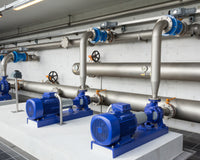
A pressure booster system is an integral part of a pressure-boosting installation designed to maintain constant water pressure. It works with a surface pump, and this combination is essential for drawing water from a private water source. Pressure booster systems are used in holiday homes, allotment gardens, as well as single-family homes, service establishments, and industrial plants. The installation and operating costs of pressure booster systems are low. However, the question arises: where should a pressure booster system be installed?
Compact pressure booster system under a kitchen sink
Modern pressure booster systems are compact. A pressure booster system consists of a pump and a water-air tank, and the compact version can easily be installed inside the home. Pressure booster systems are very often placed in the basement. Some models are even small enough to fit under a kitchen sink, which is a practical and convenient solution. These tanks have a maximum capacity of 50–60 liters. Ready-made systems available for sale are convenient to use and quiet. However, remember that tanks with a pressure greater than 0.005 MPa/m³ must have a UDT certificate, while those used for drinking water should additionally have a certificate from the State Hygiene Institute.
A pressure booster system in a home can be installed in a room where the temperature is not below +5°C or above +40°C. It must have a properly functioning ventilation, electrical, and heating system. The floor beneath the pressure booster system should have a slope of at least 1% toward the drainage grates. However, these are not all the requirements. The room in which you plan to install the pressure booster system must have a minimum height of 2.2 m, and its minimum area must be 5 m². Unrestricted access to the inspection opening must be provided. The pressure tank must be placed at least 0.6 m from the wall. The pump itself must be at least 0.5 m from the wall. All systems must be in good working order and watertight. The capacity of the sewer system must not be lower than the pump's output so that it can drain the water in the event of a pressure booster system failure.
Traditional pressure booster system in a concrete tank
Compact and modern pressure booster systems are very quiet, so they can be installed inside the home. However, traditional pressure booster sets are considerably larger and operate much more loudly. For this reason, it is better to install them outside the home. A commonly used solution is to place the pressure booster system in an underground concrete tank. This option both conceals the pressure booster set and provides effective sound insulation. The tank is made of reinforced concrete, insulated with damp-proofing foil, and thermally insulated with a layer of polystyrene. The access opening is secured with a reinforced-concrete slab and a watertight cover. Electricity must be supplied to the pressure booster room constructed in this way to power the heater beneath the tank and the lighting. However, this solution is not protected against flooding and carries the risk of ventilation problems.
Pressure booster system: applications, construction, and choosing the right system
Pressure booster system – although the name may sound technical, this device plays a key role in many water installations. Its main task is to maintain constant water pressure, which translates into comfort and reliable operation of the entire system. Put simply, a pressure booster system ensures that water flows with the right force and is available whenever it is needed.
This equipment is used in various settings – from single-family homes and farms to industrial plants. Thanks to a pressure booster system, you do not have to worry about water failing to reach where it should.
Where are pressure booster systems used?
Pressure booster systems are widely used in many sectors. Here are a few examples of their applications:
-
Domestic water supply systems – they ensure comfortable everyday use, for example when bathing, washing dishes, or watering the garden.
-
Agriculture – they form the basis of irrigation systems, enabling precise water delivery to crops.
-
Industry – they support technological processes that require constant, controlled water pressure.
Without pressure booster systems, many of these processes would be impossible or far less efficient..
How to choose the right pressure booster system?
Choosing the right pressure booster system is no easy task. It requires taking several key factors into account that affect the efficiency and durability of the entire system:
-
System size – the device should be matched to the size of the installation and the water demand.
-
Pump type – you can choose between self-priming pumps (for shallow water intakes) and submersible pumps (for deeper wells).
-
Pressure tank capacity – the greater the water demand, the larger the tank should be.
Example: In a single-family home, a small set with a self-priming pump is sufficient. In a large farm, however, a system with a deep-well pump and a larger tank will work better. It is crucial to understand how the individual components work together in order to choose a solution perfectly suited to your needs and avoid unnecessary costs.
Modern technologies in hydrophores
Hydrophores are also keeping pace with technological progress. Models equipped with automatic control systems are becoming increasingly common. What does this mean in practice?
-
The device automatically monitors the pressure in the system.
-
The pump starts only when necessary, helping to save energy.
-
The system operates more efficiently, is more reliable, and extends the service life of the entire installation.
The result? Lower energy consumption, greater reliability, and user comfort. Modern hydrophores are an investment in efficiency and durability.
Hydrophores and sustainable water management
In an era of growing environmental awareness and the need to conserve natural resources, hydrophores are becoming increasingly important. Their role in sustainable water management is invaluable:
-
They reduce water losses through precise control of its flow.
-
They ensure reliable water supplies wherever water is truly needed.
-
They support smart resource management systems, which is particularly important in the context of climate change.
What does the future hold? It is difficult to predict, but one thing is certain: hydrophore technologies may play a key role in building a more sustainable world.
Hydrophores—the pillar of the future?
Everything suggests that hydrophores will become one of the foundations of modern, sustainable water management. Their role will grow alongside the need to use resources efficiently and implement smart technological solutions.
Time will tell exactly what role they will play. But it is worth taking a closer look at them today, because the future may belong to them.
How a hydrophore works in a water system
A hydrophore is an indispensable device in locations without access to the municipal water supply network. Its primary task is maintaining stable pressure in the water system, enabling comfortable use of water—in the kitchen, bathroom, and while watering the garden.
Importantly, the hydrophore pump does not run continuously. It starts only when the pressure in the system falls below a specified level. This operating method results in lower energy consumption and an extended service life of the entire system.
A pressure-boosting system is a carefully designed setup that provides adequate water flow pressure – regardless of whether someone is taking a shower or watering the garden. This system is ideal for:
-
single-family homes,
-
on recreational plots,
-
on farms,
-
and wherever fluctuations in water demand occur.
Even with a sudden increase in water consumption, the pressure-boosting system operates flawlessly – without pressure drops and without causing stress for the user.
The role of pressure and automation in the operation of a pressure-boosting system
Efficient operation of a pressure-boosting system relies on precise pressure control supported by automation. The key component of this system is the pressure switch – a pressure-operated switch that:
-
switches on the pump when the pressure drops below the set minimum,
-
switches it off when the pressure reaches the upper threshold.
As a result, the pump operates only when necessary, which helps save energy and minimize the risk of failure.
The second important component is the pressure gauge – a small but extremely useful device that shows the current pressure in the tank. Thanks to it, the user has full control over the operation of the system.
The pressure switch and pressure gauge make a well-coordinated pair that ensures:
-
smooth system operation,
-
user safety,
-
adapting operation to current needs,
-
reliability even with intensive water consumption.
Components of a pressure-boosting system
A pressure-boosting system is a complex yet well-designed system in which every component performs an important function. It works like a well-coordinated team – each element has its task, and together they provide reliable support for a household water system. Understanding the structure and operation of a pressure-boosting system will help you not only choose the right model, but also operate and maintain it properly.
Let us therefore take a look at what a complete pressure-boosting system consists of and what role its individual components play.
Pressure tank – function and importance
The pressure tank is the heart of the system – it serves as a reservoir that stores water and compressed air. Its presence means the pump does not have to start every time you turn on a tap.
Benefits of using a tank:
-
Energy savings – less frequent pump activation reduces electricity consumption.
-
Extended system lifespan – fewer pump operating cycles mean less mechanical wear.
-
Stable pressure – allows water to be used at several outlets simultaneously without pressure drops.
In practice, this means greater user comfort and reliable operation of the entire water system.
Pressure pump – types and applications
A pressure pump is responsible for pumping water into the system. Its selection depends primarily on the depth of the water source. There are two main types of pumps:
|
Pump type |
Application |
Intake depth |
|---|---|---|
|
Self-priming pump |
Ideal for shallow wells and tanks |
Up to approximately 7–8 metres |
|
Submersible pump |
For deep water intakes |
Up to several hundred metres |
Choosing the right pump type for local conditions is crucial – only then will the system operate efficiently and reliably.
Pressure switch and pressure gauge – pressure control and regulation
The last, but extremely important, components of the system are the pressure switch and pressure gauge – a duo responsible for controlling and regulating the pressure in the system.
-
Pressure switch – automatically switches the pump on and off depending on the pressure level. This ensures that water flows from the tap with the appropriate force, without fluctuations.
-
Pressure gauge – indicates the current pressure in the tank. It allows you to quickly assess whether the system is working properly.
Together, they form a control system that ensures safety, stability, and user convenience – without the need for constant intervention on your part.
Types of pressure tanks
Choosing the right pressure tank is a key element of an efficiently operating water system. Several types of tanks are available on the market, differing in construction, purpose, and functionality. Each has its own unique advantages, so it is worth taking a closer look at them to consciously choose the model best suited to the needs of your home, garden, or business.
Diaphragm tank – construction and advantages
A diaphragm tank, also known as a membrane pressure tank, is a modern solution in which water and air are separated by a flexible rubber diaphragm. As a result, the water does not come into contact with metal, which significantly reduces the risk of corrosion and extends the device's service life.
How does such a tank work? The diaphragm acts like a balloon – it expands and contracts depending on the amount of water. This helps maintain constant pressure in the system and ensures smooth system operation without sudden pressure spikes.
Key advantages of a diaphragm tank:
-
No contact between water and metal – lower risk of corrosion.
-
Stable pressure – user comfort and system protection.
-
Availability in various capacities – easy to adapt to domestic and industrial needs.
-
High durability and reliability – long-lasting, trouble-free operation.
This is an ideal solution for people with limited access to water who want to manage its consumption efficiently.
Galvanized tank – a traditional solution
The galvanized tank is a classic solution that remains highly popular. Made of steel coated with a layer of zinc, it is characterized by solidity and resistance to mechanical damage. Although the water comes into direct contact with the metal, its simple construction and proven technology continue to convince many users.
In a galvanized tank, the air cushion plays a crucial role by maintaining the appropriate pressure in the system. This enables efficient water delivery even when consumption is high.
Key features of the galvanized tank:
-
Mechanical strength – ideal for intensive use.
-
Simple construction – easy to operate and service.
-
Requires regular air replenishment – periodic maintenance is necessary.
-
Proven technology – a popular choice for households and farms.
This is a solution for those who value traditional, reliable technologies and are not concerned about simple maintenance tasks.
Stainless steel tank – durability and corrosion resistance
Stainless steel hydrofor tanks are designed for the most demanding users. Made of high-grade stainless steel, they offer maximum corrosion resistance and exceptional durability, making them an ideal choice for both domestic and industrial applications.
Their smooth, shiny surface is not only aesthetically pleasing but also makes it easier to maintain hygiene, which is extremely important in industries such as food and pharmaceuticals. In addition, these tanks perform excellently in demanding conditions where other materials fail.
Key advantages of the stainless steel tank:
-
Resistance to rust and corrosion – ideal for use in humid environments.
-
High durability – an investment for many years.
-
Easy to keep clean – particularly important in the food and pharmaceutical industries.
-
Aesthetic appearance – modern design and functionality in one.
This is the choice for those who value quality, reliability, and peace of mind for years to come. And who knows—perhaps even more advanced materials will soon emerge to revolutionize hydrofor technology.
Types of pumps used in pressure systems
In pressure systems, the pump plays a key role – it is responsible for supplying water to the installation and maintaining the appropriate pressure. Choosing the right pump affects not only operating efficiency but also the durability and reliability of the entire system. So how do you choose the right type? Below, we present the most common types of pumps used in pressure systems and their applications.
Self-priming pump – for shallow water intakes
A self-priming pump is an ideal solution for people using shallow water sources, such as dug wells or above-ground tanks. Its greatest advantage is its ability to draw in water independently – without the need to fill the pipes beforehand.
Why is it worth choosing?
-
No need to use check valves – simplifying the installation.
-
Lower installation costs – fewer components and less work.
-
Easy start-up – ideal for holiday homes and simple installations.
-
Easy operation – no specialist knowledge or professional assistance required.
This solution is suitable wherever simplicity, reliability, and quick installation are important.
Submersible pump – for deep wells
A submersible pump is the best choice when the water table is below 8 metres. It is installed directly in the well, below the water level, which eliminates suction problems and ensures stable operation.
Main advantages of submersible pumps:
-
High efficiency – ideal for intensive use.
-
Stable operation even in difficult conditions – for example, with fluctuating pressure.
-
Resistant to minor contaminants – thanks to its design, adapted for operation in deep water intakes.
-
Compatible with a pressure tank – ensures constant pressure in the system.
This solution is recommended for homes in rural areas, farms, and anywhere without access to the mains water supply.
Surface pump – installation and applications
A surface booster pump is a classic, proven solution that is installed outside the water source – usually next to a well or tank. Its advantage is easy installation and servicing, making it a popular choice in many households.
Why is it worth considering?
-
Simple installation – no specialist tools or expertise required.
-
Easy access for maintenance – everything is located above ground.
-
Stable pressure in the installation – ideal for everyday use.
-
Versatile applications – single-family homes, gardens, and small farms.
It is worth remembering, however, that surface pumps work best with a suction depth of up to 7–8 meters. This makes them an ideal choice for shallow wells and tanks.
What a hydrofor system contains
At a time when efficiency and savings matter, a hydrofor system becomes an indispensable solution for household water management. It is a complete, ready-to-operate installation that integrates all the necessary components for water extraction, storage, and distribution.
A typical hydrofor system contains:
-
Hydrofor pump – responsible for drawing and pumping water, ensuring its flow through the installation.
-
Diaphragm tank – stores water and stabilizes pressure, resulting in smooth system operation.
-
Installation equipment – valves, pressure switches, and other accessories that ensure safe and automated operation.
The pump is the heart of the entire system – without it, drawing and pumping water would not be possible. The diaphragm tank acts as a buffer that not only stores water but also maintains constant pressure in the installation. The equipment, in turn, ensures reliable, maintenance-free system operation, increasing its durability and user comfort.
Advantages of ready-made hydrofor systems
Ready-made hydrofor systems combine convenience, functionality, and savings. Their greatest advantages include:
-
Completeness and compatibility – all components are factory-matched, eliminating the risk of errors when selecting parts.
-
Easy installation – the systems are designed with users without technical experience in mind, allowing for quick and trouble-free commissioning.
-
Compact design – they are ideal for small spaces such as basements, storage rooms, or utility rooms.
-
Versatile applications – they can be used in single-family homes, farms, workshops, or holiday cottages.
Example of use: In a holiday cottage, a hydrofor system can provide constant access to water from a well without the need to connect to the water supply network. This solution is convenient, independent, and economical.
When to choose a set instead of separate components
Choosing a ready-made pressure booster set instead of assembling individual components separately offers many benefits:
-
Guaranteed compatibility – all components are factory-matched, minimizing the risk of failures and installation errors.
-
Time and cost savings – installation is faster, and the price of a set is often lower than the total cost of individual components.
-
Manufacturer's warranty – most sets are covered by a warranty, making any potential claims easier and providing peace of mind.
-
Ease of servicing – the compact design makes maintenance and any necessary repairs easier, resulting in lower operating costs.
Summary: Ready-made pressure booster sets are a modern, convenient, and informed solution for anyone who wants to manage water efficiently in their home or on their property. In the future, we can expect even more advanced systems that will automatically analyze water consumption and adjust their operation to the user's individual needs.
Types of pressure booster systems
Choosing the right pressure booster system is a key step if you want efficient and trouble-free operation of your water system—both at home and in commercial buildings. There are many models available on the market, differing in design, functionality, and intended use. In this section, we will take a closer look at the most commonly chosen types to help you select and match the device to your individual needs.
Tankless pressure booster system – characteristics and applications
A tankless pressure booster system is a modern alternative to conventional pressure systems, increasingly chosen by users who value compactness, efficiency, and space savings. Its main feature is the absence of a traditional pressure tank. Instead, the central element of the system is a pump integrated with an electronic controller that precisely regulates the pressure in the installation.
This solution is particularly effective in places where space is limited, such as:
-
small boiler rooms,
-
holiday cottages,
-
modern apartments,
-
technical rooms with limited space.
Thanks to intelligent control, the device starts only when necessary, resulting in:
-
lower energy consumption,
-
longer system lifespan,
-
quieter operation,
-
greater user comfort.
Although the lack of a tank may seem like a disadvantage, in practice it proves to be an advantage. Advanced automation effectively maintains stable pressure, offering convenience and reliability. This is the direction in which modern water installations are moving – toward greater automation and minimalist solutions.
Domestic pressure booster systems – when are they needed?
Domestic pressure booster systems are indispensable in places where mains water pressure is too low or access to the water supply network is limited. In such conditions, a home pressure booster system ensures stable pressure and an uninterrupted water supply – the basis of everyday comfort, from the morning shower and washing dishes to watering the garden.
They are most commonly used in:
-
single-family homes,
-
households in rural areas,
-
suburban buildings,
-
places with their own water source (e.g. a well).
When several people use water at the same time – someone is doing laundry, someone is washing dishes, and someone is watering the garden – the pressure booster system ensures constant pressure. No drops, no surprises. Everything operates smoothly, regardless of demand.
The choice of the right model depends on several key factors:
-
house area,
-
number of residents,
-
water source (mains, well, tank),
-
technical specifications – such as tank capacity, pump power, or control type.
It is worth keeping track of technological developments – perhaps even more intelligent systems will soon appear that adapt themselves to your lifestyle. One thing is certain: the importance of pressure booster systems in domestic water installations will only continue to grow.
The pressure booster system in practice
Although it may seem inconspicuous at first glance, a pressure booster system is a key element ensuring everyday comfort. It is thanks to this system that water flows from the tap at the right pressure – whether you live in a single-family home, relax at a vacation property, or run a farm. When the water supply network fails or does not exist at all, the pressure booster system takes over responsibility for supplying water.
The most important component of the system is the pressure booster system – the heart of the entire installation. It ensures that water is available at any time and with the right pressure. In single-family homes, a water pressure booster system provides convenience – from the morning shower to watering the garden. In horticulture, it becomes an indispensable tool in the fight against drought, enabling:
-
precise plant watering,
-
water savings thanks to controlled flow,
-
time savings – the system operates automatically,
-
reduction of stress associated with a lack of water at critical moments.
Pressure tank in a dug well and deep well
When using a dug well or deep well, the pressure tank acts as an intermediary between the water source and the household installation. Depending on the type of well, choosing the right set is crucial:
|
Well type |
Recommended solution |
Characteristics |
|---|---|---|
|
Dug well |
Set with a self-priming pump |
Ideal for rural areas where water is located shallowly beneath the ground |
|
Deep well |
Submersible pump + pressure tank |
An effective solution for drawing water from great depths, even several dozen meters |
In the case of deep wells, a set consisting of a submersible pump and a pressure tank guarantees constant access to clean, fresh water at the appropriate pressure – even in difficult terrain conditions.
Cooperation with an irrigation and water treatment system
A pressure tank works perfectly as a central element of irrigation and water treatment systems. In gardens, a galvanized pressure tank is often used, distinguished by:
-
corrosion resistance,
-
resistance to mechanical damage,
-
adaptability to intensive operation,
-
long service life even in difficult conditions.
In the context of water treatment, the pressure tank plays a supporting role – by maintaining constant pressure, it enables filters and purification devices to operate efficiently. This results in:
-
better water quality at the tap,
-
healthier conditions for household members,
-
greater durability of the entire water installation.
The future of pressure tank systems may belong to smart systems that combine the functions of a pressure tank, irrigation, and water treatment into one integrated, eco-friendly solution. Even today, it is worth investing in technologies that are not only efficient but also environmentally friendly.
How to choose the capacity of a pressure tank
Choosing the right pressure tank is the key to an efficiently operating water installation. But how do you determine which tank capacity will be best? It is not only a matter of everyday comfort, but also of reliability in more demanding situations. Let’s see what to consider.
The pressure tank capacity has a direct impact on how often the pump runs. A tank that is too small causes the pump to start almost continuously, which leads to:
-
higher energy consumption,
-
faster pump wear,
-
shorter service life of the entire installation.
In turn, an oversized tank is an unnecessary expense and a waste of space. Therefore, it is worth choosing the capacity optimally – so that the system operates efficiently and economically.
When choosing a tank, several key factors should be taken into account:
-
Number of users of the installation—the more people there are, the greater the demand for water.
-
Average daily water consumption—depending on lifestyle and the number of water-using appliances.
-
Additional needs—e.g., watering the garden, supplying irrigation systems, or washing the car.
Example: For a family of four with a garden, a tank with a capacity of 100 to 200 liters will usually be sufficient. Both compact models and larger, more advanced solutions are available on the market, so you can easily find something suited to your circumstances.
A properly selected tank guarantees stable tap pressure and user comfort—with no surprises while showering or watering the garden. Perhaps intelligent systems will soon appear that select the capacity themselves based on consumption analysis? Who knows. Even today, however, it is worth choosing solutions that genuinely meet your needs—here and now.
Pressure in the installation and its regulation
Water system pressure may seem like a minor detail, but it has a huge impact on user comfort. For a pressure tank system to operate flawlessly, it is worth knowing how a pressure tank works and how to control the pressure.
The pressure tank maintains constant pressure in the installation through the cooperation of the pump and the pressure switch. The pressure switch is responsible for:
-
automatic pump switching on and off,
-
adjusting the system's operation to current demand,
-
smooth operation of the installation,
-
reduced energy consumption and extended equipment lifespan.
Note: The maximum pressure of the pressure tank should not exceed 1 MPa. Exceeding this value may lead to failures or damage to the installation. That is why precise pressure regulation is so important.
Electronic controllers are being used increasingly often, enabling more precise management of operating parameters. This solution is not only convenient but also safe.
And what will the future bring? Perhaps systems that detect leaks and pressure drops themselves and automatically adjust their settings. Technology never stands still—and we can only benefit from it.
Choosing the right pressure tank for the user's needs
Choosing a pressure tank is not just a technical decision—it is a choice that affects everyday comfort and the efficiency of the entire water system. So let’s consider how to choose a pressure tank that truly meets your expectations.
First, determine your needs:
-
Number of users – the more people there are, the greater the demand for water.
-
Frequency and purpose of use – a single-family home, company, or farm—each of these places has different requirements.
-
Type of water source – a shallow well requires a different pump than a deep water intake.
Depending on the water source:
-
Dug well (shallow) – choose a self-priming pump.
-
Deep well – use a submersible pump.
It is also worth paying attention to automation features, which increase safety and convenience:
-
Dry-run protection – protects the pump from damage in the event of a lack of water.
-
Electronic pressure control – precise control of operating parameters.
-
Real-time monitoring systems – ongoing monitoring of the equipment’s condition.
Dozens of models are available on the market—from simple sets to advanced systems with intelligent control. This allows you to perfectly tailor the pressure tank system to your needs.
What comes next? Most likely, even more automated and personalized solutions that adapt to your lifestyle on their own. But even today, it is worth choosing equipment that offers flexibility, savings, and modern features.
Pressure tank system operation and maintenance
Do you want your pressure tank system to operate reliably for many years? The key to success is regular maintenance and technical inspections. They not only extend the equipment’s service life but also help you avoid costly failures. It is also worth understanding how the entire system works and what components it consists of—this will allow you to detect irregularities more quickly and respond before problems with access to water arise.
Checking the pressure in the tank is one of the most important aspects of operation. Maintaining the appropriate pressure level affects both the system’s performance and safety. Pressure fluctuations may indicate problems with the pressure switch or pressure gauge—these components should be checked during every inspection. The technical condition of the pump is also crucial, as it drives the entire system.
Pressure tank requires regular inspection for leaks, corrosion, and mechanical damage. In diaphragm models, particular attention should be paid to the condition of the diaphragm—wear can lead to a drop in pressure and unstable operation. It is also worth cleaning sediment from the inside of the tank from time to time, which significantly improves its performance.
Although many maintenance tasks can be performed yourself, it is worth using a specialist’s services from time to time. A professional may notice faults that escape the user’s attention and prevent more serious failures. This will ensure that the pressure-boosting system operates efficiently, while giving you peace of mind and confidence in your access to water. If you suspect that one of the installation components is not operating within its specifications, it is also worth contacting the manufacturer or supplier to request a diagnosis, provided you do not have the technical knowledge required to resolve the reduced performance of the individual components.
How to care for a pressure-boosting system and its components
For the pressure-boosting system to operate flawlessly, you need to know the function of each of its key components. The pump, tank, pressure switch, and pressure gauge—each plays an important role and requires individual care. Regular maintenance is not a luxury but a necessity.
The pump is the heart of the system. Its failure can disable the entire system. It is worth regularly:
-
check the condition of the seals and impeller,
-
listen for unusual sounds—noise is often the first sign of wear,
-
respond immediately to any irregularities to avoid serious failures.
Tank—regardless of whether it has a diaphragm or not—also requires attention:
-
check the tightness and condition of the protective coating,
-
in diaphragm models, check the condition of the diaphragm—its rupture may result in a pressure drop,
-
clean the inside of the tank to remove deposits and prevent corrosion and blockages.
The pressure switch and pressure gauge are responsible for monitoring the pressure in the system. Their proper operation affects the stability of the entire system. The following is recommended:
-
regular calibration and testing,
-
checking pipes and connections—leaks can lead to water loss and increased energy consumption.
Systematically caring for each of these components is not only a way to extend the life of the pressure-boosting system, but also a guarantee of comfort and safety—because no one wants to be left without water at the least appropriate moment. The extended warranty provided by the manufacturer is equally important.
The most common problems and how to solve them
A pressure-boosting system can sometimes surprise you—unfortunately, not always positively. Fortunately, many problems can be anticipated and quickly resolved. Here are the most common faults and ways to eliminate them:
|
Problem |
Possible causes |
Solution |
|---|---|---|
|
Pressure drop |
Leaking tank, damaged pressure switch, worn diaphragm |
Regular inspections, replacement of damaged components |
|
Noisy pump operation |
Worn bearings, impeller, or other mechanical components |
Replacing worn parts and responding quickly to noise |
|
Leaks |
Damaged seals |
Replacing seals and checking connections |
|
Power supply disturbances |
Power surges, voltage fluctuations, and power outages |
Installing a voltage stabilizer |
|
Contaminated water |
Sand, sediment, and fine particles |
Installing filters, regular cleaning and replacement |
Troubleshooting a pressure tank system is not only a matter of technique but also of strategy. The better you know your system, the sooner you will notice that something is wrong. Perhaps intelligent solutions that notify you when servicing is required will appear soon? One thing is certain – prevention is better than cure.
Price list for pressure tank sets and tanks in 2025
2025 looks set to be an interesting year for the pressure tank market. Users are increasingly paying attention not only to quality but also to the prices of pressure tank sets and tanks. Technology is advancing, demand is growing, and prices? They are changing dynamically, reflecting both innovations and rising production costs.
Prices of pressure tank sets in 2025 will vary considerably. Models equipped with smart controllers, pressure sensors, and high-capacity tanks may cost more, but they offer:
-
greater user comfort,
-
lower energy consumption,
-
greater durability,
-
better control over the system.
Basic sets, ideal for small houses, are still within the reach of the average budget. This is good news for those looking for simple but effective solutions.
In the case of pressure tanks, the material they are made of is crucial. The table below compares the two most popular types:
|
Tank type |
Advantages |
Disadvantages |
|---|---|---|
|
Stainless steel |
High durability and corrosion resistance |
Higher price |
|
Galvanized steel |
Lower purchase cost |
Requires more frequent maintenance |
Investing in better material may prove more cost-effective in the long run, especially where reliability and durability matter.
It is also worth noting that growing competition among manufacturers means that more and more models are appearing on the market in various price ranges. This is good news for consumers – greater choice means a better chance of finding a solution perfectly tailored to individual needs.
And what does the future hold? Everything indicates that we can expect even more modern, energy-efficient, and affordable products.
Frequently Asked Questions (FAQ)
What is a pressure tank used for in a water system?
A pressure tank system maintains constant water pressure in the installation, ensuring comfortable use at every point of use. It prevents you from experiencing pressure drops, even when several people use water simultaneously. The system stores water in the tank, so the pump does not have to start every time. This is not only convenient but also saves energy and extends the service life of the entire system.
Which pressure tank system should you choose for a single-family home?
In a single-family home, a compact pressure tank system with a self-priming pump and a 100–200-liter diaphragm tank is usually sufficient. Such a system is quiet, energy-efficient, and easy to install. If water consumption is higher, for example, in homes with a garden, it is worth considering a submersible pump working with a larger tank. It is important to choose a model suited to the number of household members and the actual water demand.
Can a pressure tank system run dry?
A pressure tank system should not run dry, as this can damage the pump and cause the entire system to overheat. Operating without water leads to rapid wear of the bearings and impellers, shortening the equipment’s service life. To prevent this, it is worth using dry-run protection, which automatically switches off the pump if the water level drops. This is a small investment that can save you from costly repairs.
How often should a pressure tank system be serviced?
A pressure tank system requires regular maintenance, preferably at least once a year. The condition of the tank, seals, pressure switch, and pressure gauge should be checked, and in the case of diaphragm models, the condition of the diaphragm as well. Regularly cleaning sediment from the inside of the tank and checking the installation for leaks significantly extends the equipment’s service life. In addition, it is worth having a specialist inspect the system every few years to detect any hidden faults.
What is the difference between diaphragm and galvanized tanks?
A diaphragm pressure tank has a flexible membrane separating the water from the air, which eliminates contact between the water and the metal and reduces the risk of corrosion. It is more modern and quieter and requires less maintenance. A galvanized tank, on the other hand, is a traditional solution that is cheaper and more mechanically durable, but requires regular air replenishment and more frequent maintenance. The choice depends on your needs – for a home, a diaphragm tank is the better option, while galvanized tanks are often used on farms.
Where can you buy IBO equipment and pumps?
You can purchase our IBO products on the B2B platform. If you are an end customer, we encourage you to check our partner stores and wholesalers. You can also always contact us: +48 22 721 11 92, biuro@dambat.pl.
The information is for informational purposes only. Before purchasing, we recommend reviewing the detailed product specifications. Dambat – manufacturer of IBO pumps.