How to increase water pressure in a house or apartment — a pump manufacturer’s guide
Comfortable water use in the kitchen and bathroom requires stable, predictable water pressure. In practice, Polish buildings are expected to have correct water pressure within the range specified by regulations, while for noticeable comfort we aim for values close to the “household optimum.” Below, we explain the causes of pressure drops, show how to increase water pressure, and how to choose a pressure-boosting pump or pressure tank to ensure constant pressure and the proper water flow.
1. Standards, recommendations, and reference points
In typical internal installations, water pressure should be between 0.5 and 6 bar (0.05–0.6 MPa). Values below the minimum constitute low water pressure, which makes using the water installation difficult, while exceeding the upper limit can cause noise, water hammer, and accelerated wear of fittings. For many points of use, a comfortable value is around 3–4 bar, which makes it easier to maintain water pressure without excessive consumption. This is the level targeted in design and maintenance practice.
- Water pressure range in a building: 0.5–6 bar (legal framework; excluding hydrants).
- Adequate water pressure at the point of use: usually 1.5–3 bar (regulators and fittings).
- Optimal water pressure for household comfort: often around 3–4 bar, depending on the system.
Within these ranges, it is easy to design the installation’s operating pressure to ensure the proper water flow for showers, taps, and household appliances, while avoiding overloading the pipes or equipment.
2. Why does the pressure drop? The most common causes and effects
Causes of excessively low pressure can be mundane: partially closed valves, dirty filters, narrowed fittings, or pipe sections clogged with limescale. In older buildings, the pipe diameter may be inadequate for increased water consumption (renovations, additional bathrooms). The water treatment plant (media beds, fine filters) and fluctuations generated by the water supply network also have an impact. Each of these factors can cause a pressure drop, resulting in a “lazy” showerhead, tanks taking a long time to fill, or problems with household appliances. Overall, we experience this as a low-pressure problem and reduced water-use comfort.
- Reason for low pressure: a leak or leakage — continuous water meter operation, damp walls, and signs of moisture.
- Cause of weak pressure: clogged filters/aerators or restrictions after replacing fittings — common in kitchens and bathrooms.
- Causes of excessively low pressure: throttling at the pressure reducer, improper valve adjustment, or an installation error.
- Effects of low pressure: longer filling times, uneven water flow, and reduced water flow rate at points of use.
3. Quick step-by-step diagnostics
- Check the pressure level at the building entrance and at the farthest point of use (with a pressure gauge); record the water pressure level in bar.
- Check the filters, aerators, and valves — cleaning them often immediately produces a noticeable improvement in water pressure.
- Check the pressure reducer (if present) and its settings — this is precise water pressure adjustment.
- Assess the condition of the system (especially old risers) and local flow resistances (elbows, tees, check valves).
- Review the configuration of the water treatment station / water treatment system — fine filters and RO (reverse osmosis) membranes may restrict the water flow.
If the low pressure problem persists after basic measures, consider increasing the pressure using dedicated equipment.
4. Technical solutions — from simple to advanced
4.1. Adjustments and tidying up the system
- Flushing the filters, restoring the pressure reducer’s nominal settings, and fully opening the valves often provide a quick restoration of proper pressure.
- If sediment is responsible for the restricted water flow, replacing a section of pipe at a specific point (water supply system) is often more effective than a temporary “patch.”
- Review and adjust the configuration of the water treatment plant so that it does not restrict peak demand.
4.2. Booster pump and pressure-boosting pumps
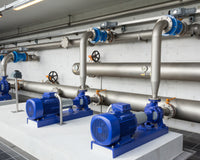
When pressure that is too low occurs mainly during peak hours or on remote floors, a compact pressure booster pump (also called a pressure-boosting pump) installed on the line supplying a branch or bathroom is a good choice. Modern devices with a flow sensor or pressure switch start automatically, enabling effective pressure boosting with minimal interference in the system.
4.3. Pressure tank system (pressure tank + pressure tank pump)
If you use your own water source or municipal water supply systems periodically provide insufficient water pressure, consider a pressure tank system. A diaphragm tank with an automatic control system and a pressure tank pump provide constant pressure and a flow “buffer,” stabilizing the operating pressure. Models with a speed controller (inverter) maintain optimal water pressure under variable demand, improving water-use comfort and reducing noise.
4.4. Multi-pump systems — larger buildings and peak demand
In multi-family and commercial buildings, we use systems with 2–4 pumps and cascade control. These types of pressure-boosting pumps make it possible to boost water pressure and maintain the set value under variable loads — this means effective pressure boosting during peak hours and quiet operation at night.
5. Equipment selection — how to avoid oversizing?
- Determine the water source parameters (minimum water pressure and available water flow from the water supply network or a well).
- Add up typical and peak water consumption (the number of outlets). This determines the need to increase the amount of water during peak periods.
- Define the target appropriate pressure level at the farthest point (e.g., 3 bar on the top floor) — this is your optimal water pressure.
- Decide whether local water pressure boosting is sufficient or whether a central booster pump installation in the boiler room will be necessary.
If in doubt, let us select a booster pump for the specific system resistance — our experience shows that this shortens commissioning and ensures effective pressure boosting without parameter “fluctuations.”
6. Installation and commissioning — the manufacturer's best practices
6.1. Booster pump installation
- Install mesh filters upstream of the system, a check valve, and a diaphragm tank on the discharge side — this stabilizes the operating pressure and makes it easier to maintain water pressure.
- Use vibration dampers and flexible connections to limit noise transmission to the structure.
- Verify the controller settings: setpoint, start/stop thresholds — this provides a real improvement in pressure with minimal energy consumption.
6.2. Pressure tank — what should you pay attention to?
- Choose the tank capacity to suit the domestic water system (number of residents, water outlets). A tank that is too small means more frequent cycles and a reduced service life of the controller.
- Check the nitrogen/air pre-charge pressure in the diaphragm tank — this is essential for maintaining adequate water pressure and preventing the operating pressure from being “lost” during water consumption.
- Ensure easy service access to the pressure switch, pressure gauge, and drain valve.
7. Operation: how to maintain results for years
- Regular filter inspections, flushing the filter bed, and checking the pressure reducer are simple ways to improve pressure without investment.
- Periodic pressure level checks (at the system inlet/outlet) make it possible to detect a pressure drop early and respond before insufficient water pressure occurs.
- After changes to the system (new outlets, increased water demand), consider readjusting the water pressure in the pump controller.
8. Diagnostic table — from symptom to action
| Symptom | Potential cause | Action |
|---|---|---|
| Low water pressure in the shower | Dirty filter, throttling at the pressure reducer | Clean the filters, adjust the valve settings, set the optimal water pressure |
| Large fluctuations in water pressure | Tank too small, no modulation | Choose a larger pressure tank / variable-speed control (constant pressure) |
| No water on the top floor | Insufficient supply from the water supply network, high losses in risers | Consider installing a central pump (booster) and adjust the pipe diameters |
| Loud operation after modernization | Poor anchoring, no dampers | Add flexible connections and adjust the mountings |
Frequently asked questions (FAQ)
Is a small booster pump for the shower enough?
Yes, if the source guarantees a minimum water pressure level and flow rate. A local booster pump improves pressure-use comfort in a specific bathroom. When the low-pressure problem affects the entire apartment or house, central pressure boosting will be more effective.
When should you choose a pressure tank instead of just a pump?
When you need not only increased water pressure, but also a stable flow “buffer” and operation with a weak supply from the water supply network or your own water source. A pressure tank system maintains constant pressure and reduces the frequency of pump starts.
Is high water pressure a problem?
Yes — excessive pressure shortens the service life of fittings. If the inlet pressure is above 5–6 bar, use a pressure reducer to set the appropriate pressure level (e.g. 3 bar) and protect the installation.
Where can I buy IPRO devices and pumps?
You can purchase our IPRO products on the B2B platform. If you are an end customer, we encourage you to check our partner stores and wholesalers. You can also always contact us: +48 22 721 11 92, biuro@dambat.pl.
Summary
First, diagnose the issue (causes of low water pressure), then remove restrictions and make minor adjustments. If that is not enough, a central or local booster pump installation and a properly selected pressure tank will ensure effective pressure boosting, stable operating pressure, and a high level of water-use comfort for years.