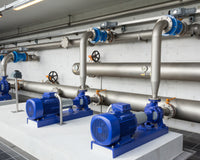

Circulation pump for underfloor heating—selection, parameters, and reliability of the IBO brand
Underfloor heating has been gaining a dominant position for years among modern heating systems in Polish single-family, multi-family, and commercial construction. Its popularity is no coincidence—low supply temperatures, even heat distribution, and high user comfort are features that installers and investors value more than those of any other system. However, behind the success of underfloor heating is a device that receives far too little attention: the circulation pump. It is the pump that determines whether the entire underfloor heating system will operate quietly, reliably, and energy-efficiently for years to come—or cause problems during the very first heating season.
Dambat—a Polish manufacturer operating continuously since 1999—supplies heating solutions to the market under the IBO and IPRO brands, which are known to installers throughout Poland. A wide selection of circulation pumps, installation accessories, and manifolds means that you can complete the selection of the right circulation pump for any underfloor heating project in one place—without compromises or overpaying.
The following guide is primarily intended for installers, sanitary-system designers, and heating-system specialists, but it will also be useful to any informed investor who wants to understand what they are paying for. Here you will find reliable information on selection parameters, hydraulic characteristics, pump types, and practical installation tips with specific figures and rules.
Why is the circulation pump the heart of an underfloor heating system?
Unlike traditional heating systems with radiators, where the heating medium can move by gravity (natural convection), underfloor heating requires water to be forced through a dozen or several dozen parallel-connected pipe loops. Each loop has its own hydraulic characteristics—specific resistance, length, and diameter. Without a circulation pump operating at the correct duty point, the entire heating system simply will not function properly: some loops may overheat, others may remain too cool, and uneven floor temperature distribution will be noticeable to the touch.
The operation of a circulator pump in an underfloor heating system differs from its operation in a radiator system in several key respects. First, the heating medium temperatures are much lower—typically 35–45°C on the supply and 30–40°C on the return, compared with 70–80°C in radiator systems. The lower temperature means lower water kinematic viscosity, which affects the system’s hydraulic characteristics and, consequently, pump selection. Second, underfloor heating system operation is characterized by significantly higher flow rates at relatively low resistance, determining the choice of a pump with a wide performance range. Third, for trouble-free operation and many years of service, build quality and the device’s energy class are especially important—so it is worth choosing high-efficiency pumps and high-durability pumps, such as those offered by Dambat as part of the IBO series.
Understanding the pump’s role is the starting point for correctly designing the entire system. Selecting a pump suitable for the operating conditions is essential. Inaccurate checking of all system components can result in excessive noise, insufficient heating in some zones, higher electricity bills, or increased failure rates. That is why analyzing the manifold, calculating hydraulic resistance, and matching the pump to the curve on which the entire system is to operate are so important.
Key parameters for selecting a circulator pump for underfloor heating
Every professional circulator pump selection starts with two fundamental hydraulic parameters: flow rate Q [l/min] and head H [m of water column]. These two values define the pump’s operating point—and this is precisely the point against which we plot the hydraulic performance curve to check whether the selected device will operate within its optimal range. It is impossible to professionally carry out circulator pump selection without knowing both values.
How do you calculate the required water flow rate?
The water flow rate through an underfloor heating system is calculated based on the design heat demand and the assumed temperature difference between the supply and return. The basic formula used in installation practice is:
Q [l/min] = (Φ [kW] / (1.163 × Δt [K])) × 16.667
Where: Φ is the installation’s heat output [kW], and Δt is the supply–return temperature difference [K]. For typical underfloor heating, Δt = 5 K is assumed (e.g. supply 40°C, return 35°C). Example: for a building with a heat demand of 15 kW, the required water flow rate is:
Q = (15 / (1.163 × 5)) × 16.667 = 43.0 l/min
This is the total value for the system. The actual water flow through individual loops is set at the manifolds using flow regulators or thermostatic valves, so the pump selection parameters must take into account the operation of the entire manifold system, not just one loop. When selecting a circulating pump for large facilities with many heating circuits, it is worth using the tools available on the Dambat website, including the volumetric flow calculator.
How is the head determined?
The head (available pressure) is determined for the hydraulically most unfavorable loop—usually the longest one or the one with the greatest local resistance. It includes the linear resistance of the pipes, local resistance (fittings, tees, thermostatic valves, manifold), and, in the case of a condensing boiler, the resistance of the boiler heat exchanger. In practice, for a typical underfloor heating system in a single-family home, with loops 80–120 m long and ø16 PE-RT or PEX pipe, hydraulic resistance is usually between 1.5–4.0 m H₂O. These are relatively low values, so pumps with low to medium head and high volumetric flow are selected.
Pump selection parameters should be included in the technical documentation for every underfloor heating project. A good underfloor heating design includes a manifold diagram, hydraulic calculations, pump and controller selection, and guidelines for the installer regarding flow settings on individual loops. An installer who works without such a document operates intuitively—and intuition rarely replaces calculations.
Types of circulating pumps used in underfloor heating
There are two main motor technologies used in circulating pumps on the market: AC asynchronous motors (traditional, with a wet rotor) and modern EC motors with permanent magnets (electronically commutated). The choice between them directly affects operating costs, ease of use, and the long-term efficiency of underfloor heating.
AC pumps – proven and economical to purchase
Classic circulation pumps with asynchronous motors are a solution known for decades and still used in smaller systems. Their main advantages are simple construction, resistance to difficult operating conditions, and a relatively low purchase price. They usually offer 2–3 fixed speeds, allowing manual output adjustment—the installer selects the appropriate speed for the heating season or the characteristics of the building. The disadvantage is constant power consumption without the ability to automatically adapt to current demand, resulting in higher electricity costs compared with EC pumps.
EC pumps – modern and energy-efficient
Modern circulation pumps with EC motors, such as the MAGI series offered by Dambat under the IBO brand, are energy class A devices (EEI ≤ 0.23) equipped with electronic output control. The permanent-magnet motor and differential pressure controller automatically adjust output to the system's current needs—they respond to the closing of thermostatic heads in individual zones and reduce the speed instead of pumping at full power into a closed circuit. These modern circulation pumps are precisely aligned with the trend toward energy-saving solutions and meet the requirements of the ErP (Energy-related Products) regulation concerning the energy efficiency of devices.
Dambat offers a wide range of modern circulation pumps with EC and AC motors for heating systems under the IBO brand—including models with threaded and flanged connections, adapted to various system sizes. The full range can be viewed in the circulation pumps and installation equipment category on the manufacturer's website.
Underfloor heating circulation pump – what distinguishes dedicated devices?
The term underfloor heating circulation pump or underfloor heating pump does not refer to a separate product class, but rather indicates devices whose technical parameters—above all, the Q/H characteristic—have been selected specifically to meet the requirements of underfloor heating systems. Such an underfloor heating circulation pump is characterized by a wide flow range combined with a relatively low head, corresponding to the hydraulic profile of a typical underfloor heating system with a multi-circuit manifold. IBO offers models that meet these criteria, with the option to match the power and connections to the specific underfloor heating project.
Selecting a circulation pump step by step – a methodology for installers
Below, we present a concise selection methodology used in design practice. It is a proven, logical procedure that can be fully verified through calculations. Choosing the right pump should not result from familiarity with a single brand or model—it should be based on an analysis of the specific system.
- Calculate the building or zone’s heat demand (in kW) using EN 12831 standards or simplified indicator-based methods.
- Determine the required water flow rate Q [l/min] using the formula Q = Φ / (1.163 × Δt) × 16.667, assuming Δt = 5 K for underfloor heating.
- Calculate the hydraulic resistance of the most hydraulically unfavorable loop—linear losses according to Darcy–Weisbach or the pipe manufacturer’s tables, and local losses using the equivalent-length method.
- Determine the duty point (Q; H) and plot it on the pump curve chart—the duty point should lie within the optimum efficiency range (BEP ± 20%).
- Check the energy requirements—does the pump meet ErP requirements (EEI ≤ 0.23 for class A)? Does it offer automatic speed control?
- Verify the installation dimensions—union spacing (most commonly 130 mm for DN25/32 pumps), flow direction and thermal insulation requirements.
- Choose the right pump from the Dambat IBO range or consult the manufacturer’s technical department using the form on dambat.pl.
Choosing the right pump is a decision that should be documented in the installation’s technical report. A reliable installer provides the investor not only with the warranty card but also with basic calculations confirming that the selected circulation pump operates at the optimum point on its performance curve.
Energy efficiency of underfloor heating systems—the role of the pump
Underfloor heating efficiency depends on several factors: the efficiency of the heat source (condensing boiler, heat pump), the quality of the building’s insulation, zone control and—often overlooked—the energy efficiency of the circulation pump. A traditional circulation pump in class C or D consumes 50 to 120 W throughout the heating season (7–8 months in Poland), which, with 3,000 operating hours per year, amounts to 150 to 360 kWh of annual electricity consumption. By comparison, a modern class A EC circulation pump consumes 5 to 30 W in variable-speed mode—70–90% less energy.
Underfloor heating efficiency directly affects the total operating cost of the heating system. Over a 15-year operating period (the typical assessment horizon for a heating system), the difference in electricity costs between a Class D pump and a Class A pump may amount to several thousand zlotys, depending on consumption and energy costs. Therefore, investing in a more efficient device pays for itself relatively quickly – usually within 2–4 heating seasons. This is an argument worth communicating to investors when discussing the system budget.
Dambat supplies high-efficiency pumps from the MAGI series (Class A, EEI ≤ 0.23) that meet all the requirements of the ErP regulation. High-efficiency pumps feature automatic control based on a proportional curve or constant differential pressure – operating modes suited to various types of heating systems, including systems with zonal thermostatic control. More about our product can be found in the relevant category of energy-efficient circulation pumps.
Underfloor heating system – installation and commissioning of the circulation pump
Even the best-matched circulation pump will not perform its function if installed incorrectly. An underfloor heating system is a complex hydraulic system in which every component must be installed in accordance with professional installation practices and the manufacturer's guidelines.
Several principles determine the reliability of a heating system:
- Direction of the rotor shaft during installation – the pump rotor shaft should be horizontal (horizontal shaft), ensuring proper motor venting and bearing cooling by the heating medium. Vertical installation may shorten the device's service life.
- Ventilation of the system – the entire system must be vented before starting the pump. The presence of air in the heating system is one of the most common causes of cavitation, noise, and reduced underfloor heating efficiency.
- Thermal insulation of the pump – we recommend installing it in an insulated housing (insulating sleeve) or using thermal protection. Lack of insulation results in heat loss and condensation on the electrical housing.
- Mesh filter upstream of the pump or magnetic filter – every heating system should have a mesh filter (sediment filter) with a mesh size of ≤ 0.5 mm or a magnetic filter installed upstream of the pump inlet; ideally, both should be used. Mechanical impurities are the main cause of damage to mechanical seals and impellers.
- Separate bypass branch for the underfloor heating zone – when connecting an underfloor heating system to a radiator system, it is recommended to use a differential-pressure valve or bypass that protects the pump from operating with closed circuits (closed thermostatic heads).
- Adjusting flow rates at the manifold – after commissioning the system, the next step is to hydraulically balance all the loops at the manifold using flow meters (flow regulators). Only after this adjustment will the system operate according to the design.
Manifolds and pump groups for underfloor heating are available from Dambat under the IBO brand. This is complete installation equipment comprising manifolds, pump groups, and control components—everything needed to efficiently commission a modern underfloor heating system.
IBO circulation and heating pumps – why choose Dambat products?
Dambat is a Polish company with over 25 years of experience in the production and distribution of pumping equipment. Operating since 1999 and offering products under the IBO and IPRO brands, the company has built a strong position among installers and contractors who value reliability, spare-parts availability, and efficient technical service. For heating-system specialists, the category of circulation and heating pumps is particularly important—these devices must operate reliably for a dozen or more years, often in conditions of high dust levels, fluctuating system pressure, and cyclical switching on and off.
Highly durable pumps from the IBO range feature a wet rotor made of stainless steel or ceramic materials, eliminating the traditional problems associated with corrosion and mechanical seal wear. The housings are made of cast iron or bronze—materials proven over decades in heating installations. Highly durable pumps of this type are standard in commercial and industrial installations, where downtime means real financial and logistical losses.
Dambat’s offer for installers includes not only the devices themselves, but also comprehensive technical support: data sheets with Q/H curves, installation instructions, CE declarations, and access to the B2B platform for installation companies. Browse the current range and use the calculation tools directly on dambat.pl.
Underfloor heating design and pump selection – cooperation with the installer
The most common mistake when implementing an underfloor heating system is separating the underfloor heating design stage from the equipment selection stage. The designer calculates the heat demand and draws the loop layout; it is important that the installer knows the planned layout and can select the right pump for the system conditions. This helps avoid unpleasant surprises such as noise or excessive consumption.
A good underfloor heating design should include:
- Heat demand calculations according to EN 12831 or PN-EN 12831-1
- Hydraulic diagram showing the loop circuits and manifold locations
- Pump selection – model, operating point, speed/operating mode, installed power
- Flow settings for individual manifold loops
- Guidelines for installers on adjustment, air removal, and pressure testing
Dambat supports installers at every stage of the project—from selection through technical consultation to post-warranty service. The IBO and IPRO brands guarantee that spare parts will not be a problem to obtain in 5 or 10 years—something absolutely crucial for heating system installations.
Modern heating systems – the circulation pump as part of building automation
Modern heating systems integrate with building automation (BMS, Smart Home systems) and require devices capable of two-way communication or, at minimum, adaptive operation based on external signals. Modern circulation pumps equipped with EC controllers can operate in AUTO mode, automatically optimizing the operating point based on changes in system pressure. Some models support communication protocols (e.g., a 0–10 V analog input or digital ModBus), enabling integration with a higher-level building controller or a boiler with an external pump control function.
In the context of heating system operation in modulated mode (a condensing boiler or heat pump with power modulation), synchronizing the pump's operation with the heat source's output is particularly important. A constant pump speed when the boiler is operating at reduced output leads to too small a temperature difference between the supply and return, which reduces the boiler's condensing efficiency—and conversely, insufficient pump capacity when the boiler is operating at full output causes the heat exchanger to overheat. Modern electronic control of an EC pump solves this problem automatically by responding to the actual pressure difference in the system.
These energy-saving solutions—electronically controlled EC pumps integrated with modulating heat sources—make it possible to achieve actual seasonal system coefficients of performance (SCOP) close to the theoretical values declared by boiler and heat pump manufacturers. Implementing a modern heating system without considering the energy class of the circulator pump is like buying a high-performance engine and installing it with an old, high-resistance gearbox. You can find the full range of energy-efficient IBO pumps in the energy-efficient circulator pumps category.
IPRO pumps from Dambat – premium solutions for demanding installations
The IPRO brand, developed by Dambat as a premium line, is an answer to the needs of installations requiring a higher level of reliability, an extended warranty, and advanced technical specifications. IPRO products come with a 36-month manufacturer’s warranty and are intended for applications with elevated requirements—commercial and industrial facilities, as well as installations where uninterrupted operation is critical.
For heating systems serving multi-zone facilities, hotels, production halls, or office buildings, where heating systems operate around the clock and throughout the year, using devices from the IPRO line is economically and technically justified. The higher purchase cost is offset by a longer service life, lower servicing costs, and the availability of dedicated replacement parts. You can browse the full IPRO range in the IPRO category on dambat.pl.
FAQ – frequently asked questions about circulator pumps for underfloor heating
Below you will find answers to the questions installers and investors most frequently ask when selecting and installing a circulator pump in underfloor heating systems.
Which circulator pump should you choose for underfloor heating in a single-family home?
Selecting a circulator pump for underfloor heating in a typical single-family home (up to 200 m² of heated floor area) begins with calculating the required flow rate and the system’s hydraulic resistance. For a building with a heat demand of 10–15 kW and underfloor heating loops using ø16 pipe, the required flow rate is typically 25–50 l/min, while the resistance is 1.5–3.5 m H₂O. In this case, energy-efficient A-class pumps from Dambat’s IBO series, equipped with an EC motor and automatic proportional control, are a good choice. Avoid overestimating the required parameters—a pump that is too large will operate noisily and inefficiently.
How does an A-class circulator pump differ from a C- or D-class pump?
The energy class of a circulation pump is expressed by the EEI (Energy Efficiency Index). A Class A pump has an EEI ≤ 0.23, while Class C or D pumps have values above 0.40. In practice, this means that a Class A pump consumes 3–5 times less electricity than an older Class C pump at a comparable hydraulic output. Dambat offers Class A pumps from the MAGI IBO series in its energy-efficient circulation pump category.
How often should a circulation pump in a heating system be serviced?
A modern wet-rotor circulation pump with an EC motor is virtually maintenance-free throughout its service life—it has no mechanical seals requiring replacement or oil-lubricated bearings. Basic maintenance tasks include checking the system pressure annually and topping up with demineralized water if necessary, checking the pump settings (operating mode and selected curve), venting it with a manual air vent if cavitation noises are audible, and checking the condition of the mesh filter upstream of the pump and cleaning it every 1–2 seasons. For IBO Dambat pumps, service instructions and replacement-part diagrams are available directly on the manufacturer's website.
What is a pump’s operating point, and why is it so important?
The pump operating point is a pair of values (Q; H)—volumetric flow rate and head—at which the pump actually operates in a given system. It is determined graphically as the intersection of the pump characteristic curve (Q/H) and the system characteristic curve. If the operating point lies near the BEP (Best Efficiency Point) zone, the pump operates at its highest efficiency—quietly, without cavitation, and with minimal power consumption. An operating point shifted to the left (flow rate too low) risks motor overheating and cavitation, while a point shifted to the right (flow rate too high) may cause overloading and excessive noise. Therefore, selecting a circulation pump is not a matter of choosing “just in case”—it means precisely targeting the operating point.
Is an IBO circulation pump from Dambat suitable for operation with a heat pump?
Yes. IBO Dambat circulation pumps are designed to operate with heating medium temperatures of up to 110°C (standard versions) or 95°C (energy-efficient EC models), allowing them to be used with condensing gas boilers, oil boilers, and heat pumps. In heat pump systems, the heating medium temperature is most often between 35 and 55°C, which is fully within the operating range of IBO pumps. It is important to account for a slightly different hydraulic characteristic when selecting a pump—heat pumps operate with higher flow rates and a smaller temperature difference than gas boilers. Therefore, EC pumps with automatic proportional control are particularly recommended here.
What is the optimal operating mode for a circulation pump in a underfloor heating system?
In a underfloor heating system with zone-based thermostatic control (thermostatic heads on the manifold or actuators controlled by an automation system), proportional-pressure-curve mode (“AUTO” mode or “proportional curve”) is recommended. In this mode, the pump reduces the available pressure proportionally as the flow decreases—which happens automatically when some thermal heads close after the set temperature is reached in a zone. This ensures that the pump always operates quietly and with optimal electrical power consumption. Constant-pressure mode (ΔP-c) is used in radiator systems with thermostats installed on each radiator. Constant-speed mode (speeds I/II/III) is intended for systems without thermostatic control or during system commissioning.
How do I select a circulation pump for a large multi-zone installation (e.g., a multi-family building)?
In large multi-zone installations—tenement buildings, multi-family buildings, and hotels—one main (group) pump is typically used for the primary circuit, with separate pumps for the secondary circuits (zone manifolds). Selecting the main pump requires adding up the flow rates of all secondary circuits and determining the resistance of the primary circuit (boiler room + main manifold). In this case, the circulation pump should operate in constant-pressure or proportional-curve mode, and its operating point must be determined for the system at full load. For such facilities, Dambat offers industrial pumps and IBO flanged versions, available in the industrial pumps category.
Can I install a circulation pump myself, or do I need to have an installer do it?
Installing a circulation pump in a central heating system does not require special qualifications—in theory, anyone able to work with plumbing systems can do it. In practice, however, properly commissioning a circulation pump requires knowledge of the system’s characteristics, the ability to read Q/H curves, and expertise in bleeding the system and hydraulically balancing the manifold. Incorrect settings (the wrong operating mode, air trapped in the system, or a lack of flow balancing) can cause thermal discomfort, noise, or a shortened service life. It is recommended that commissioning be entrusted to a qualified installer who will confirm in writing that the selection and settings are correct—this protects both the investor and the device itself.
Where can I find technical documentation and instructions for IBO Dambat pumps?
Complete technical documentation for IBO Dambat pumps—including installation and operating instructions, datasheets with Q/H curves, CE declarations, spare-parts diagrams, and design files (DWG/DXF)—is available free of charge in the “Downloads” section of the manufacturer’s website. dambat.plA manual search tool is also available, allowing you to quickly find documentation for a specific model.