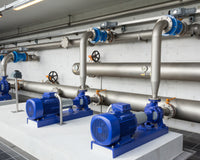

Submersible pumps are used in many situations: from domestic installations, through gardening and agriculture, to manufacturing plants and service facilities. Their main task is to reliably deliver water from sources such as deep wells and dug wells. In places where the presence of mineral particles prevents effective pumping, sand-resistant pumps come to the forefront—a special category of devices designed to operate in water containing sand. A properly selected submersible pump provides stable flow and high efficiency, as well as long, trouble-free operation.
What does sand resistance involve?
A sand-resistant pump differs in design from standard models. Durable materials are used here (stainless steel, technopolymer elements, aluminum components), and the flow channels are shaped so that particles are carried along and safely discharged. In many models, controllers with probes provide protection by responding to a lack of water and stopping operation—protecting against so-called dry running. As a result, submersible pumps help maintain a continuous water supply even in difficult water intakes and minimize the risk of damage.
Applications—where do submersible pumps perform well?
The range of applications includes private deep wells, any typical drilled well, as well as industrial deep-water intakes. Submersible pumps serve single-family homes, field and garden irrigation systems, installations on farms, in service and manufacturing facilities, and even fountains and fire-protection systems. Such a wide range of submersible pump applications results from their pressure-based design—a submersible pump provides a stable water column over long pipeline sections, even with high demand.
Basic features and benefits
-
Materials and workmanship: technopolymer components, stainless steel, and precision bearings contribute to the quality of the submersible pump and its long service life.
-
Resistance to the medium: a design adapted to sandy water reduces wear on the hydraulic section during deep-well pumping.
-
Electronics and control: controllers with probes stop operation when there is no water, protecting the motor; soft start is often available.
-
Universal installation: many models can operate vertically and horizontally, expanding the use of submersible pumps in confined spaces.
-
Parameters: high material resistance and optimal pump efficiency support continuous operation in agriculture and industry.
Choosing a submersible pump—what should you consider?
Device selection should be based on several input data points. The most important are: the type and diameter of the borehole, depth, water-table level, and distance from the point of use. Water quality (sand content, pH), required pressure, and expected consumption are equally important. In practice, choosing a submersible pump comes down to finding a compromise between a high-efficiency submersible pump (flow rate), head, and resistance to abrasion. If the water contains noticeable amounts of sand, models in the sand-resistant pump class provide a greater safety margin.
Key selection parameters
-
Flow rate and pressure: the required flow (l/min) and head determine the high efficiency of the installation.
-
Geodetic conditions: differences in elevation, pipeline length, and pipe diameters affect losses and the actual pump efficiency.
-
Water characteristics: mineral particles and chemical parameters determine whether choosing a sand-resistant pump version makes sense.
-
Operating mode: continuous/intermittent operation, possible vertical and horizontal operation, and the need for dry-running protection.
-
Economics: the device’s energy efficiency and service costs—the use of the pump should be cost-effective throughout its life cycle.
Typical application areas
Submersible pump applications include, among others: water-supply and pressure-booster installations, single-family homes and plots, garden and field irrigation, agriculture and horticulture, service businesses and manufacturing plants, as well as firefighting systems and fountains. In these roles, submersible pumps offer stable pressure and long pumping distances, enabling convenient water use at multiple points simultaneously.
Operation and safety
To ensure the system operates for a long time without failure, it is advisable to use dry-running protection, clean filters regularly, and monitor operating parameters. Choosing units with soft start reduces mechanical overloads, while appropriate electrical protection safeguards the motor. This is how submersible pumps help maintain continuous water supply to the home and crop irrigation throughout the season.
Summary
Submersible pumps in a sand-resistant version are solutions for demanding water intakes where the water contains mineral particles. Their design and materials support system durability, while intelligent control improves safety. The right selection—based on borehole parameters, water quality, and expected flow—ensures that a submersible pump provides a stable supply for homes, farms, and irrigation systems. A well-designed system and professional advice make it easier to choose correctly and achieve effective use of submersible pumps for many years.
FAQ—Frequently asked questions about sand-resistant submersible pumps
Sand-resistant submersible pumps are devices designed to operate in water containing mineral particles. Their hydraulic section and flow channels are shaped to carry sand particles along and safely discharge them. They use abrasion-resistant materials (including technopolymers, aluminum, and stainless steel), which limits wear and promotes stable operation even in more difficult water intakes. They are suitable for deep wells and water intakes where sand is suspended in the water. According to the description, selected designs tolerate elevated sand content (even above 500 mg/m³) and water with a lower pH, which contributes to corrosion resistance and longer component life. Typical submersible pump applications include: water-supply and pressure-booster installations, single-family homes and plots, horticulture and agriculture (irrigation), service businesses and manufacturing plants, as well as firefighting systems and fountains. In these roles, a submersible pump provides stable flow and pressure over long pipeline sections. Yes. Many models are designed to operate both vertically and horizontally, making installation easier in confined spaces and allowing them to be adapted to the specific characteristics of the borehole or tank. Durability is ensured by: technopolymer elements, stainless steel, aluminum components, as well as brass details with glass fiber. Careful attention to tightness, resistance to mechanical overloads, and protection against oil loss supports long, trouble-free operation. The described sets use controllers with probes that stop operation when there is no water (protection against so-called dry running). Other important features include: highly sealed motors, electrical components with increased moisture resistance, and an optional soft start that limits mechanical overloads during startup. When choosing a submersible pump, consider: the type of water intake (e.g., a drilled well), the borehole diameter and depth, the water-table level, the distance to the point of use, soil and water conditions, and target consumption (number of users). This makes it possible to select a model with the required pump efficiency and sand resistance. The main advantages include: a wide range of available sizes, high build quality, the ability to operate in sandy water, corrosion resistance (including at lower pH), vertical and horizontal operation, long service life, additional protection (dry running), and, in selected models, a wide motor operating range and soft start. Yes. Submersible pumps can supply pressure-booster installations and irrigation systems in horticulture and agriculture. Thanks to stable pressure and long pumping distances, they can easily serve several water outlets simultaneously, according to the needs of a farm or home. The basis is regular monitoring of the water intake’s operating conditions, use of dry-running protection, periodic inspections, and cleaning of components exposed to deposits. Proper selection for the conditions (water quality and demand) and correct installation are the simplest ways to achieve many years of stable operation. You can buy our IBO products on the B2B platform. If you are an end customer, we encourage you to check our partner stores and wholesalers. You can also always contact us: +48 22 721 11 92, biuro@dambat.pl.What are sand-resistant submersible pumps and how do they work?
What type of water are they intended for?
Where are they used?
Can they operate vertically and horizontally?
What materials and design solutions are used?
What safeguards improve operating reliability?
How do you choose the right pump for a specific well?
What are the key advantages of sand-resistant pumps?
Are they suitable for pressure-booster installations and irrigation?
How should you maintain the pump so that it operates for a long time without failure?
Where can I buy IBO devices and pumps?