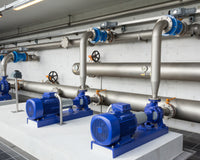

Submersible pumps are used in many different situations, both in households and in industry and agriculture. Their primary application is supplying water to homes, gardens, fields, as well as production plants and service outlets. High-quality devices are effective even where other solutions cannot be used. Some models also have additional features that make the entire water intake process even more efficient and smooth, while providing even greater overall capabilities.
One popular option is sand-resistant submersible pumps, designed to operate in contaminated, sand-rich environments. How do they work? What are their characteristics? And what are their advantages? We answer these and other questions in our article.
Basic characteristics
Sand-resistant submersible pumps are made from the highest-quality materials and developed using the latest technology. They are resistant to the presence of sand, which poses a serious threat even in seemingly very clean water. Their uninterrupted operation is possible, among other things, thanks to an appropriate design and the use of specialized materials such as technopolymers, aluminum, and stainless steel.
In many cases, sand-resistant submersible pumps are equipped with special controllers containing probes that enable operation in very difficult conditions and—which is important—interrupt the liquid intake process if there is no water in the well. This function prevents the most important components, including the motor, from seizing and keeps the device’s failure rate relatively low.
To make a good decision and choose a device that will work well in our situation, it is worth seeking expert advice and considering the most important factors, such as the type of well, the depth of the borehole, the position of the water table, the distance from the well to the place where we want to use the water, as well as the general soil and water conditions in the given area. The intended use of the water is also important, as is the number of people who will use it and, consequently, the broadly understood demand.
Sand-resistant submersible pumps - advantages
Sand-resistant submersible pumps are high-quality products offering many advantages. Some of them include:
- wide availability and a variety of sizes, making it possible to select a device suited to the needs of a particular user,
- the highest-quality construction, enabling very good operating results,
- the ability to pump water with an elevated sand content, even above 500 mg/m³,
- excellent resistance to low-pH water and, consequently, resistance to corrosion,
- the ability to operate in difficult conditions, often both vertically and horizontally,
- some models offer a wide motor operating range and a so-called soft start,
- long service life and no operating problems,
- wide range of applications: water supply systems, pressure-boosting systems, households, single-family homes, allotments, municipal water systems, horticulture and agriculture, irrigation systems, service businesses, production and industrial plants, fire-extinguishing systems, fountains,
- additional protection in the event of so-called dry running, meaning pump operation without water,
- maximum motor tightness, as well as the ability to operate reliably even under high pressure,
- excellent construction: designed for intensive use, resistant to mechanical overloads and damage, leak-tight, protected against oil loss, with waterproof electrical components,
- safe, long-term operation without damage,
- made of durable brass, long-lasting stainless steel, and high-quality Noryl reinforced with glass fiber.