Quick answer
FIXLine diaphragm tanks are versatile vessels designed to stabilize pressure and store water in booster, heating, and domestic hot water systems. Thanks to their steel construction and butyl diaphragm, they provide high durability, operational safety, and resistance to temperatures of up to 90°C.
Who are they for?
-
For plumbing installers – reliable, durable vessels with a wide range of applications.
-
For household users – pressure stabilization in cold- and hot-water systems.
-
For booster-system owners – effective water storage and protection of the system against water hammer.
-
For owners of central heating and domestic hot water systems – pressure equalization and improved system safety.
-
For users of systems with inverters – smooth operation control and minimized pressure pulsation.
Applications
- Water stabilization and storage in booster systems (vertical and horizontal).
- Pressure equalization in water systems controlled by inverters.
- Operation in central heating systems.
- Operation in domestic hot water systems.
- Use in solar systems and systems with up to 50% glycol.
FIXLine diaphragm tanks provide pressure stabilization in systems operating across a wide range of temperatures and loads.
Features, description, and technical data
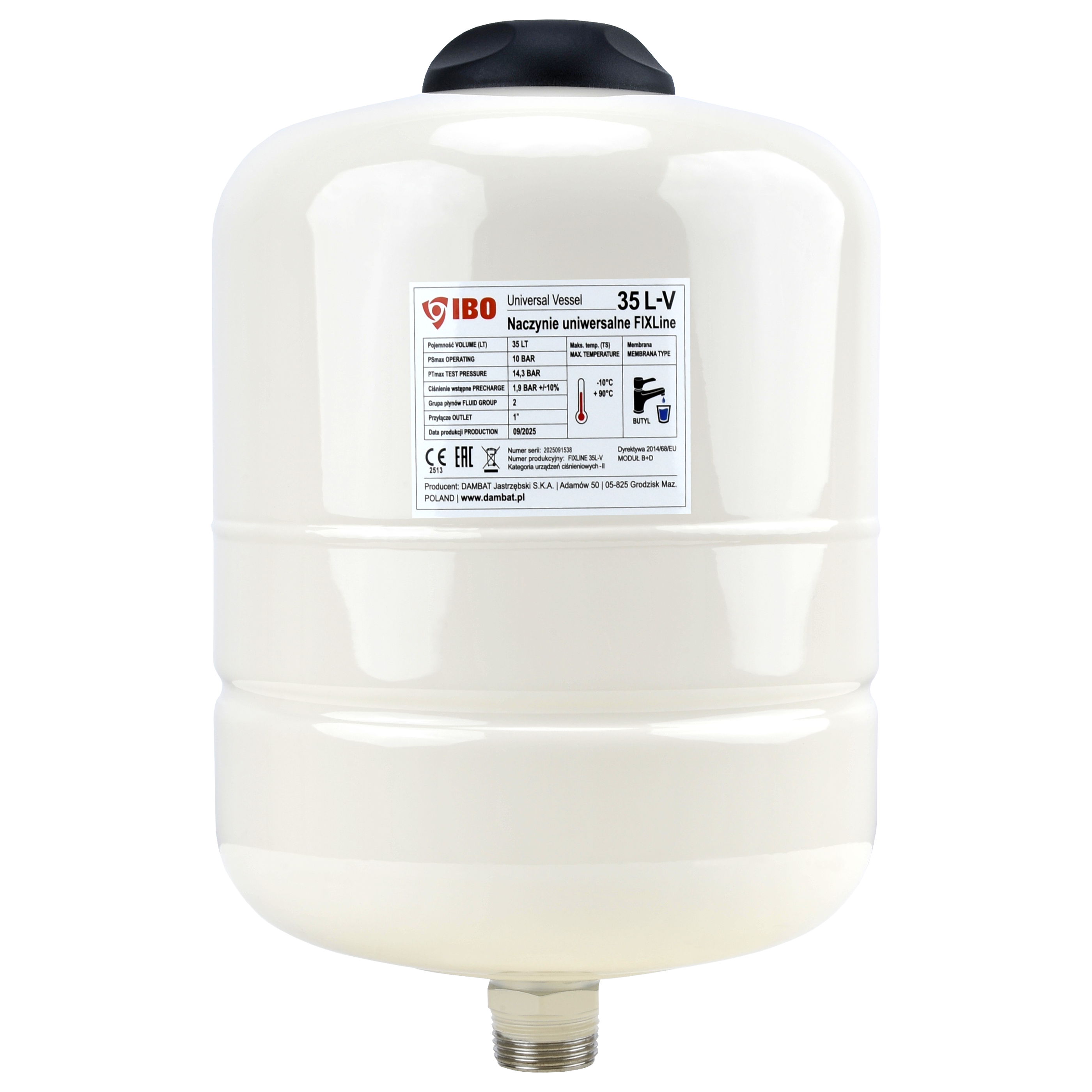
FIXLine diaphragm tanks are steel vessels equipped with a durable, non-replaceable diaphragm made of BUTYL, which separates the liquid from the air chamber. The diaphragm is characterized by high tensile strength and resistance to high temperatures. The tank design enables operation in cold-water, hot-water, and heating systems.
Each model has a valve that enables the pre-charge air pressure in the tank to be checked and topped up. According to the FIXLine product catalog, the tanks are designed for systems in which the glycol solution does not exceed 50% :contentReference[oaicite:1]{index=1}.
Technical parameters (for the entire FIXLine series)
-
Operating temperature: from -10°C to 90°C
-
Maximum operating pressure: 10 bar
-
Maximum test pressure: 14.3 bar
-
Pre-charge pressure: 1.9 bar ±10%
-
Diaphragm: BUTYL
-
Intended use: central heating, domestic hot water, cold/hot water, systems with glycol ≤50%
-
Available versions: vertical (5–100 V), horizontal (24–100 H)
-
Connection: 1”
Dambat – a trusted manufacturer of pumps and hydrotechnical equipment with quality certificates.
FAQ
How do FIXLine diaphragm tanks work?
FIXLine tanks use a BUTYL diaphragm to separate the water from the air cushion, thereby stabilizing the pressure in the system. This allows the system to operate more smoothly and protects it against pressure surges. The solution also increases the service life of system components.
Which systems are FIXLine tanks designed for?
The FIXLine series can operate in domestic water, central heating, domestic hot water, booster, and solar systems. They can be used in both homes and commercial installations. They are suitable wherever pressure equalization or stabilization is required.
Can FIXLine tanks operate with glycol?
Yes, provided that the glycol solution does not exceed 50%, as confirmed by the manufacturer's product catalog. This is important in solar systems or systems requiring freeze protection. Exceeding this limit may affect the service life of the diaphragm.
What sizes and capacities are available for FIXLine?
The series includes vertical models from 5 V to 100 V and horizontal models from 24 H to 100 H. They differ in dimensions, capacity, and mounting configuration. This makes it possible to select the optimal tank for any system.
Is the diaphragm in FIXLine tanks replaceable?
No, the diaphragm in FIXLine tanks is non-replaceable due to their steel construction. However, it is made of highly durable BUTYL with high thermal resistance and strength. This ensures tightness and long-term operation in demanding systems.
What are the benefits of using a diaphragm tank?
The tank stabilizes pressure, protecting the system against water hammer. This extends the service life of pumps, valves, and other system components. It also ensures smoother and quieter system operation.