How to legally use your own well? Owner's Guide (2025)
1. Normal use of water – when you do not need a permit
Pursuant to the Water Law, the land owner has the right to the so-called "ordinary use of water". This means that without additional formalities you can:
- drill a well up to 30 meters,
- take water in an amount up to 5 m³ per day (annual average),
- use it only for your needs own household or farm.
Important: you may not sell this water or make it available to other entities.
2. When is a water permit required?
A water permit is required if:
- the well depth exceeds 30 m,
- water intake is greater than 5 m³ per day,
- water is used for business activities.
Lack of permission in such cases may result in administrative and financial penalties.
3. Penalties for illegal water consumption – what threatens well owners?
Illegal abstraction of groundwater, e.g. without a permit from a well deeper than 30 m or above 5 m³/d, has serious consequences. Polish Waters may impose increased administrative fees, many times higher than the standard rates. In extreme cases, there may also be an order to close the intake and restore the area to its original condition. The financial penalty may range from several to several dozen thousand zlotys - so it is definitely cheaper and safer to ensure the legality of the well.
4. Documents needed for a water permit
An application for a permit (Articles 389-396 of the Water Law) requires attaching a number of documents:
- Application (Polish Waters form).
- Water law report – descriptive and graphic.
- A document confirming legal title to real estate.
- Extract and excerpt from the Local Development Plan or decision on the General Meeting.
- Arrangements with the owners of neighboring land (if the installation runs through someone else's land).
- Environmental decision (if required).
- Stamp duty proof.
- Industry design of a well with a description of health and safety and required distances (§31 WT).
- Water consumption monitoring and measurement plan.
The water law report is a basic document that must be submitted together with the application for a water law permit. It consists of a descriptive part (purpose and method of water use, abstraction characteristics, impact on the environment) and a graphic part (maps, diagrams, installation cross-sections). It must be prepared in accordance with the requirements of Polish Waters, and is often developed by specialized design offices. The report also includes evidence of rights to the property, drawings from the local development plan or WZ, and an industry design of the well. A complete report is a guarantee of efficient obtaining of the permit.
5. Minimum distances from objects
The well must be located in accordance with §31 of the Technical Conditions (MI Regulation of 12/04/2002). For drinking wells, the following apply:
- 5 m from the plot border,
- 7.5 m from the axis of the ditch,
- 15 m from livestock buildings, silos, tight tanks,
- 30 m from sewage infiltration pipes,
- 70 m from animal enclosures and filtration fields.
6. Good practices in locating and operating wells
- Choose a place at the highest point of the plot.
- Move the well away from a septic tank, slurry or composter.
- Make sure the enclosure is tight and the terrain slopes outside.
- Install a water meter - it will help you avoid exceeding the permissible limits.
- Perform water tests every 2 years (microbiology, iron, manganese).

7. A well in times of drought - why monitoring is important
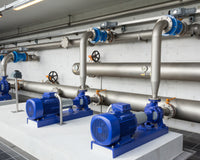
Climate change is making periodic droughts more frequent. In such conditions, it is important to use your well responsibly and sparingly. The simplest solution is to install a water meter or flow meter, which will allow you to control the consumption and avoid exceedances. It is also worth using pumps with controllers VFD – maintain constant pressure and reduce energy consumption. Protection against dry running and monitoring of pump operation not only allow you to meet legal requirements, but also protect the well during periods of low water levels.
Local restrictions on groundwater abstraction are becoming more and more common. That's why installers recommend systems with:
- water consumption metering,
- protection against dry running,
- inverter control (VFD) for energy efficiency.
These are solutions you can find in pumps IBO i IPRO.
8. Why is it worth preparing?
- Documents and permits are not just a formality - they are also protection against penalties.
- Correct well location protects drinking water from contamination.
- Good operational practices extend the life of the pump and the entire installation.
Documents needed to legally dig your own well
To obtain a water permit for a well deeper than 30 m or with water consumption > 5 m³/day, a complete set of documents is required. Below is a list with the legal basis:
| Documentary | Legal basis / source |
|---|---|
| Application for a water permit (Polish Waters form) | Water law – art. 389–396 |
| Water law report - descriptive part (purpose, amount of abstraction, impact on the environment) | Water law – art. 409–410; Polish Waters guidelines |
| Water law report - graphic part (maps, cross-sections, installation diagrams) | Polish Waters (gov.pl) – requirements diagram |
| A document confirming the legal title to the property (e.g. land and mortgage register, notarial deed, lease) | Civil Code; administrative practice |
| Extract and excerpt from the local development plan or decision on development conditions (WZ) | Act on spatial planning and development |
| Arrangements/consents of neighboring land owners (if the installation passes through someone else's land) | Civil law |
| Environmental decision (if required for the investment) | EIA Act (on environmental impact assessments) |
| Proof of payment of stamp duty | Stamp Duty Act |
| Industry design of a well/installation (with health and safety description, minimum distances according to WT §31) | MI Regulation of 12/04/2002 |
| Consumption monitoring and measurement plan (e.g. water meter, flow meter) | Water law – user obligations |
FAQ - How to legally use your own well (2025)
Below you will find the most frequently asked questions and answers. Click to expand.
Does my well require a water permit?
No if total you meet the conditions for "ordinary use of water": depth up to 30 m, conscription to 5 m³/d (annual average) and only for the purposes of your own farm (without selling/making it available to others).
Yes - if any condition is exceeded (depth >30 m, consumption >5 m³/d or business use).
How to calculate the limit of 5 m³/d "on an annual average"?
This is a daily average over 365 days. Example: 900 m³ in the season and 0 m³ in the off-season gives 900/365 ≈ 2.47 m³/d — limit maintained.
- Put it on water meter.
- Record stocks every month and calculate the annual average.
- When the forecast exceeds 5 m³/d - start the permitting process.
What does "ordinary use of water" mean and what is not allowed?
This is private use of water for home/agriculture on your own plot. It's not allowed sell water, supply it to other people's businesses or use it in business processes without permission.
If your company uses it (e.g. guesthouse, greenhouse) - you will need a water permit.
How to understand the depth of the well "up to 30 m" and how to prove it?
It is about the depth of the well being calculated from ground level to the bottom well. Not to the water table or to the location of the pump.
Store hole metrics/drilling profile — this is evidence during the inspection.
How to measure minimum distances when locating a well?
For a drinking well (WT §31): 5 m from the plot border, 7.5 m from the axis of the ditch, 15 m from livestock buildings/silos/tight tanks, 30 m from the drainage pipes and 70 m from paddocks/filtration fields.
If the plot does not allow for the distance to be met, the system must be redesigned (e.g. move the drainage pipes).
What documents will be needed for a water permit?
- Application (Polish Waters form) + proof of payment.
- Water law report (description + graphic part).
- Legal title to the property, local zoning plan/wz, possibly environmental decision.
- Industry design of the well (OSH, distances from §31), measurement plan.
- Arrangements with land owners (if the installation passes through someone else's land).
What are the consequences of illegal groundwater abstraction?
Increased administrative fees, an order to suspend the use of the intake and restoration of the area, as well as financial penalties are possible.
Protect yourself: a water meter + a register of readings, a set of technical documents and - in the event of a planned increase in consumption - submit an application for a permit in advance.
How to use a well during drought and how to protect the pump?
- Monitor water intake and levels; limit watering in hot weather.
- Apply dry running and controller VFD (constant pressure, lower energy consumption).
- Consider rainwater retention to reduce pressure on the intake.
How to document legality in the event of an inspection?
- Drilling profile (depth), site drawings with dimensions from boundaries/ditch/installation.
- Water test cards, log of water meter readings (annual average ≤ 5 m³/d).
- Invoices/service contracts and pump/installation documentation.