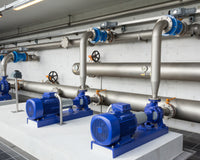

Demonstration of the operation of the hydrophore set with IBO pumps and IPRO
Hydrophore is the heart of the home water supply system. Its task is to ensure stable pressure and thus comfortable use of the installation - from watering the garden, through filling the bathtub, to Power supply dishwashers or flushing the toilet. The efficiency of such a system is determined not only by the pump itself, but also by a properly selected and adjusted pressure tank with a diaphragm.
Based on tests and presentations made using the hydrophore set, we can clearly see the difference between its three operating modes:
- Tank without air – no compressibility, the pump works intermittently.
- A tank with a correctly set diaphragm – stable operation, longer breaks between switches on.
- Tank overinflated – installation practically useless.
Tank without air - worst case scenario for the pump
In the first stage of the test, the air was almost completely released from the tank. This means that the interior worked as a direct water buffer, without the possibility of pressure compensation.
Effects visible immediately:
- the pump starts very often - almost constantly,
- there are jerks and vibrations of the water installation,
- hydraulic and mechanical loads increase,
- long-term operation in this condition may result in damage to the pump and installation.
The lack of an air cushion means that any water consumption - even a small one - forces the pump to operate immediately. This shortens its service life and increases the risk of failure of the entire set.
Correctly set diaphragm – optimal operation of the set
The tank was then filled with air to the recommended working pressure (in the example approx. 1.7 bar). In this variant, the diaphragm works as intended - it compresses and expands mechanically, compensating for changes in water volume.
Effects after adjustment:
- water flows even when the pump is temporarily turned off,
- pump start and stop intervals are extended,
- the system works evenly, without pressure surges,
- the load on the pump and the entire installation is reduced,
- the service life of components and the comfort of use increase.
This is a correct, correct model of the hydrophore operation. In the case of larger tanks, the effects are even better and the intervals between switching on are noticeably longer.
Too high air pressure - counterproductive effect
In the last test, the tank was inflated with air to approx. 4 bar. In such a system, the diaphragm practically does not work, the water has no place to expand, and the pump is unable to fill the system effectively.
Result:
- the tank begins to function almost exclusively as an air tank,
- the system does not ensure stable water flow,
- the pump works ineffectively - in practice, the water system "does not work".
Comparison of working methods of a hydrophore tank
| Tank condition | The effect in the installation | Consequences |
|---|---|---|
| No air | Very frequent starts, jerks, pressure fluctuations | Faster wear of the pump, risk of damage to the installation |
| Correct pressure, diaphragm is working | Stable operation, less frequent switching on, even flow | The highest durability of the pump and installation, greater comfort of use |
| Air pressure too high | Difficulty maintaining flow, problems filling the system | The system is practically useless, parameters need to be adjusted |
Why is it worth choosing IBO i pumps? IPRO from Dambat?
Choosing the right pump is one thing, but it is the proper setting of the pressure in the tank with the diaphragm that determines the efficiency of the entire system. Pumps IBO and IPRO offered by Dambat are designed to work in demanding conditions and work perfectly with expansion tanks.
- high resistance to changing working conditions,
- energy-saving, modern engines,
- optimal hydraulics, adapted to work with a hydrophore,
- durability confirmed in many years of use,
- trouble-free cooperation with expansion tanks in home and industrial installations.
A properly selected Dambat hydrophore set, based on IBO or pumps IPRO and a properly adjusted tank with a diaphragm, this is a guarantee of stable pressure, comfort of use and long life of the entire water installation.