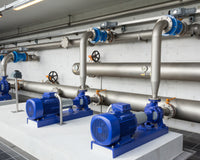

A hydrophore is an integral element of a hydrophore installation, whose task is to maintain constant water pressure. The hydrophore works with a surface pump and such a set is necessary to draw water from your own intake. Hydrophores are used in summer houses, allotment gardens, but also in single-family houses, service points and industrial plants. The costs of installation and operation of hydrophores are low. However, the question arises: where to install the hydrophore?
Compact water pump under the sink
Hydrophores produced nowadays are characterized by small dimensions. The hydrophore set consists of a pump and a water-air tank and in a compact version it can be successfully installed inside the house. Hydrophore sets are often placed in the basement of a building. Some models of water pumps can even fit under the sink, which is a practical and convenient solution. The capacity of such tanks is a maximum of 50-60 liters. Ready-made sets for sale are convenient to use and quiet. Please remember that tanks with a pressure greater than 0.005 MPa/m³ must have a UDT certificate, and those used for drinking water should also have a certificate from the National Institute of Hygiene.
The water pump at home can be installed in a room where the temperature is not lower than +5°C but not higher than +40°C. It must have efficient ventilation, electrical and heating installations. The floor under the hydrophore should maintain a slope of 1% towards the sewage grates. However, these are not all the requirements. The room in which we intend to install the hydrophore cannot be lower than 2.2 m and its minimum area is 5 m2. It is necessary to provide free access to the inspection hole. The hydrophore tank should be placed at a minimum distance of 0.6 m from the wall. The pump itself from the set cannot be located closer to the wall than 0.5 m. All installations must be operational and watertight. The capacity of the sewage system cannot be lower than the capacity of the pump, so that it is able to discharge water in the event of a hydrophore failure.
Traditional hydrophore set in a concrete tank
Compact and modern hydrophores they are very quiet, so they can be installed inside the house. However, traditional pressure booster sets are much larger and operate much louder. For this reason, it is better to install them outside the house. A frequently practiced solution is to place the hydrophore in an underground concrete tank. This option allows, on the one hand, to hide the pressure booster set, and on the other hand, it provides effective acoustic insulation. The tank is made of reinforced concrete, insulated with a moisture-proof foil and insulated with a layer of polystyrene. The access opening is secured with a reinforced concrete slab and a waterproof cover. Electricity should be supplied to the hydrophore station constructed in this way to power the heater under the tank and the lighting. However, this solution is not protected against flooding and carries the risk of ventilation problems.