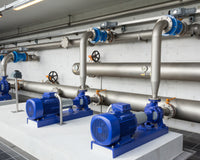

Hydrophore is a common name for a water-air installation whose task is to maintain constant water pressure. An integral element of the hydrophore set is a pressure tank filled with liquid and air and a centrifugal pump. The hydrophore tank is connected to the water supply system and equipped with a pressure gauge. Hydrophores are used primarily in single-family houses and allotment gardens, but this is not their only application. They are also successfully used in industrial plants and service points.
When should a hydrophore be installed?
Most of the properties are privately owned Connection to the water and sewage network. However, there are situations when there is no such connection and the property owner must supply water on his own, for example using an underground water intake, i.e. a deep well. In such cases, the proper functioning of the home water system is directly dependent on the installation hydrophore set. It is not only responsible for maintaining optimal water pressure, but also protects the pump against excessive use, i.e. turning it on and off too often. Traditional diaphragmless hydrophores are characterized by large dimensions, but more compact membrane hydrophores are mobile and quieter, and their capacity is usually from 50 to 100 liters. Another solution is a set of two tanks (one for water, the other for air), which cooperate using a compressor.
Hydrophore is also installed in single-family houses with access to the water supply network if the pressure in the tap is too low. The hydrophore set can also be used to collect water for watering garden plants - it can suck it not only from a well, but also from a rainwater tank. It is also perfect when you need to supply water to a summer house. The hydrophore accumulates pressure and stores a supply of water that meets the needs of users during breaks in pump operation.
How does a hydrophore installation work?
The principle of operation of the hydrophore is not complicated and uses a pressure difference. Hydrophores work with self-priming pumps or submersible pumps. The cylindrical hydrophore tank is partially filled with water, above which there is compressed air. Suctioning water from the tank into the water supply system causes the air to expand and its pressure to drop. The pressure difference is controlled by a pressure switch and measured with a manometer. When the air pressure reaches the minimum value, the pump turns on. An electric motor drives a vane impeller in the pump, the movement of which increases the angular momentum of the liquid. In this way, a pressure difference is created between the suction and discharge sides of the pump, thanks to which it is possible to pump water from the well into the hydrophore tank. The air begins to compress and its pressure increases as the amount of water sucked in increases. A non-return valve prevents water from flowing back into the well.
When the maximum air pressure is reached, the pressure switch turns off the pump and water can be distributed to the water supply network. Simply put, increasing air pressure presses on the water and "pushes" it into the water network when you turn on the tap. The loss of water is equivalent to the expansion of air, the pressure of which drops - and the cycle can start again.