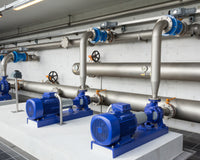

Water collection, regardless of whether it is carried out for household needs, for agriculture or for the needs of a large factory, should always be efficient, trouble-free and smooth. However, to achieve this goal, it is very important to use appropriate accessories that are of high quality and perfectly compatible with each other. One of the conveniences that is worth using is an inverter - an element that is not only recommended, but even necessary for the proper operation of the entire structure. What are inverters? What are their characteristics? How do they work? And why is it worth using them? We explain these issues in our article.
Inverter - characteristics and application
An inverter is an electronic device, which allows you to control one or more pumps. Its other names are frequency converter and CPS frequency converter. The main task of this important element is to maintain the appropriate pressure, regardless of the current water demand. The use of an inverter allows you to save electricity and at the same time increases the efficiency of the entire installation, ensuring excellent and quiet operation, as well as system reliability.
The inverter is not only a recommended part, but also necessary for the proper functioning of a modern installation. This small element makes the pump operation convenient and automatic. It's no wonder that inverters can be found in many installations, including:
- professional water supply installations that supply water to single-family houses,
- installations for irrigation of gardens and farmlands,
- industrial installations whose smooth operation is necessary for the proper functioning of machines,
- as well as in installations aimed at lowering the groundwater level.
Submersible pump with a frequency converter - why is it worth it?
Inverters are used in both small and large water installations because they have many advantages. Some of them are:
- multifunctionality and possibility of use in households, rural farms, gardening, rain showers, construction, waterworks and industry,
- elimination of the hydrophore tank, which requires a large area,
- guarantee of constant pressure regardless of water consumption,
- no pressure surges, and therefore longer service life of both the pump itself and the entire installation,
- lack of the so-called water hammer,
- reduction of electricity consumption: the use of an inverter allows you to reduce the operating costs of a submersible pump by up to 40%,
- additional possibilities, such as automatic restart, which increases our convenience,
- alarm register that informs us about current threats,
- protection against dry running, i.e. minimizing the risk of seizing pumps,
- overload protection, especially in the event of blocking of the pump rotor,
- protection against low and high voltage,
- protection against phase loss and asymmetry,
- convenient and quick installation,
- convenient operation, menu also available in Polish,
- compatibility with most pumps available on the market (however, note: inverters work with pumps of different power, so it is necessary to check all basic parameters),
- possibility of building multi-pump sets and supporting up to six pumps,
- various installation options: wall installation, installation on the discharge pipeline, installation directly on the pump,
- high quality and low failure rate.